Tuesday, April 28, 2026

Nobody Sells You the Thing You Actually Need

Nobody Sells You the Thing You Actually Need. Advice, implementation and software are three different purchases.

AI consulting is three different purchases wearing one name. Advice tells a business what to do. Implementation builds the thing. Software licenses a capability. Buyers usually describe a need in one of those categories and receive a quote from another, which is why so many engagements end with both sides feeling misled.

Three Purchases That Sound Like One

Advice is the purchase of judgment. The deliverable is a decision, a priority order, or a recommendation not to proceed. Nothing is built and the value lies in the choices that get avoided.

Implementation is the purchase of construction. Something specific gets configured, connected, tested, and handed over. The deliverable is a working system and the specification has to exist before the work starts.

Software is the purchase of capability. A vendor provides a tool with defined functions and the buyer supplies everything else, including the decision about what the tool is for.

These three are sold by different organisations with different economics. They are also frequently sold by the same organisation, which is where the confusion becomes profitable rather than merely unfortunate.

A buyer who needs advice and purchases implementation ends up with a well-built system solving a problem that was never the constraint. A buyer who needs implementation and purchases advice ends up with a document and no change. Both outcomes are common and neither is caused by incompetence.

Why the Mismatch Happens So Reliably

Buyers describe symptoms rather than categories. The opening statement is usually some version of wanting to use AI to become more efficient. That sentence does not indicate which of the three purchases is required.

Sellers interpret ambiguous requirements through the lens of what they sell. This is not cynicism. A firm that builds systems genuinely sees a building problem, and a firm that advises genuinely sees a decision problem.

The result is that the same enquiry produces three different diagnoses depending on who receives it. Each diagnosis is internally coherent and each is partly right, which makes comparison across quotes almost meaningless.

Buyers then compare on price, because price is the only dimension that appears comparable. Comparing the price of advice against the price of construction is a category error that produces predictably poor decisions.

Understanding how consultants, agencies and vendors differ in what they are actually selling resolves most of this before any conversation begins. The distinction is structural rather than a matter of quality.

The mismatch also survives because both parties want the meeting to go well. A buyer who cannot articulate the need adopts the framing offered by the seller, since that framing at least sounds definite. Agreement is reached on a description neither side wrote.

That agreement holds until delivery, at which point the buyer discovers the scope does not cover the part they cared about. The scope covered exactly what was written, and what was written came from a conversation where nobody named the category.

What Each Seller Is Positioned to Recommend

Incentives shape recommendations even among honest sellers, and pretending otherwise leads to bad buying.

A software vendor is compensated for seats and renewals. Its natural recommendation is that the tool be deployed widely and quickly, because usage drives retention. It has no economic reason to advise that a process be redesigned first, and often no capability to do so.

An implementation agency is compensated for built work. Its natural recommendation is a project with defined scope, because that is what can be priced and delivered. It has little incentive to conclude that the correct answer is a change of policy costing nothing.

An advisory firm is compensated for judgment, which creates its own distortion. Advice is easier to sell repeatedly than to make consequential, and the failure mode is a stream of recommendations that never quite reach implementation.

None of these incentives make a seller untrustworthy. They do mean that a buyer should know which one they are speaking to and should discount the recommendation in the direction set by the economics of that seller.

The practical protection is to obtain the diagnosis from a party with no stake in the remedy. That separation costs something and it costs far less than building the wrong thing well.

Diagnosing Which One the Business Actually Needs

Three questions usually settle the category, and they can be answered before any seller is contacted.

The first asks whether the business knows which specific process it wants changed. If the answer is no, the need is advice, and any implementation quote received at this stage is premature regardless of how attractive it looks.

The second asks whether the process is documented well enough that a stranger could describe the desired end state. If the process is known but undefined, the need is process work, which sits between advice and implementation and is rarely what anyone quotes for.

The third asks whether the specification exists and only the building remains. If so, the need is implementation, and the buyer should be comparing builders on capability and price rather than on strategic insight.

Most businesses that believe they need implementation are actually at the second question. The process is understood by the people who run it and has never been written down in a form anyone could build from.

Discovering that early saves the most money. A build against an undefined process produces something that works exactly as specified and does not fit how the work happens. That is the most expensive form of technically successful project.

A fourth question is worth asking privately. What would change in the business if the project succeeded completely? If the honest answer is a modest saving on a task nobody minds doing, the spending belongs elsewhere.

That question filters more proposals than any technical review. Projects survive scrutiny on feasibility and fail on relevance, and relevance is the cheaper of the two to test.

Buying in the Right Sequence

The sequence that works runs from diagnosis to definition to construction to licensing. Most buying runs in the reverse order, starting with a tool that impressed someone and working backwards to justify it.

Reverse-order buying is not irrational. The tool is the most visible element, it demonstrates easily, and it comes with a price that can be approved without a business case. Everything upstream of it is abstract by comparison.

The cost of that order appears later. The tool is in place, the process it should support has not been defined, and the definition work now has to happen with a sunk commitment shaping the answers.

Running the sequence properly means accepting a slower start. The first phase produces no visible technology and its output is a specification, a priority order, and a list of things not to do. That deliverable is unsatisfying and it determines whether everything after it works.

A serious view of what an implementation roadmap should contain before any building starts gives a buyer a way to judge proposals. The test is whether the thinking was done or skipped. The presence of a sequence, rather than a list of features, is the signal.

Slowing the start also gives the business time to notice its own capacity. Every one of these engagements consumes internal attention, and a company running three at once will deliver none of them properly.

What a Good Proposal Looks Like

A proposal worth accepting states which of the three purchases it is. That sounds elementary and very few proposals do it.

It defines the deliverable in terms the buyer could verify without technical help. A written recommendation, a documented process, a configured system passing stated tests. Anything described only as support or partnership is unbounded and should be rewritten before signature.

It names what is excluded. Exclusions are more informative than inclusions, because they reveal whether the seller has understood where the work ends and who picks it up afterwards.

It states who owns the result and what happens when the engagement ends. Ownership of configurations, instructions, and accounts should transfer to the buyer as a matter of course, and a proposal silent on this point is telling the buyer something.

It also states what the seller will need from the business. Engagements fail as often through unavailable internal time as through poor delivery, and a proposal that asks for nothing has not thought about how the work actually happens.

Any proposal that answers all five points can be compared fairly against another that does the same. Comparison between a proposal that answers them and one that does not is not a comparison at all, and price is the least useful place to start.

The market for this work is young enough that the categories are still blurred, and the blurring benefits sellers more than buyers. Clarity is available at no cost to anyone willing to decide, before the first conversation, which of the three things they are buying. The businesses that get value from this spending are usually not the ones that found the best supplier. They are the ones that knew what they were shopping for.

Frequently Asked Questions

What is the difference between an AI consultant and an AI agency?
A consultant sells judgment and the deliverable is a decision or a recommendation. An agency sells built work and the deliverable is a configured, working system. The two require different inputs, because an agency needs a specification that a consultant is often hired to produce. Firms offering both should be asked which capability is leading the engagement.

How can a buyer tell which category they need?
Ask whether the specific process to be changed is known, and whether it is documented well enough to build from. An unknown process indicates a need for advice. A known but undocumented process indicates process work. A documented process with an agreed end state indicates implementation.

Is it a problem if one firm offers all three?
Not necessarily, provided the phases are separately scoped and separately priced. The risk is that the diagnosis phase is conducted by a party whose revenue depends on the build that follows. Splitting the diagnosis from the delivery removes that pressure. Where splitting is impractical, the diagnosis deliverable should be usable by another supplier.

What should a diagnosis phase cost relative to the build?
It is normally a small fraction of the total and it determines whether the remainder is spent well. Buyers frequently resist paying for a phase that produces no visible technology. That resistance is the single most reliable predictor of an implementation that solves the wrong problem.

Who should own the tools and configurations after an engagement?
The buyer, without exception. Accounts, instructions, prompts, integrations, and documentation should sit in the name of the business rather than the supplier. Arrangements where the supplier retains ownership create a dependency that is expensive to unwind later. This should be settled in writing before work begins.

What is the most common wasted spend in this category?
Building a well-specified system for a process that was never the constraint. The work is delivered competently, the tool functions as promised, and nothing measurable improves because the bottleneck was elsewhere. That outcome is a diagnosis failure rather than a delivery failure. It is also almost entirely preventable by asking what would change if the project succeeded perfectly.

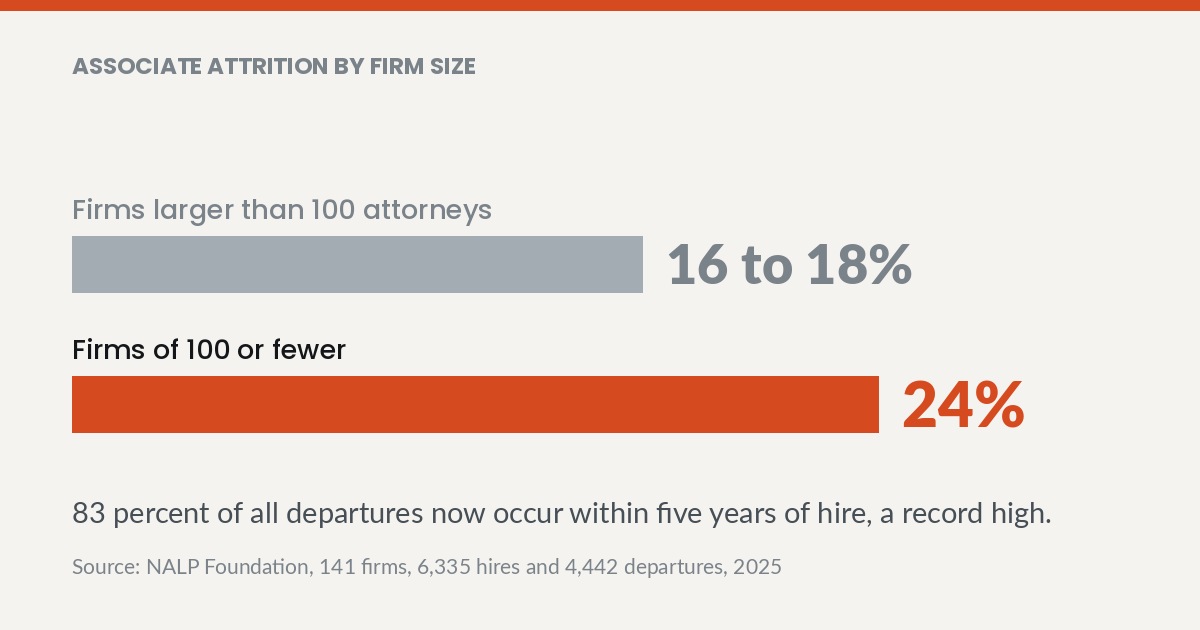
Small Law Firms Lose Associates at 24 Percent While Everyone Larger Loses 16 to 18

Associate attrition by firm size: Firms larger than 100 attorneys 16 to 18%, Firms of 100 or fewer 24%. NALP Foundation, 141 firms, 6,335 hires and 4,442 departures, 2025

A law firm management consultant should read the NALP Foundation cohort data before touching compensation. Associate attrition at firms of 100 or fewer attorneys is 24 percent, against 16 to 18 percent for all four larger cohorts. The gap is structural, and small firms hire laterals to fix systems problems that lateral hiring cannot fix.

The Cohort Nobody Benchmarks Against

NALP Foundation data for 2025, covering 141 firms, 6,335 hires and 4,442 departures, sorts associate attrition by firm size. Four of the five cohorts land between 16 and 18 percent. Firms of 100 or fewer attorneys sit alone at 24 percent.

Overall associate attrition across all firms is 19 percent, down from 20 percent in 2024 according to the same NALP Foundation report. That headline number is the one most firms quote. It buries the fact that one cohort carries a materially worse result than every other.

Small firms rarely benchmark against firms their own size because the published commentary focuses on large firm dynamics. A managing partner comparing against a 19 percent industry figure concludes the firm is running close to normal. The relevant comparison shows the firm running well behind its actual peer group.

Why the Size Cutoff Matters

US Census County Business Patterns for 2023 counts 165,491 offices of lawyers establishments. Calculated from those establishment counts, 71.8 percent of law offices have fewer than five employees and 94.2 percent have fewer than twenty. The cohort with the worst attrition contains almost the entire profession.

Firm size determines what infrastructure exists to support an associate. Below a certain headcount, there is no professional development function, no formal supervision structure, and no dedicated matter staffing process. Those functions still have to happen, and they happen informally or not at all.

Departures Cluster Early and Are Getting Earlier

NALP Foundation reports that 83 percent of departures occur within five years of hire, a record high, up from 80 percent in 2024. Attrition is not distributed evenly across a career. It concentrates in the period when an associate is most dependent on supervision and least productive.

A firm that loses an associate in year four has absorbed the full cost of training and captured very little of the return. The economics of associate hiring assume a longer payback period than the profession is currently achieving. Small firms feel this more acutely because each departure represents a larger share of capacity.

Early departure is a supervision signal before it is a compensation signal. Associates leaving inside five years are usually describing unclear expectations, inconsistent feedback, and work assignment that feels arbitrary. Those complaints do not get resolved by a salary adjustment.

The Lateral Problem Is a Supervision Problem

NALP Foundation data shows 5 percent of lateral hires departing within one year, against 1 percent of entry-level hires. Laterals leave at five times the rate of the people the firm trained itself. That is the single most diagnostic number in the dataset.

The standard explanation blames cultural fit or compensation mismatch. The more accurate explanation is that firms hire laterals to solve problems that lateral hiring does not solve. A practice group struggling with matter staffing, origination credit disputes, or partner bandwidth hires an experienced associate and expects the underlying condition to improve.

Nothing about the new arrival changes the condition. The bandwidth problem persists because the partners who created it still work the same way. The origination dispute persists because the compensation structure that produced it was never revisited.

The lateral arrives into that same condition with less institutional knowledge and no onboarding structure. Entry-level associates at least receive whatever training the firm provides. Laterals are presumed to need none, which means they receive none.

Boomerangs Are Declining Too

Boomerang associates fell to 6 percent of hires from 11 percent in 2024, per the NALP Foundation. Returning alumni are the cheapest and lowest-risk hires available to any firm. A decline in that channel indicates that departing associates are leaving with a worse impression than they used to.

Exit conditions determine boomerang rates more than market conditions do. Firms that handle departures poorly close a hiring channel that costs nothing to maintain. The decline should be read as feedback on how the firm treats people on the way out.

The Economics Underneath the Attrition

Thomson Reuters reports in the 2026 State of the US Legal Market, based on a 184-firm panel, that direct expenses consume 32 percent of the average firm's revenue. Direct expenses in that measure mean fee-earner compensation and benefits. That is the largest single cost category in the business by a wide margin.

Direct spend on lawyer compensation rose 8.2 percent in the Thomson Reuters 2025 data. Support staff cost grew more than 6 percent while overhead per lawyer grew 4.3 percent. Firms are paying more per lawyer and losing them faster.

Associate realization stands at 85.6 percent, the lowest of any timekeeper level in the Thomson Reuters data. Associates are the most expensive growing cost and the least fully realized timekeepers. Attrition inside that group destroys value at both ends of the equation.

Realization Is a Supervision Metric

Low associate realization is usually treated as a billing problem and handled through write-off review. It is more accurately a supervision and matter staffing problem. Work assigned without adequate scoping, direction, or partner review generates time that clients will not pay for.

The same conditions that suppress realization drive early attrition. An associate producing work that gets written down learns that the effort was wasted and receives no useful correction. Firms that fix scoping and feedback see both numbers move together.

What Small Firms Should Build Instead

The instinct at a small firm facing attrition is to raise associate salaries toward the larger cohorts. The data does not support that as the primary lever. Larger firms pay considerably more and still lose associates at 16 to 18 percent, which means compensation sets a floor rather than a ceiling on retention.

Onboarding That Applies to Laterals

Most firms have some entry-level orientation and nothing at all for experienced hires. Given that laterals depart at 5 percent within one year against 1 percent for entry-level hires, that allocation is backwards. A lateral needs context on client relationships, internal norms, billing expectations, and who actually decides things.

The content is not difficult to produce and it does not require a professional development department. It requires someone to write down what everyone already knows and assumes is obvious. Firms that build this find lateral integration improves without any change in compensation.

Supervision With a Named Owner

Every associate should have one identified supervising attorney responsible for work quality, feedback, and development. Informal supervision distributed across a practice group produces inconsistent standards and no accountability. The associate experiences that inconsistency as arbitrary treatment.

Feedback should be scheduled rather than triggered by problems. An associate who only hears from a supervisor after a mistake concludes the relationship is purely corrective. Regular short reviews cost little and address the most common reason associates give for leaving early.

A Partnership Track That Can Be Described

Associates leaving inside five years frequently report that no one could explain the path forward. Small firms often have no formal partnership track and assume the answer is obvious to everyone. Writing down criteria, timing, and the origination credit implications removes the ambiguity that drives departures.

Succession planning connects directly to this same question. A firm whose partners are approaching transition without a defined associate path is training talent for competitors. Firms rebuilding supervision, matter staffing, and partnership criteria at once are doing operational design work. That is why many bring in a fractional COO rather than adding the project to an existing partner workload.

Staffing Decisions as Retention Decisions

Matter staffing determines what an associate learns and how quickly. Firms that assign work by availability rather than development produce associates with uneven skills and no sense of progression. Deliberate staffing costs nothing beyond the attention required to think about it.

Mentoring programs work when they are tied to specific matters rather than scheduled coffee. An associate learns more from a partner explaining a decision on live work than from any structured program. Small firms have a natural advantage here and mostly fail to use it.

Billable targets interact with all of this in ways firms rarely examine. A target set without regard to matter mix pushes associates toward volume over development. Firms that review targets alongside staffing decisions get better realization and better retention from the same headcount.

The profession has decided that attrition is a compensation arms race, and the numbers do not agree. Firms of every size lose associates, and the smallest firms lose them fastest despite paying least and having the most direct access to the people they are losing. Laterals departing at five times the entry-level rate is not a market signal about pay. It is a firm telling on itself about what happens after someone walks through the door. The work of fixing that sits entirely inside the firm, costs very little, and almost nobody does it.

Frequently Asked Questions

Why do small firms lose associates faster than large firms?
NALP Foundation data for 2025 puts associate attrition at firms of 100 or fewer attorneys at 24 percent, against 16 to 18 percent for all four larger cohorts. Larger firms maintain professional development functions, formal supervision structures, and defined advancement criteria. Small firms perform those functions informally or not at all, which produces inconsistent experiences for associates. The gap reflects infrastructure rather than compensation.

Should my firm raise associate salaries to fix attrition?
Compensation sets a floor on retention rather than determining it. Larger firms pay substantially more and still record 16 to 18 percent associate attrition according to NALP Foundation data. Thomson Reuters data shows direct spend on lawyer compensation rising 8.2 percent while attrition remained elevated across the profession. Firms generally recover more retention from supervision and clarity than from pay adjustments alone.

Why do lateral hires leave so much faster than entry-level associates?
NALP Foundation reports 5 percent of lateral hires departing within one year against 1 percent of entry-level hires. Laterals typically receive no onboarding because firms assume experience substitutes for institutional context. They also frequently arrive to solve a structural problem, such as partner bandwidth or matter staffing, that hiring alone cannot resolve. The conditions that prompted the hire remain in place after the lateral starts.

How early do most associate departures happen?
NALP Foundation data for 2025 shows 83 percent of departures occurring within five years of hire, a record high and up from 80 percent in 2024. That concentration means firms absorb training costs without capturing the productive years that justify them. Early departures typically reflect supervision quality, feedback consistency, and unclear advancement paths. Firms should treat the first five years as the retention problem rather than treating attrition as a general condition.

What does associate realization have to do with retention?
Thomson Reuters reports associate realization at 85.6 percent, the lowest of any timekeeper level. Work that gets written down is usually work that was poorly scoped, inadequately directed, or assigned without sufficient review. Those same conditions tell an associate that effort is being wasted and no correction is coming. Improving matter scoping and partner review tends to move realization and retention in the same direction.

How large is the small-firm segment in practice?
US Census County Business Patterns for 2023 counts 165,491 offices of lawyers establishments. Calculated from those counts, 71.8 percent of law offices have fewer than five employees and 94.2 percent have fewer than twenty. The cohort with the highest associate attrition therefore represents the overwhelming majority of legal employers. Industry commentary focused on large firm dynamics describes a small fraction of the market.

Friday, April 24, 2026

Consultant, Agency or Vendor: What You Are Actually Buying

Consultant, agency or vendor. Three different things are sold under one word. The mismatch is what disappoints.

AI business consulting describes three different products sold under one word. A consultant sells judgment about which decisions to make. An agency sells execution capacity for decisions already made. A vendor sells software and the support that surrounds it. Buyers who confuse the three pay for one thing and expect another.

Three Products, One Word

The word consulting has stretched to cover almost any paid outside help involving AI. That stretch is convenient for sellers and expensive for buyers. Underneath the shared label sit three businesses with different economics, different staffing, and different definitions of a job done well.

The stretching happened because demand arrived faster than expertise did. Every firm with adjacent capability repositioned toward the term, and the term absorbed all of them without resistance. A word that describes everything eventually stops describing anything a buyer can compare.

A consultant is paid to reduce uncertainty on behalf of a client. The output is a decision the client can defend: what to automate, what to leave alone, what sequence to follow, and what to stop doing entirely. Hours form the cost structure, and judgment is the actual product.

An agency is paid to produce work at a defined standard. The output is deliverables at volume, including content, campaigns, configured workflows, integrations, and trained staff. Agencies are excellent at execution and structurally poor at telling a client the work should not happen.

A vendor is paid for a product that must keep functioning. The output is software that works, plus onboarding and support sized to keep the subscription active. A vendor recommends its own category by design, and pretending otherwise helps nobody involved.

Understanding what advisory work on AI actually covers makes the boundaries visible again. Advisory work ends where implementation begins, and that ending is a feature rather than a limitation. Blurring the boundary produces engagements where nobody can state clearly what was purchased.

The categories are easy to identify from the questions asked in a first conversation. A consultant asks about decision rights, constraints, and what has already been tried. An agency asks about volume, timelines, and approval workflow. A vendor asks about current systems and seat counts.

The practical question is which of the three a business needs first. That answer depends entirely on whether the core decision has already been made. Working through which of the three fits a given situation before writing a brief prevents most of the disappointment that follows.

The Mismatch Produces the Disappointment, Not the Price

Failed engagements get described afterward in financial terms almost without exception. The fee was too high, the retainer ran too long, the return never appeared. Those descriptions are accurate and completely beside the point.

The failure almost always started as a category error made early. A business bought execution while the underlying decision was still open, or bought advice after the decision had already hardened. Both errors feel like value problems and are actually fit problems.

Buying execution too early is the more expensive of the two mistakes. An agency handed an undefined problem will build something competent, because building is what agencies exist to do. The output arrives on schedule and solves a problem the business never confirmed was worth solving.

Deciding where AI belongs in the business before capacity is purchased is unglamorous work that prevents this outcome. It requires naming which processes carry real cost, which carry only visible friction, and which remain too unstable to automate at all. Very little software appears anywhere in that conversation.

Buying advice too late produces the opposite form of waste. When the decision is settled and the constraints are known, further analysis restates what the room already agreed on. The business needs hands at that point rather than a second opinion.

Scope documents provide an early warning that a mismatch is forming. A scope written entirely in activities, such as workshops held or assets produced, describes motion instead of outcome. A scope that names a decision to be reached, or a standard to be met, tends to survive contact with reality.

Packaged offerings occupy the middle ground and confuse buyers most reliably. Reviewing productized offerings that assume the problem is already defined is worthwhile once the problem genuinely has been defined. A packaged solution applied to an undefined problem simply hides the definition step inside a scope document nobody rereads.

What Each Should Be Held To

Accountability differs by category, and applying the wrong standard breaks otherwise sound relationships. Holding a consultant accountable for deliverable volume produces slide decks nobody needed. Holding an agency accountable for strategic insight produces confident recommendations from people paid to stay busy.

A consultant should be judged on decision quality and on how quickly ambiguity gets resolved. The right test is whether the client can now explain the reasoning without the consultant in the room. An advisor who becomes structurally necessary has failed at the assignment.

An agency should be judged on throughput, consistency, and adherence to a defined standard. The right test is whether the work would be recognized as correct by someone who has never met the agency. Volume produced without a standard is simply cost with a delivery schedule.

A vendor should be judged on uptime, support responsiveness, and the cost of leaving the platform. That last item receives the least attention during selection and matters the most across a multiple-year horizon.

Reference conversations become useful once the categories are separated. The question worth asking a consultant reference is what decision the work produced and whether it held. The question worth asking an agency reference is whether quality stayed consistent after the first month. The question worth asking a vendor reference is what the migration looked like when someone tried to leave.

Compensation structure explains most provider behavior better than stated intent does. Hourly work rewards depth and punishes speed, retained work rewards continuity, and subscription work rewards renewal above everything else. Reading the incentive before signing predicts the relationship more accurately than any reference call.

Smaller companies face this problem with fewer resources to absorb an error. Advisory work scaled to a company without a large internal team differs from enterprise engagements in duration, depth, and the amount of implementation folded into the same relationship. The three categories still exist, though one person may end up covering two of them.

Capability categories create a second layer of confusion for buyers. Drafting, summarizing, and content production get sold as a single competence, though buyers rarely separate the tool from the process surrounding it. Treating content and drafting capability as an operating capability rather than a product line clarifies who should be responsible for the result.

The Handoff Is Where Value Leaks

Every engagement of every category ends at a boundary of some kind. Advice ends at a recommendation that someone must accept. Execution ends at a delivered artifact that someone must adopt. Product ends at a working login that someone must use.

None of those endings is the same thing as a changed business. The gap between the last deliverable and a durable operating change is where most of the value quietly escapes. Nobody is contractually responsible for that gap, which is exactly why it persists across engagements.

Closing it requires deciding in advance who runs the new process after the outside party leaves. That person should be named in the engagement rather than discovered afterward. An engagement without a named internal owner is a purchase rather than a change.

Knowledge transfer deserves the same treatment as any other deliverable. Written decisions, rejected options, and the reasoning behind both should sit inside the business when the relationship ends. Engagements that leave behind only finished artifacts leave the company unable to adjust when conditions shift.

The operating layer is where all of this becomes concrete. Treating the daily management of automated work as its own discipline assigns responsibility for monitoring output quality, handling exceptions, and retraining staff as the process shifts. Without that layer, a well-built system degrades without anyone noticing.

Sequencing matters as much as ownership in determining whether value survives. A sound progression from decision to deployment stages the work so each phase produces something usable rather than something impressive. Sequencing failures create long projects with no interim value, which is precisely how sponsors lose patience.

The end state is worth describing plainly, because it looks nothing like the sales material. A company where the work has been genuinely embedded into how the business runs appears unremarkable from outside. Processes move faster, exceptions get handled deliberately, and no separate AI initiative exists because the initiative already finished.

Buyers rarely get burned by the wrong price. They get burned by asking a category of provider to do something that category was never built to do, then blaming the provider for behaving exactly as its economics require. Naming the three products before writing the brief is a short exercise. It costs an afternoon and prevents the kind of engagement that ends politely, on budget, and with nothing changed.

Frequently Asked Questions

What is the difference between an AI consultant and an AI agency?
A consultant is paid to reduce uncertainty and produce a decision the client can defend. An agency is paid to produce work at volume once that decision already exists. The consultant should work toward becoming unnecessary, while the agency should work toward becoming reliable. Confusing the two produces either expensive analysis of a settled question or fast execution of an unexamined one.

When should a business hire a vendor instead of a consultant?
A vendor makes sense once the problem, the owner, and the required category of software have all been settled. At that point the remaining questions are functional, and a product conversation answers them efficiently. Hiring a vendor before those elements are settled means the vendor defines the problem. Vendors define problems in terms their own product already solves.

Can one provider be all three?
Some can, and smaller engagements frequently require exactly that. The risk is that advice and execution sit inside the same fee, which removes any incentive to recommend doing less. Buyers accepting this arrangement should insist that the recommendation phase produce a written decision, including the options that were rejected. That record keeps the advisory work honest even when the same party performs the build.

How long should an AI advisory engagement run?
Advisory work should end once the client can explain the reasoning without assistance. That point arrives sooner than most retainers assume it will. Engagements continuing past it convert judgment into maintenance, which is handled better internally or by an execution partner at lower cost. A defined end date protects both parties from a slow drift into dependence.

What is the most common reason these engagements disappoint?
The category was wrong for the stage the business had actually reached. Execution capacity was purchased before the decision was made, or analysis was purchased after it had already been settled. Neither error appears as a fit problem in the postmortem, because both of them look like poor value. The fix happens before the contract rather than during it.

Who should own the work after the engagement ends?
A named person inside the business, identified before the engagement starts. That person should control the process being changed rather than the technology being installed. Without this, the new way of working has no defender once the outside party leaves. Most decay in delivered systems traces back to that single omission.

Thursday, April 23, 2026

A Business That Cannot Run Without You Cannot Be Sold

A Business That Cannot Run Without You Cannot Be Sold. Owner dependency is usually described as a lifestyle complaint.

Founder dependency is the condition in which a business relies on one person for decisions, relationships, or knowledge that exist nowhere else. Owners describe it as a workload problem. Buyers treat it as a risk to be discounted, and lenders treat it the same way, which makes it a valuation problem long before it becomes a lifestyle one.

A Workload Complaint With a Balance Sheet Consequence

The usual framing is personal. The owner cannot take a holiday, cannot switch off, and answers questions at weekends that nobody else can answer. All of that is true and it is the least important part.

What matters commercially is that the business, as an object, cannot be transferred. A buyer purchasing it would be purchasing a set of relationships and judgments that walk out of the door on completion day.

Every experienced buyer knows this and prices for it. The discount does not appear as a line labelled founder dependency. It appears as a lower multiple, a larger earn-out, a longer handover, or a withdrawn offer late in the process.

The same logic applies to lending. Credit decisions weigh whether the business can service debt if the principal is unavailable. A business where that answer is no borrows on worse terms, whatever its profitability.

Owners rarely see any of this until they attempt a transaction. By then the condition has usually been building for years and cannot be corrected inside the timeline of a sale.

What a Buyer Is Actually Buying

A buyer is not buying revenue. Revenue is a description of what happened while the current owner was present. A buyer is buying the mechanism that produced it, and the question is whether the mechanism is separable from the person.

That question gets tested during diligence in ways owners find uncomfortable. Who holds the customer relationships. Who sets pricing. Who resolves a supplier dispute. Who decides whether a job is quoted at a discount and on what basis.

If the answer to most of those is the owner, the buyer is acquiring a job rather than an asset. Some buyers will still proceed, at a price that reflects the difference and with terms that keep the owner attached for years.

The most common structure in that situation is a deferred payment tied to performance after completion. Owners often read that as a sign of buyer confidence. It is more accurately read as a mechanism for transferring the dependency risk back onto the seller.

Reducing the dependency before a sale changes the shape of the offer more than it changes the headline figure. Cleaner terms and shorter tie-ins are often worth more to a departing owner than a marginally higher price.

There is a further consideration for owners who do not intend to sell. The same structural weakness that lowers a price also concentrates risk during illness, family emergency, or simple exhaustion. Nobody schedules those events around the operating calendar.

Where the Dependency Actually Sits

Founder dependency is usually described as a single condition. It is really four, and they need different remedies.

The first is relationship dependency. Customers and suppliers deal with the owner personally and would question whether to continue without them. This is the most visible form and often the least difficult to address.

The second is decision dependency. Choices above a certain size or ambiguity route to the owner because no rules exist for making them without one. Nobody has ever written down what a manager is permitted to decide alone.

The third is knowledge dependency. The owner holds context about why things are done a certain way, which supplier is unreliable in which season, and what happened the last time a similar situation arose. None of it is recorded.

The fourth is judgment dependency, and it is the hardest. The owner makes calls that genuinely require experience, and the experience took decades to build. This one cannot be documented away and has to be transferred through deliberate exposure over time.

A structured review of the signs that a business cannot run without its founder is useful mainly because it separates these categories. Owners who treat all four as one problem tend to apply the wrong remedy to three of them.

Separating them also reveals which ones the owner has quietly chosen. Some dependency is designed rather than accidental, because holding the key relationship or the final decision feels like security. That preference is understandable and it is the thing being priced.

Why Delegation Fails as a Remedy

The standard advice is to delegate more. Owners who try this usually find it does not hold, and they conclude the problem is the quality of their team.

The team is rarely the issue. Delegation fails because the owner delegates the task without delegating the decision that governs it. The manager can perform the work and must return for approval whenever anything varies from the ordinary.

That arrangement generates more interruption than doing the work directly. It also teaches the manager that judgment is not welcome, which produces exactly the passivity the owner then complains about.

Effective transfer requires defining the boundary. What can this person decide alone, what requires consultation, and what must escalate. Those boundaries need to be written and generous enough that the manager actually uses them.

The second failure mode is the reversal. An owner delegates, the manager makes a decision the owner would have made differently, and the owner overrides it. One override undoes months of transfer, because everyone now understands that the boundary is provisional.

Accepting a worse decision than the one the owner would have made is the price of the transfer. Owners who cannot tolerate that price will remain the constraint, and no organisational design will change it.

Building a Business That Survives an Absence

The work has a recognisable sequence and it takes longer than most owners expect. Beginning several years before any intended exit is normal rather than cautious.

The first step is documenting what happens rather than what should happen. Recording the actual practice, including the informal corrections, is more valuable than a tidy manual describing an idealised process nobody follows.

The second is establishing decision rights in writing. Each management role gets a defined authority, expressed as thresholds and categories rather than as vague encouragement to take ownership.

The third is transferring relationships deliberately. That means introducing the manager into the account, letting them lead the next several conversations, and having the owner become progressively less visible rather than disappearing at once.

The fourth is testing the arrangement under real conditions. A planned absence of two weeks, with no contact, reveals more than any amount of process review. Whatever breaks during that period is the actual dependency, and everything else was theory.

Many businesses lack the internal capacity to run this sequence alone. Structural work of this kind is one of the areas that organisational consulting engagements are built to cover. It is design work rather than advice, and it usually runs across several quarters.

The fifth element is removing the owner from routine communication paths. As long as customers and staff can reach the owner directly for ordinary matters, they will, regardless of what any document says.

Changing that requires the owner to redirect rather than answer. Every question answered personally reinstates the dependency the structure was built to remove, and the redirection has to continue long enough to change habits on both sides.

The Test and the Timeline

The diagnostic is simple and most owners avoid running it. Leave the business entirely for two weeks. No calls, no messages, no checking. Then examine what happened.

Three outcomes are possible. Everything ran, in which case the dependency is smaller than assumed. Things ran with visible strain, which identifies exactly where the gaps are. Or something material failed, which is unpleasant information and far better received now than during diligence.

The results should be treated as data rather than as a verdict on the team. A failure during the absence usually reflects a missing rule rather than a missing capability, and missing rules are cheap to fix once identified.

The timeline for correction depends on which of the four dependencies dominate. Documentation and decision rights can be substantially improved within a couple of quarters. Relationship transfer takes a year or more because customers adjust at their own pace.

Judgment transfer is the slowest and requires a successor who is present for enough real decisions to build their own pattern library. That cannot be compressed by effort, only started earlier.

The businesses most in need of this work are the ones whose owners have the least time to do it. That is the same fact stated twice. An owner consumed by daily operations cannot step back to build the structure that would free them. Breaking that loop usually requires treating the structural work as an actual project with a deadline, rather than as something to be attended to once things calm down. Things do not calm down on their own, and a business that cannot run without its owner will keep proving that point until somebody deliberately changes the design.

Frequently Asked Questions

How much does founder dependency reduce a valuation?
The effect varies by sector and buyer type and it is consistently negative. It appears through the structure of the deal as often as through the price, in the form of longer earn-outs, larger holdbacks, and extended handover commitments. Some buyers withdraw rather than discount. The cleanest way to understand the impact is that it converts a sale into a conditional sale.

How long does it take to reduce the dependency?
Documentation and decision rights can be materially improved within two or three quarters. Relationship transfer generally takes a year or more because customers accept a new contact at their own pace. Judgment transfer is slowest and depends on a successor accumulating real decisions. Starting several years before an intended exit is the sensible planning assumption.

What if there is no obvious successor internally?
The absence of a successor is itself a finding rather than an obstacle. Some of the dependency can be reduced through documentation and decision rules regardless of who is in post. Where a genuine capability gap exists, hiring for it is usually cheaper than the valuation discount it causes. That calculation should be run explicitly rather than assumed.

Is this only relevant to owners planning to sell?
No. The same structure that makes a business sellable makes it resilient to illness, absence, and sudden opportunity. Businesses that cannot operate without one person carry that risk continuously, whether or not a transaction is ever contemplated. The exit case simply makes the cost visible.

Does documenting processes actually help?
It helps when the documentation records what genuinely happens rather than an idealised version. Manuals describing a process nobody follows create a false sense of transfer and can make matters worse. The test is whether an unfamiliar competent person can follow the document to an acceptable result. Anything that fails that test needs rewriting rather than filing.

What is the first step for an owner who recognises this?
Run the absence test and record what breaks. Two weeks with no contact produces a specific list of dependencies that no amount of internal discussion would surface. That list becomes the work plan. Starting with the test rather than with a general improvement effort keeps the project bounded and honest.

Sunday, April 19, 2026

Readiness Is About Process Maturity, Not Technical Skill

Readiness Is About Process Maturity, Not Technical Skill. Businesses assume the barrier to AI is technical.

An AI readiness assessment measures whether a company has processes defined clearly enough to hand over to a machine. It is not a test of technical capability. Most businesses that stall on adoption do so because the underlying work was never documented, not because the software was too difficult to operate.

What a Readiness Assessment Is Actually Measuring

The phrase suggests a technology audit. Owners expect questions about systems, integrations, and whether anyone on staff can write code. Those questions appear and they are not where the assessment finds its answers.

The useful questions are operational. Can the business describe how a given task is performed, step by step, without the person who performs it in the room? Does that description match what actually happens? Do two people performing the same task produce the same result?

A company that answers yes to those questions is ready, whatever its technical situation. A company that answers no is not ready, and buying software will not change the answer.

This is why readiness work looks so much like operations work. The assessment surfaces process gaps that were always there and were tolerable while a human absorbed them. Automation removes the absorption, and the gaps become visible faults.

A structured look at whether a company is genuinely prepared for AI adoption tends to produce a list of process fixes rather than a list of tools. Owners expecting a shopping list are often disappointed and usually better served.

The Technical Barrier Is Mostly Imaginary

The technical bar for using current tools is low and falling. Most business-grade AI products require no code, connect to common systems through prebuilt integrations, and are configured through plain language instructions.

A capable operations manager can set up a working deployment in a day. The setup is genuinely not the hard part, and treating it as the hard part misdirects the whole effort.

Businesses that believe technical skill is the constraint respond by hiring technical help. The implementer arrives, configures the tool competently, and leaves. Within a few weeks the deployment produces inconsistent results, and the inconsistency is attributed to the technology.

The real cause sits upstream. The implementer built exactly what was specified, and the specification was drawn from a process description that did not match reality. Nobody checked the description against the work.

This is a common and expensive sequence. It ends with a business concluding that the technology is not ready for it, when the truth runs the other way.

There is a related error in how readiness gets scored. Businesses rate themselves against the tools they own rather than the processes they run. Owning capable software says nothing about whether the work feeding it is defined.

A useful score ignores the technology entirely on the first pass. It asks only how much of the operation could be handed to a competent stranger with written instructions and no supervision.

Levels of Process Maturity

Process maturity moves through recognisable stages, and each stage supports a different kind of automation. Knowing which stage a process occupies prevents most misapplied effort.

At the first stage the work exists only in the heads of the people who do it. It gets done reliably because those people are experienced. Nothing is written down and outcomes vary between individuals without anyone noticing.

At the second stage the process is documented, but the documentation is aspirational. It describes how the work should happen. Anyone who follows it exactly will produce something the team then has to correct.

At the third stage the documentation matches the work. Exceptions are named, the rules for handling them are written, and a new person can follow the process to an acceptable result with limited supervision.

Automation becomes reliable at the third stage. Attempted at the first, it produces output nobody trusts. Attempted at the second, it produces output that looks correct and quietly diverges from what the business actually needs.

The distance between the second and third stages is where most readiness work happens. It is unglamorous, it takes weeks rather than days, and it delivers value regardless of whether any tool is ever deployed.

Owners frequently object that their work is too varied to document. That objection is usually about the whole business rather than any single process within it. Broken into individual flows, most operations contain several highly repeatable ones.

Order intake, invoice preparation, appointment scheduling, and first-line enquiry handling are repeatable in almost every sector. The variety sits in the exceptions and in the customer relationship, not in the mechanics.

The Exception Problem

Every process has exceptions, and exceptions are where automation projects go wrong. The main path is easy to describe because everyone agrees on it. The edge cases live in individual judgment and were never written anywhere.

An experienced person handles an exception without registering it as one. The order arrives with a missing field and they know which customer it is. The invoice looks wrong and they recognise the pattern from a similar case last year.

That knowledge is invisible until it is removed. A tool handling the same flow will process the exception as though it were normal, and the error will travel downstream before anyone notices.

Readiness therefore requires an exception inventory. What can go wrong, how often, how it is currently caught, and what the correct handling is. Producing that inventory is the single most valuable step in most readiness projects.

The inventory also settles the scope question. Processes with few, well-understood exceptions are good automation candidates. Processes where the exceptions are frequent and judgment-heavy should keep a person in the loop, and knowing which is which prevents a great deal of wasted effort.

Data Is a Process Question First

Data quality is usually framed as a technical matter. It is generally a process matter wearing technical clothing.

Records are inconsistent because different people entered them differently, under different assumptions, with no agreed standard. That is a definitional gap rather than a systems failure, and no migration fixes it.

The practical implication is that a data cleanup project without a matching process change will need repeating. The records get corrected, the same entry habits continue, and the quality degrades back to its previous state within a year.

Readiness assessment should therefore examine how data enters the business, not only what state it is currently in. Who creates records, under what definitions, with what validation, and who is accountable when the definitions drift.

The same logic applies to where records live. Information split across several systems with no agreed source of truth creates disagreement about which version is correct. That disagreement is settled by a decision rather than by software.

Businesses that fix the entry point find that the historical mess matters less than expected. Most automation depends on recent records, and recent records improve immediately once the definitions are settled.

What to Fix First

Readiness work should be sequenced by value rather than by tidiness. The instinct to document everything before starting anything produces a long project with no visible return, and it usually stalls.

The better approach picks one process that is high volume, low judgment, and currently consuming meaningful staff time. Document that process properly, inventory its exceptions, agree its quality standard, and only then consider what tool might help.

Choosing well matters more than choosing quickly. The candidates that reliably repay attention share a common shape. Reviewing the use cases that consistently save small businesses money is a faster way to recognise that shape than deriving it from scratch.

Running one process to a defined standard also produces something more valuable than the saving itself. It teaches the organisation what readiness actually feels like, which makes every subsequent assessment faster and more honest.

The second process takes a fraction of the time of the first. By the third, the team has developed a working method for documenting exceptions and defining acceptable output. That capability, rather than any individual deployment, is the asset being built.

Treating readiness as a technical question leads to a purchasing decision. Treating it as a process question leads to an operational one, and the operational answer is the one that holds.

The distinction also changes who leads the work. A technical framing puts the decision with whoever is most comfortable with software. A process framing puts it with whoever understands the operation, which is almost always the better placement.

There is a further consequence worth stating. Process definition pays for itself even where no automation follows, because it improves training, reduces variation, and makes handovers survivable. Very few technology investments have that property.

A business that completes this work is not merely ready for AI. It is ready for a new hire, a change of supplier, an absence, or a sale. It can describe what it does without depending on who happens to be doing it.

The companies that adopt these tools well are rarely the most technically sophisticated. They are the ones that already knew how their own work happened, and could therefore explain it to something that had never watched a person do it. Readiness is a description problem, and descriptions are written by managers rather than engineers.

Frequently Asked Questions

How long does an AI readiness assessment take?
A focused assessment of a small or mid-market business usually runs a few weeks rather than months. Most of that time goes into observing how work actually happens rather than reading what is documented. Assessments that finish in days have generally accepted the written process at face value. The observation step is what makes the findings usable.

Does the business need technical staff to be considered ready?
No. Current tools are configured through plain language and prebuilt connections rather than code. What the business needs is someone who understands the operation well enough to specify what the tool should do. Technical help can be brought in for setup once that specification exists.

What if the processes are not documented at all?
That is the most common starting position and it is workable. Documentation should begin with one high-volume process rather than the whole operation. Attempting to document everything before acting reliably produces a stalled project. One well-documented process teaches the method for all the others.

How do you tell whether documentation is accurate?
Ask someone unfamiliar with the task to follow the written process and produce a result. Then compare that result with what an experienced person produces. Gaps between the two reveal the undocumented judgment that automation would otherwise remove. That test takes an afternoon and prevents months of misdirected work.

Should data be cleaned up before starting?
Partially. Fixing how records are created matters more than correcting the historical set, because most automation depends on recent data. A cleanup without a matching change to entry standards will need repeating within a year. The definitional work should come first and the correction second.

What does a failed readiness assessment look like?
It looks like a report recommending tools without describing the processes those tools would run. Reports of that kind are common because they are faster to produce and easier to sell. The signal of a serious assessment is a list of process gaps with named owners and a sequence for closing them. Tool selection belongs at the end of that list rather than the start.

Tuesday, April 14, 2026

The Real Cost of AI Is Not the Subscription

The Real Cost of AI Is Not the Subscription. Software pricing is the visible number.

The cost of AI for a small business is mostly not the software. Subscription pricing is visible, predictable, and small relative to the rest. The expensive part is the internal time spent deciding what the tool is for, rebuilding the process around it, and maintaining it once the initial enthusiasm fades.

The Visible Price Is the Least Interesting Number

Vendor pricing is designed to be easy to say yes to. It is monthly, per seat, cancellable, and comparable across competitors. Every property of that pricing model is intended to make the purchase decision fast.

Fast purchase decisions are exactly the wrong mode for this category. The subscription is a small commitment attached to a large one, and the large one never appears on the invoice.

What follows the purchase is a sequence of internal costs. Someone has to decide which task the tool will handle. Someone has to document how that task currently works. Someone has to test whether the output is acceptable, and define what acceptable means.

Each of those steps consumes the attention of people who already have full workloads. That attention is the scarcest resource in a small business, and it is spent without ever being budgeted.

A realistic view of what AI actually costs a small business once every line is counted puts the software well down the list. Owners who plan only for the subscription are planning for the smallest item.

Deciding What the Tool Is For

Most failed adoptions fail here, before anything technical happens. The tool is purchased with a general sense that it will help, and the specific task it will perform is never named.

General intentions produce general usage. A few people experiment, results vary, and nobody can say whether the tool is working because nobody defined what working would look like. The renewal arrives and the decision defaults to keeping it.

Naming the task is harder than it sounds, because the tasks worth automating are rarely the ones people complain about loudest. The loud tasks are usually irregular and judgment-heavy. The valuable ones are repetitive, high-volume, and invisible precisely because everyone has stopped noticing them.

Finding those tasks requires someone to observe the work rather than ask about it. Asking produces a list of annoyances. Observing produces a list of frequencies, and frequency is what determines whether automation pays.

This step is unavoidable and it cannot be bought. A vendor can demonstrate capability and cannot tell a business which of its own processes are worth the change. That judgment stays inside the company.

The Rebuild Nobody Budgets For

Inserting a tool into an existing process almost never works. The process was designed around a human doing the task, with all the informal correction that implies. Removing the human exposes every step that was never actually specified.

Consider a business that automates part of its customer response handling. The tool produces drafts quickly and well. Then the questions start.

Who reviews the drafts before they go out. What happens when the draft is wrong in a way the reviewer does not catch. Which categories of enquiry must never be automated. Who updates the instructions when the product changes.

None of those questions existed before, because a person handled the whole flow and applied judgment silently. The tool did not create the questions. It exposed that they had never been answered.

Answering them is process work, and process work takes weeks of management attention. That is the real cost line, and it recurs every time a new tool is introduced into a workflow that was never formally defined.

There is a second, less obvious cost hidden in the rebuild. Every automated step removes a moment where a person would have noticed something unusual. Those informal checkpoints were never documented and their removal is never planned.

Replacing them requires deliberate design. A business that automates a step and adds no detection for the exceptions that step used to catch has traded a labour cost for a risk it cannot see.

Maintenance Is a Role, Not a Task

Every deployed tool needs an owner. Not a champion or an enthusiast, but a named person responsible for whether it still works and whether it is still worth having.

Ownership covers a specific set of duties. Updating prompts and instructions when the business changes. Checking output quality on a schedule rather than by complaint. Managing access when people join and leave. Deciding when the tool has stopped earning its place.

In small businesses this ownership is usually informal. It lands on whoever showed the most interest during the trial. That works until the person changes role or leaves, at which point the tool degrades quietly and nobody notices for months.

Quiet degradation is the characteristic failure mode. A tool producing steadily worse output rarely announces itself. It is discovered when a customer complains or when someone finally reads the results carefully.

The fix is to assign ownership formally and to allocate time for it. An hour a week of protected attention prevents most of this. The failure is not that businesses lack the hour. It is that nobody was ever told the hour was part of the job.

The Cost of Not Having a Technical Team

Small businesses without internal technical staff face a specific version of this problem. They can buy tools and they cannot easily evaluate them, integrate them, or diagnose them when the output drifts.

The common response is to hire an external implementer for the setup. That solves the installation and leaves the harder half untouched, because the implementer departs before the process questions arrive.

The better sequence is to define the process first, in plain language, before any vendor conversation. A documented process turns a vague requirement into a specification, and a specification makes vendor comparison possible.

Approaches to adopting AI in a small business with no technical team tend to succeed when they start from the process rather than the product. The absence of technical staff is a genuine constraint and it is not usually the binding one.

The binding constraint is management attention. A business with no engineers but a clearly defined process will adopt tools more successfully than one with engineers and an undocumented workflow.

How to Budget for This Honestly

A defensible budget for an AI initiative contains four lines rather than one. Software cost is the first and smallest. Internal time for process definition is the second and usually the largest.

The third line is transition cost, covering the period when the old way and the new way run in parallel. That period is longer than expected because trust builds slowly, and running both systems briefly is far cheaper than switching before the output is reliable.

The fourth line is ongoing ownership. It is a permanent allocation rather than a one-off, and it should be attached to a named person with the time formally protected.

Any proposal missing lines two through four is a purchase order rather than a plan. Approving it means committing to costs that will be absorbed silently by the operating team, which is how initiatives quietly consume more than they were worth.

The budget should also state what will be measured and when. Without a stated measure, renewal decisions are made on impression rather than evidence, and impressions favour whichever tool the loudest person enjoyed using.

The discipline that helps most is to start with one process rather than several. A single well-chosen task, properly defined, owned, and measured, teaches the organisation what the real cost structure looks like. That knowledge makes the second and third decisions far cheaper.

Return on this spending is the number owners most want and least often calculate. The reason is that the denominator was never recorded, because the internal hours were absorbed rather than booked.

Return does not track tool capability closely. Two businesses can deploy identical software against similar tasks and get results that differ by an order that has nothing to do with the technology.

The difference is usually process clarity. A tool applied to a defined, repeatable task with a clear quality standard produces reliable savings. The same tool applied to an ambiguous task produces output that has to be checked so carefully the checking costs more than the original work.

The second determinant is whether the time saved is recovered. Automating a task that consumed part of the day for several people frees fragments of attention. Fragments do not become useful unless something is deliberately assigned to fill them.

Businesses that capture the return decide in advance what the freed capacity will do. Businesses that do not simply absorb it, and then wonder why the savings never appeared in any number they track.

The technology in this category is improving faster than most organisations can absorb it, which makes the temptation to buy first and think later stronger every quarter. The businesses that come out ahead are rarely the ones that adopted earliest. They are the ones that knew what their processes were before they went looking for something to run them.

Frequently Asked Questions

How should a small business estimate the true cost of an AI tool?
Start with the subscription, then add the internal hours required to define the process, test the output, and train the people who will use it. Add a transition period during which both the old and new methods run together. Then add a recurring ownership allocation. The software is usually the smallest of those four figures.

Is it cheaper to hire an external implementer?
External help shortens the technical setup and does not remove the process work. An implementer can configure a tool and cannot decide which tasks inside the business are worth automating. That judgment requires knowledge of the operation that outsiders acquire slowly. The most effective arrangement is external technical help combined with internal process ownership.

What is the most common reason adoption fails?
The task was never specified precisely enough. A tool deployed against a vague intention produces vague results, and nobody can judge whether it worked. Failures attributed to the technology usually trace back to an undefined process. The same tool typically succeeds elsewhere against a task that was properly described.

How much time does ongoing maintenance require?
For a single deployed process in a small business, roughly an hour a week of attention from a named person is a reasonable planning assumption. That covers quality checks, instruction updates, and access management. The requirement rises with the number of tools and the rate of change in the business. What matters is that the time is allocated rather than assumed.

Should a business start with one tool or several?
One is almost always the right answer for a first attempt. A single process teaches the organisation what the real cost structure looks like before the exposure grows. Running several at once makes it impossible to tell which produced the result. The learning from the first deployment makes every later decision cheaper.

When is the right time to stop using a tool?
When the output quality no longer justifies the review effort, or when the underlying process has changed enough that the tool no longer matches it. Both conditions are easy to miss without scheduled review, because degradation happens gradually. A quarterly check of whether each tool still earns its place prevents most of this. Cancelling early is far less costly than maintaining something nobody trusts.

Prior Authorization Costs Physicians 13 Hours a Week and Most Denials Go Unappealed

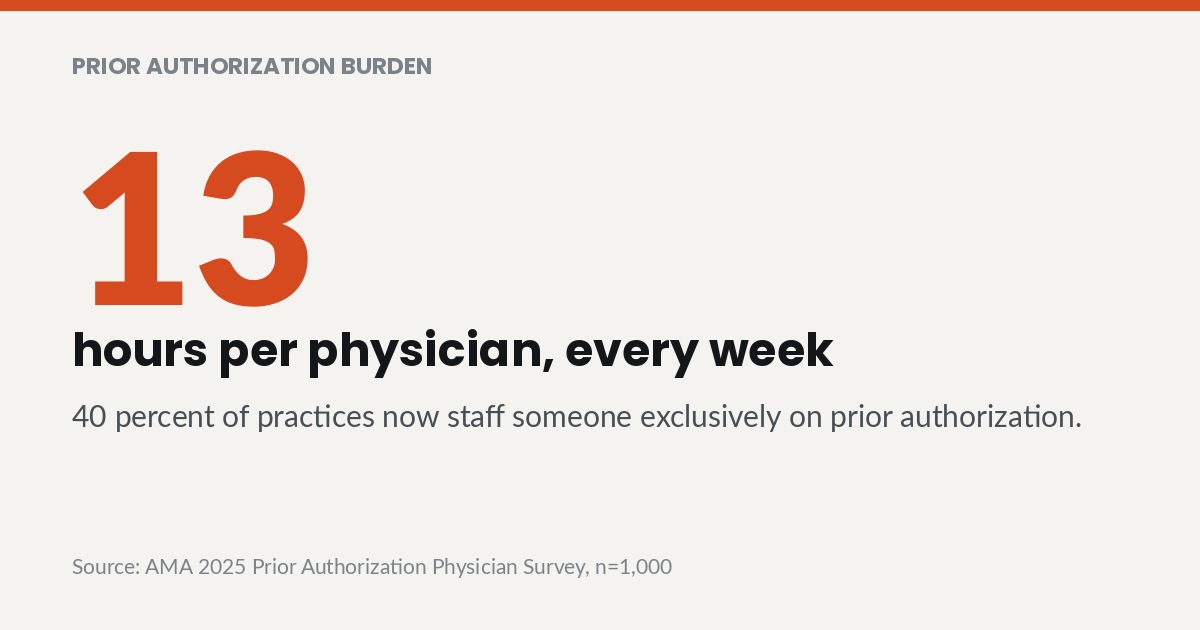
13 hours per physician, every week. AMA 2025 Prior Authorization Physician Survey, n=1,000

Prior authorization automation reduces the manual work of submitting, tracking and appealing payer approvals. It matters because physicians and staff spend 13 hours per week on prior authorization, according to the American Medical Association's 2025 survey of practicing physicians. The larger opportunity is not speed. It is the denied claims that practices never appeal.

Thirteen hours a week is a headcount decision

Administrative burden is usually discussed in the language of frustration. Prior authorization deserves the language of operations. The AMA fielded its 2025 Prior Authorization Physician Survey in December 2025 across 1,000 practicing physicians. It found that physicians and staff spend 13 hours per week on prior authorization and complete 40 prior authorizations per week.

Those two figures together describe a work center. Forty transactions moving through a process that consumes 13 hours of clinical and clerical time is not overhead. It is a production line with a throughput requirement, a queue, a cycle time and a failure rate. Every operating discipline that applies to a production line applies here.

The AMA also found that 40 percent of practices have staff working exclusively on prior authorization. That is the honest version of the number. Once volume passes a threshold, practices stop absorbing the work into existing roles and create a dedicated function.

The practices that have not made that decision are still doing the work. They do it in fragments, between patients, after hours, spread across people whose job descriptions say something else. The cost does not disappear because it was never budgeted. It shows up as slower scheduling, later charge entry and staff who spend their day on hold.

The appeal gap is where the money sits

Denials are rising and physicians know it. Seventy-four percent of physicians told the AMA in 2025 that prior authorization denials increased over the previous five years. Twenty-one percent say their prior authorizations are often or always denied.

The response to that pressure is the more revealing finding. Only 32 percent of physicians always appeal an adverse determination, according to the same AMA survey. Most denials that a practice believes are wrong are simply absorbed into the write-off column.

The stated reasons matter more than the rate itself. Among physicians who do not appeal, 59 percent do not expect success, 52 percent cite insufficient staff time and 49 percent say care cannot wait, per the AMA. Only the first of those three reasons concerns the merits of the claim.

Two of the three reasons are operational, not clinical

Insufficient staff time is a capacity constraint. Care that cannot wait is a cycle time constraint. Neither one says the denial was correct. Both say the practice lacked the operational room to contest a determination it disagreed with.

That distinction changes the nature of the problem. A practice that declines to appeal because the payer was right has a documentation problem at the front end. A practice that declines to appeal because nobody has the hours has a revenue cycle problem with a staffing cause.

Denial management is normally treated as a downstream billing activity that happens after a claim is rejected. Prior authorization denials do not behave that way. They arrive before the service is rendered, they carry a clinical deadline, and the window to contest them closes while a patient waits for care.

The result is a category of recoverable revenue that never enters the accounts receivable aging report at all. Nothing was billed. Nothing was denied on a remittance. The service simply did not happen, and no report in the practice management system flags it.

Denial rates are a payer behavior, not a fact of nature

Practices often treat denials as the fixed price of a particular payer contract. The variation across payers is real, and it is wider than most contracting conversations acknowledge. KFF analysis of CMS federal transparency data for 2024 found an average in-network claim denial rate of 19 percent in HealthCare.gov marketplace plans. Rates ranged from 13 to 35 percent across the largest insurers.

A spread that wide among insurers operating under the same rules says something about utilization management practice rather than clinical necessity. Payers make different choices about how much friction to introduce into the approval path. Those choices land on practice staff and on patients.

Burden also varies sharply by line of business. AMA respondents in 2025 rated Medicare Advantage as high or extremely high burden at 69 percent, commercial plans at 63 percent and Medicaid at 47 percent. A practice weighted toward Medicare Advantage runs a materially different back office than one weighted toward Medicaid.

Payer contract negotiation rarely addresses any of this directly. Rate gets negotiated. Authorization friction gets inherited. Practices that track denial volume, appeal rate and appeal outcomes by payer arrive at renewal with evidence instead of complaints, and evidence is what moves a utilization management conversation.

What automation removes and what it leaves behind

The tooling landscape is thinner than vendor messaging suggests. Only 24 percent of electronic health records offer electronic prior authorization for prescriptions, according to the AMA in 2025. Only 5 percent of practices report access to gold-card or exemption programs.

Gold carding is the structural fix rather than the mechanical one. When a payer exempts a physician with a strong approval history from authorization requirements on defined services, the work disappears instead of accelerating. At 5 percent adoption, gold carding is a negotiating objective for most practices rather than a current-state benefit.

Automation compresses the transaction, not the decision

Software handles the mechanical layer well. Eligibility verification at the point of scheduling, benefit checks against the payer file, pulling clinical documentation from the chart into the submission, routing through a clearinghouse, and tracking status without a telephone call all respond to automation.

Software does not make the determination. The payer's utilization management criteria still governs the outcome. Automation moves a case to that decision faster and with fewer defects, which raises clean claim rate and pulls down days in accounts receivable tied to authorization holds.

The real return is recovered capacity. Hours reclaimed from status calls and duplicate data entry become hours available for appeals, which is precisely the constraint that 52 percent of non-appealing physicians named in the AMA survey. Automation that saves time without redirecting it produces a quieter office and the same write-offs.

Designing the staffing model around the queue

Most practices staff prior authorization by accident. A capable person absorbed the work, the volume grew, and the task became that person's job without ever becoming a defined role. The result is a single point of failure operating an undocumented process with no service level.

A designed model looks materially different. Authorization requirements are checked during scheduling rather than on the day of service. Documentation standards are written per payer and per procedure before anything is submitted. Denials route to a named owner with an appeal deadline attached and a default assumption that an appeal will be filed.

That last point is the pivot. Appeals should require a reason to skip, not a reason to pursue. Reversing the default is a policy change that costs nothing and directly addresses the finding that only 32 percent of physicians always appeal.

This is ordinary operations work applied to a clinical administrative function, and most practices have nobody whose job is to do it. Practices without a full-time operations executive frequently bring in fractional COO support to build the workflow, define the metrics and hand a running function back to the internal team.

The metrics that make automation measurable

The measurement set is not exotic. Authorization turnaround time, denial rate segmented by payer and procedure, appeal rate, appeal win rate, and days in accounts receivable attributable to authorization holds cover the operating picture.

Practices that cannot produce those figures cannot tell whether an automation purchase worked. They will feel busier or less busy and call that a result. A baseline captured before implementation is the cheapest part of the project and the part most often skipped.

The burnout number is a retention number

Ninety-four percent of physicians say prior authorization increases physician burnout, per the AMA in 2025. The clinical consequences track alongside it. Ninety-five percent report care delays, 92 percent report negative clinical impact, and 26 percent report a serious adverse event resulting from the process.

Those figures are normally cited in support of policy reform, and they belong in that argument. They also belong in a staffing conversation. Physician time spent chasing authorization is the most expensive labor in the building applied to the least clinical task available to it.

Practices that move authorization work off physicians and onto a trained, properly tooled administrative function collect two returns. Cost per transaction falls because the work sits at the right wage level. The people most likely to leave stop spending their week on the activity that makes them want to leave.

The appeal statistics describe practices declining to collect money they believe they are owed. That choice is rational under a capacity constraint and expensive under every other reading. Prior authorization automation is worth buying, but the case for it is not the hours it returns. The case is what a practice decides to do with those hours once they exist, and the honest answer for most practices is that nobody has decided yet.

Frequently Asked Questions

What does prior authorization automation actually automate?
Automation handles the transactional layer of the process rather than the clinical determination. That includes eligibility verification at scheduling, benefit checks, assembling documentation from the chart, submitting through a clearinghouse and monitoring status without phone calls. The payer still applies its own utilization management criteria to decide the case. Practices that expect approval rates to change from software alone are measuring the wrong outcome.

How do I know whether my practice should appeal more denials?
The test is why appeals are being skipped rather than how many are filed. The AMA reported in 2025 that among physicians who do not appeal, 52 percent cite insufficient staff time and 49 percent say care cannot wait. Both reasons are operational and neither indicates the denial was clinically correct. A practice that cannot separate merit-based decisions from capacity-based ones is leaving recoverable revenue uncounted.

Should a practice hire dedicated prior authorization staff?
Dedicated staffing becomes justified when volume is steady enough to keep a specialist productive and complex enough that generalists make errors. The AMA found in 2025 that 40 percent of practices already have staff working exclusively on prior authorization. The alternative is not zero cost, because the work is still performed by clinical staff at a higher wage and with more interruption. Practices should price the current arrangement before deciding it is cheaper.

What is gold carding and can a mid-market practice obtain it?
Gold carding exempts physicians with strong approval histories from authorization requirements on specified services. The AMA reported in 2025 that only 5 percent of practices have access to gold-card or exemption programs, so it remains rare. Obtaining it requires clean historical approval data organized by payer and procedure, which most practices do not currently produce. Building that reporting is a prerequisite for the conversation, not an outcome of it.

How does prior authorization affect days in accounts receivable?
Authorization holds delay the service, which delays the charge, which delays the claim. The effect appears as aged receivable and as revenue that never entered the cycle because the service was abandoned. Tracking days in accounts receivable attributable specifically to authorization holds separates this from ordinary billing lag. Without that segmentation, revenue cycle reporting misattributes the cause and the fix lands in the wrong department.

Which payers should a practice examine first?
Burden concentrates unevenly across lines of business. AMA respondents in 2025 rated Medicare Advantage as high or extremely high burden at 69 percent, commercial plans at 63 percent and Medicaid at 47 percent. Denial behavior also varies widely by insurer, with KFF analysis of CMS data for 2024 showing marketplace in-network denial rates from 13 to 35 percent across the largest insurers. Practices should start with the payer combining high volume, high burden and high denial rate, because that is where process investment returns fastest.

Friday, April 10, 2026

Most Small Business AI Projects Fail Before Any Software Is Chosen

Problem first, procurement second. The decision that determines whether AI works is made before any software is chosen.

AI for small business works when it is aimed at a named, repeating, expensive problem and assigned to a person who owns the result. The choice of software matters far less than that decision. Most failed projects were settled before any tool was evaluated, because nobody agreed on what the AI was supposed to change.

The Problem Statement Is the Real Product Decision

Every AI project starts with a sentence long before it starts with a subscription. That sentence is usually some version of using AI to become more efficient across the business. A statement written that broadly cannot fail, which explains its popularity, and it cannot succeed either.

A usable problem statement names four separate things before anyone opens a browser tab. It names the task, how often the task occurs, who performs it today, and what a better outcome would look like. Anything shorter than that is an ambition rather than a project.

One test reliably separates the two kinds of statement. Someone outside the company should be able to inspect the process months later and say plainly whether it improved. When nobody inside can answer that question in advance, no software will answer it afterward.

The element missing from most statements is the current cost of the work. A problem with no cost attached cannot be ranked against anything else competing for the same attention. Attaching even a rough cost forces an honest conversation about whether the problem deserves a budget at all.

A second error is quieter and considerably more common than the first. Owners point AI at the most visible annoyance rather than the most expensive one. Visible work feels urgent because it interrupts the day, while expensive work sits inside a routine nobody has examined in years.

Deciding where automation actually fits inside a smaller operation is a strategy exercise rather than a purchasing exercise. It means looking hard at the work the business repeats, the work it repeats badly, and the work only one person knows how to do. That last category is where operational risk and automation opportunity sit directly on top of each other.

Repetition is the property that matters most, and it is the easiest one to confirm. Work that happens many times each week produces enough examples to judge output quality honestly. Work that happens twice a quarter never generates the evidence needed to trust an automated result.

Pilots rarely collapse for reasons that are technical in nature. They collapse because nobody defined a finish line, so the effort never ends and slowly loses the attention of its sponsor. The pattern behind pilots that stall between demonstration and daily use is organizational rather than technical, and it repeats across industries and company sizes.

Ownership Determines Whether Anything Survives the Pilot

Every AI effort needs one name attached to it from the beginning. Committees can advise and review, but committees do not change how work actually gets done. The owner must control the process being changed rather than the technology being installed.

That distinction gets reversed almost as a reflex inside most companies. Technical staff are handed AI projects because the subject sounds technical to everyone in the room. The result is a functioning system that nobody in the affected department trusts enough to rely on.

The reverse arrangement produces noticeably better outcomes over any reasonable time frame. When the department feeling the pain owns the project, the first version tends to be crude and immediately useful. Crude and used beats elegant and ignored in every environment where the work is real.

Businesses without technical staff assume they are disqualified from the conversation entirely. The opposite sits much closer to the truth. Firms pursuing adoption without an internal technology team are forced toward tools that function without engineering support, which removes an entire category of failure before the project begins.

The owner carries three standing responsibilities that cannot be handed to a vendor. The owner decides what the system is permitted to do, who reviews its output before that output reaches a customer, and what happens when the output is wrong. Those three answers constitute practical governance at small scale.

Review capacity is the constraint that planning consistently forgets. An automated process producing work faster than a person can check it has not saved the business anything. Deciding in advance how much output requires review, and who performs that review, keeps the gain real instead of theoretical.

Ownership also surfaces adoption that already happened without anyone granting permission. Staff are pasting customer emails, pricing notes, and draft contracts into general assistants at this moment. Treating everyday assistant use inside a small company as a managed practice rather than an accident is the cheapest improvement available to most businesses.

Informal use is not free simply because nobody sends an invoice for it. It produces inconsistent output, undocumented dependencies, and confidentiality exposure that nobody in the company agreed to accept. Naming an owner converts that quiet drift into a decision somebody is accountable for.

Cost Follows the Problem, Not the Price Tag

Cost conversations begin at the subscription line because the subscription line is easy to find. It is also the smallest number involved in the entire project. The expensive parts of adoption are the ones nobody ever sends an invoice for.

Real cost sits in data cleanup, process rewriting, review time, staff training, and the stretch where old and new methods run side by side. That overlap period is where enthusiasm usually dies quietly. Budgeting for it in advance separates a funded project from an abandoned one.

Anyone building an internal case should work through a realistic accounting of what adoption costs beyond licensing before approaching a vendor. The vendor quote answers one narrow question about software. The internal cost of changing how the work gets done answers everything that remains.

Exception handling is the line item that surprises buyers most often. Automated processes handle the ordinary case well and hand every unusual case back to a person. When the unusual case is common in that particular business, the savings evaporate while the subscription continues.

Savings behave predictably once the underlying problem has been defined properly. Returns cluster around a narrow set of repeatable patterns, and those patterns look remarkably similar across very different businesses. Examining the categories of work where automation reliably reduces spend beats searching for an application nobody has tried before.

Novelty is the enemy of return in this particular area. The applications that pay are unglamorous: document handling, first drafting, scheduling, triage, summarizing, and lookup. Every one of them describes work the business already performs many times each week.

A measurement problem hides underneath all of these calculations. Estimating savings against a process nobody has ever timed produces a number built on nothing at all. That estimate quietly becomes the benchmark, and the project gets judged against fiction for the rest of its life.

The correction is unremarkable and works better than it has any right to. Measure the manual process for a short period first, using whatever crude method is already available. A rough baseline drawn from reality outperforms a precise number drawn from imagination.

Tool Selection Is the Last Step and the Easiest One

Once the problem and the owner are settled, selection becomes fast and comparatively low stakes. Most categories contain several adequate options, and the difference between them rarely determines the outcome. The difference between a defined problem and an undefined one determines it every time.

Category matters considerably more than brand at this stage of the work. Choosing between a document tool, a customer response tool, and an analysis tool is a decision about the work itself. Comparing the tool categories that fit smaller operating budgets is useful, but only after the work in question has been named.

Reversibility deserves far more weight than buyers usually give it. A sound selection lets the business export its data, cancel without penalty, and swap the tool without rebuilding the process around it. Anything that quietly becomes irreplaceable within a quarter was chosen without enough care.

Evaluation should run on real work rather than a prepared demonstration. Vendor demonstrations use clean inputs and familiar examples, which is precisely what the business will never have. A short trial on messy internal documents reveals more than any scripted session ever will.

Local operations face a narrower and considerably clearer set of options. Their pressure points are inbound calls, appointment handling, review responses, and being found by buyers nearby. Approaches built for businesses serving a defined geographic market differ sharply from those built for companies selling remotely at scale.

The narrower the operating footprint, the more damaging a broad platform becomes. General tools demand configuration work that a small local team lacks the capacity to sustain past the first month. Smaller and more specific wins on this axis almost every time.

One further filter removes a surprising number of candidates. Ask whether the tool improves a process the business already understands, or whether it requires inventing a new process to justify the purchase. The second case is a purchase searching for a problem to attach itself to.

The uncomfortable part of this argument is that it removes the usual excuse. Failed AI projects get blamed on immature technology, weak vendor support, or staff who resisted the change. The decision that determined the outcome was made much earlier, in a room with no software in it. Someone chose a vague problem and assigned it to nobody in particular, and that choice costs nothing at all to make well.

Frequently Asked Questions

Where should a small business start with AI?
Start with a task the business repeats often and performs expensively. That task should have a person attached to it who feels the cost of doing it badly. Software selection belongs after the task has been described in plain language. Businesses that reverse this order end up with tools nobody has a reason to open.

Does a company need technical staff to adopt AI?
No, and the absence of technical staff can work in the favor of a smaller business. Companies without engineers are pushed toward tools that function without custom work, which eliminates a common source of failure. What such a company does need is an owner inside the affected department. That owner defines what good output looks like and what happens when output is wrong.

How much should a small business budget for AI?
The subscription is the smallest line in any honest budget. The larger costs are data cleanup, process redesign, review time, and the period where the old method and the new method run together. A budget covering only licensing will run out before the change takes hold. Planning for the transition is what makes the spend productive.

Which AI tools are best for a small business?
The question cannot be answered until the problem is defined, because the right category depends entirely on the work. Once the category is clear, several tools inside it will perform acceptably. Selection should then favor ease of exit, simple setup, and low ongoing configuration. Brand preference matters far less than most buyers assume going in.

Why do AI pilots fail so often?
Most pilots fail because success was never defined, which means the pilot cannot end. An effort without a finish line loses its sponsor, then its budget, and eventually its participants. Technical performance is rarely the deciding factor in any of this. The framing of the project, set before any software appeared, usually decided the result.

Should staff use AI assistants on their own?
Staff already do, whether or not the practice has ever been approved. Unmanaged use creates inconsistent output and quiet confidentiality exposure across the business. The productive response is to name what is permitted, what requires review, and what must never be pasted into an outside system. Prohibition without enforcement simply moves the activity out of view.

Cyber, Data Privacy, and Security | VWCG OS

Module 12 serves as the security and compliance layer within the VWCG OS framework. Instead of isolating cybersecurity and data privacy as ...