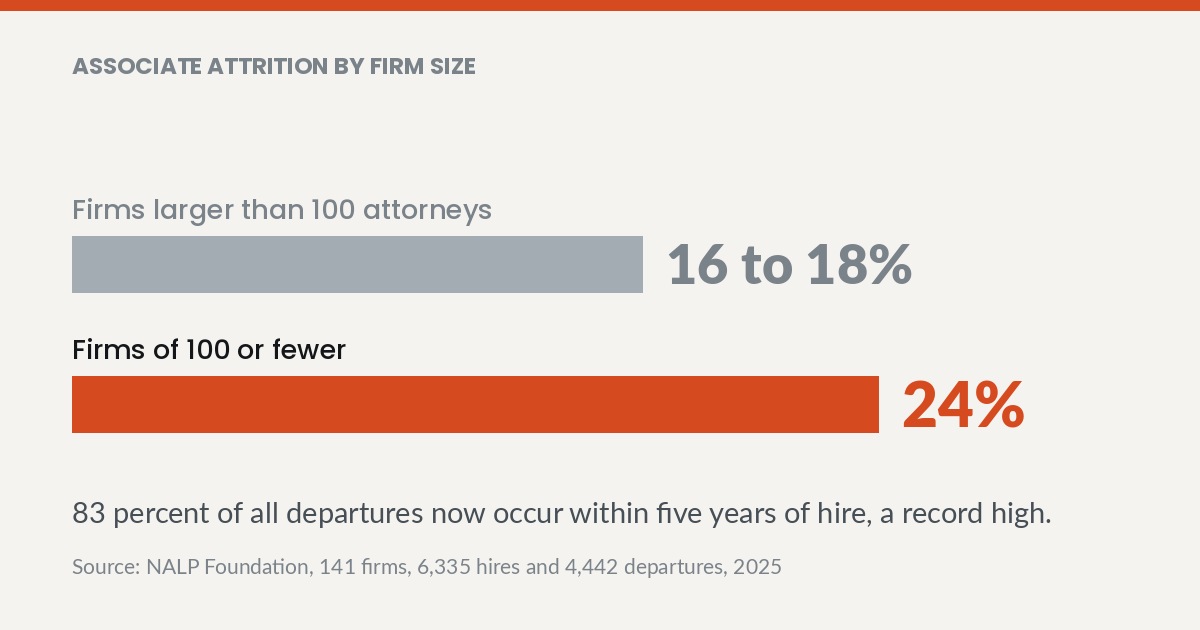
A law firm management consultant should read the NALP Foundation cohort data before touching compensation. Associate attrition at firms of 100 or fewer attorneys is 24 percent, against 16 to 18 percent for all four larger cohorts. The gap is structural, and small firms hire laterals to fix systems problems that lateral hiring cannot fix.
The Cohort Nobody Benchmarks Against
NALP Foundation data for 2025, covering 141 firms, 6,335 hires and 4,442 departures, sorts associate attrition by firm size. Four of the five cohorts land between 16 and 18 percent. Firms of 100 or fewer attorneys sit alone at 24 percent.
Overall associate attrition across all firms is 19 percent, down from 20 percent in 2024 according to the same NALP Foundation report. That headline number is the one most firms quote. It buries the fact that one cohort carries a materially worse result than every other.
Small firms rarely benchmark against firms their own size because the published commentary focuses on large firm dynamics. A managing partner comparing against a 19 percent industry figure concludes the firm is running close to normal. The relevant comparison shows the firm running well behind its actual peer group.
Why the Size Cutoff Matters
US Census County Business Patterns for 2023 counts 165,491 offices of lawyers establishments. Calculated from those establishment counts, 71.8 percent of law offices have fewer than five employees and 94.2 percent have fewer than twenty. The cohort with the worst attrition contains almost the entire profession.
Firm size determines what infrastructure exists to support an associate. Below a certain headcount, there is no professional development function, no formal supervision structure, and no dedicated matter staffing process. Those functions still have to happen, and they happen informally or not at all.
Departures Cluster Early and Are Getting Earlier
NALP Foundation reports that 83 percent of departures occur within five years of hire, a record high, up from 80 percent in 2024. Attrition is not distributed evenly across a career. It concentrates in the period when an associate is most dependent on supervision and least productive.
A firm that loses an associate in year four has absorbed the full cost of training and captured very little of the return. The economics of associate hiring assume a longer payback period than the profession is currently achieving. Small firms feel this more acutely because each departure represents a larger share of capacity.
Early departure is a supervision signal before it is a compensation signal. Associates leaving inside five years are usually describing unclear expectations, inconsistent feedback, and work assignment that feels arbitrary. Those complaints do not get resolved by a salary adjustment.
The Lateral Problem Is a Supervision Problem
NALP Foundation data shows 5 percent of lateral hires departing within one year, against 1 percent of entry-level hires. Laterals leave at five times the rate of the people the firm trained itself. That is the single most diagnostic number in the dataset.
The standard explanation blames cultural fit or compensation mismatch. The more accurate explanation is that firms hire laterals to solve problems that lateral hiring does not solve. A practice group struggling with matter staffing, origination credit disputes, or partner bandwidth hires an experienced associate and expects the underlying condition to improve.
Nothing about the new arrival changes the condition. The bandwidth problem persists because the partners who created it still work the same way. The origination dispute persists because the compensation structure that produced it was never revisited.
The lateral arrives into that same condition with less institutional knowledge and no onboarding structure. Entry-level associates at least receive whatever training the firm provides. Laterals are presumed to need none, which means they receive none.
Boomerangs Are Declining Too
Boomerang associates fell to 6 percent of hires from 11 percent in 2024, per the NALP Foundation. Returning alumni are the cheapest and lowest-risk hires available to any firm. A decline in that channel indicates that departing associates are leaving with a worse impression than they used to.
Exit conditions determine boomerang rates more than market conditions do. Firms that handle departures poorly close a hiring channel that costs nothing to maintain. The decline should be read as feedback on how the firm treats people on the way out.
The Economics Underneath the Attrition
Thomson Reuters reports in the 2026 State of the US Legal Market, based on a 184-firm panel, that direct expenses consume 32 percent of the average firm's revenue. Direct expenses in that measure mean fee-earner compensation and benefits. That is the largest single cost category in the business by a wide margin.
Direct spend on lawyer compensation rose 8.2 percent in the Thomson Reuters 2025 data. Support staff cost grew more than 6 percent while overhead per lawyer grew 4.3 percent. Firms are paying more per lawyer and losing them faster.
Associate realization stands at 85.6 percent, the lowest of any timekeeper level in the Thomson Reuters data. Associates are the most expensive growing cost and the least fully realized timekeepers. Attrition inside that group destroys value at both ends of the equation.
Realization Is a Supervision Metric
Low associate realization is usually treated as a billing problem and handled through write-off review. It is more accurately a supervision and matter staffing problem. Work assigned without adequate scoping, direction, or partner review generates time that clients will not pay for.
The same conditions that suppress realization drive early attrition. An associate producing work that gets written down learns that the effort was wasted and receives no useful correction. Firms that fix scoping and feedback see both numbers move together.
What Small Firms Should Build Instead
The instinct at a small firm facing attrition is to raise associate salaries toward the larger cohorts. The data does not support that as the primary lever. Larger firms pay considerably more and still lose associates at 16 to 18 percent, which means compensation sets a floor rather than a ceiling on retention.
Onboarding That Applies to Laterals
Most firms have some entry-level orientation and nothing at all for experienced hires. Given that laterals depart at 5 percent within one year against 1 percent for entry-level hires, that allocation is backwards. A lateral needs context on client relationships, internal norms, billing expectations, and who actually decides things.
The content is not difficult to produce and it does not require a professional development department. It requires someone to write down what everyone already knows and assumes is obvious. Firms that build this find lateral integration improves without any change in compensation.
Supervision With a Named Owner
Every associate should have one identified supervising attorney responsible for work quality, feedback, and development. Informal supervision distributed across a practice group produces inconsistent standards and no accountability. The associate experiences that inconsistency as arbitrary treatment.
Feedback should be scheduled rather than triggered by problems. An associate who only hears from a supervisor after a mistake concludes the relationship is purely corrective. Regular short reviews cost little and address the most common reason associates give for leaving early.
A Partnership Track That Can Be Described
Associates leaving inside five years frequently report that no one could explain the path forward. Small firms often have no formal partnership track and assume the answer is obvious to everyone. Writing down criteria, timing, and the origination credit implications removes the ambiguity that drives departures.
Succession planning connects directly to this same question. A firm whose partners are approaching transition without a defined associate path is training talent for competitors. Firms rebuilding supervision, matter staffing, and partnership criteria at once are doing operational design work. That is why many bring in a fractional COO rather than adding the project to an existing partner workload.
Staffing Decisions as Retention Decisions
Matter staffing determines what an associate learns and how quickly. Firms that assign work by availability rather than development produce associates with uneven skills and no sense of progression. Deliberate staffing costs nothing beyond the attention required to think about it.
Mentoring programs work when they are tied to specific matters rather than scheduled coffee. An associate learns more from a partner explaining a decision on live work than from any structured program. Small firms have a natural advantage here and mostly fail to use it.
Billable targets interact with all of this in ways firms rarely examine. A target set without regard to matter mix pushes associates toward volume over development. Firms that review targets alongside staffing decisions get better realization and better retention from the same headcount.
The profession has decided that attrition is a compensation arms race, and the numbers do not agree. Firms of every size lose associates, and the smallest firms lose them fastest despite paying least and having the most direct access to the people they are losing. Laterals departing at five times the entry-level rate is not a market signal about pay. It is a firm telling on itself about what happens after someone walks through the door. The work of fixing that sits entirely inside the firm, costs very little, and almost nobody does it.
Frequently Asked Questions
Why do small firms lose associates faster than large firms?
NALP Foundation data for 2025 puts associate attrition at firms of 100 or fewer attorneys at 24 percent, against 16 to 18 percent for all four larger cohorts. Larger firms maintain professional development functions, formal supervision structures, and defined advancement criteria. Small firms perform those functions informally or not at all, which produces inconsistent experiences for associates. The gap reflects infrastructure rather than compensation.
Should my firm raise associate salaries to fix attrition?
Compensation sets a floor on retention rather than determining it. Larger firms pay substantially more and still record 16 to 18 percent associate attrition according to NALP Foundation data. Thomson Reuters data shows direct spend on lawyer compensation rising 8.2 percent while attrition remained elevated across the profession. Firms generally recover more retention from supervision and clarity than from pay adjustments alone.
Why do lateral hires leave so much faster than entry-level associates?
NALP Foundation reports 5 percent of lateral hires departing within one year against 1 percent of entry-level hires. Laterals typically receive no onboarding because firms assume experience substitutes for institutional context. They also frequently arrive to solve a structural problem, such as partner bandwidth or matter staffing, that hiring alone cannot resolve. The conditions that prompted the hire remain in place after the lateral starts.
How early do most associate departures happen?
NALP Foundation data for 2025 shows 83 percent of departures occurring within five years of hire, a record high and up from 80 percent in 2024. That concentration means firms absorb training costs without capturing the productive years that justify them. Early departures typically reflect supervision quality, feedback consistency, and unclear advancement paths. Firms should treat the first five years as the retention problem rather than treating attrition as a general condition.
What does associate realization have to do with retention?
Thomson Reuters reports associate realization at 85.6 percent, the lowest of any timekeeper level. Work that gets written down is usually work that was poorly scoped, inadequately directed, or assigned without sufficient review. Those same conditions tell an associate that effort is being wasted and no correction is coming. Improving matter scoping and partner review tends to move realization and retention in the same direction.
How large is the small-firm segment in practice?
US Census County Business Patterns for 2023 counts 165,491 offices of lawyers establishments. Calculated from those counts, 71.8 percent of law offices have fewer than five employees and 94.2 percent have fewer than twenty. The cohort with the highest associate attrition therefore represents the overwhelming majority of legal employers. Industry commentary focused on large firm dynamics describes a small fraction of the market.


No comments:
Post a Comment