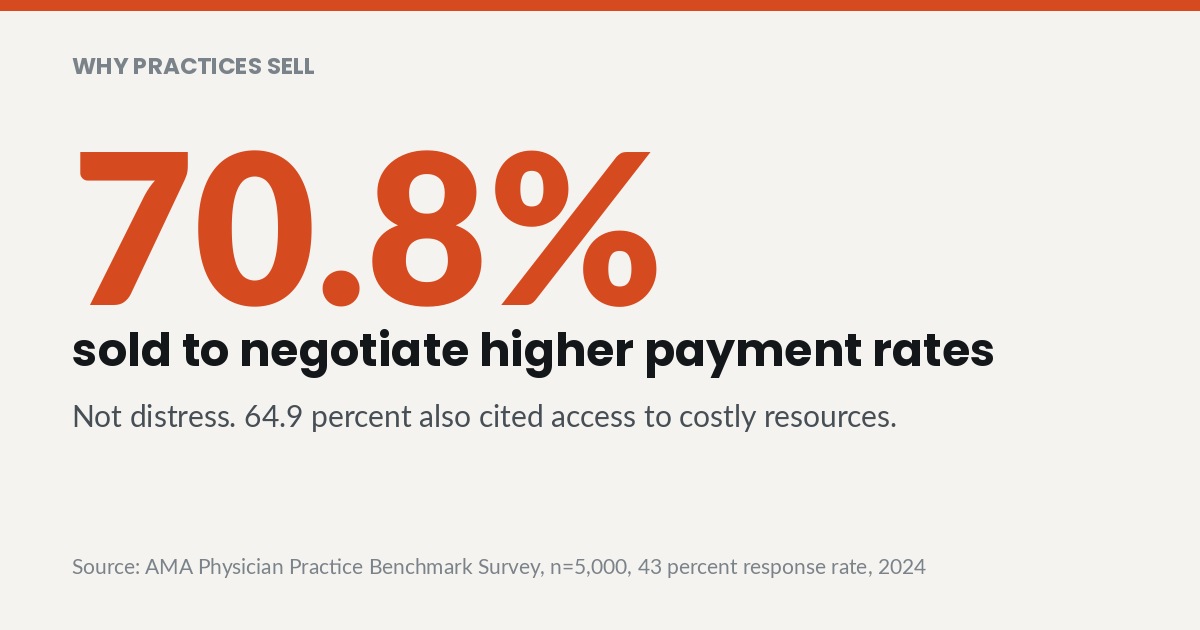
Physician practice management is the operating discipline of running a medical practice as a business: payer contracting, revenue cycle, staffing and compliance. The reason it matters now is what sellers actually say. The AMA found that 70.8 percent of practices that sold cited the ability to negotiate higher payment rates. That is a contracting problem, not a distress signal.
The stated reasons for selling are not distress reasons
The standard account of practice consolidation describes exhausted physicians and failing economics. Sellers describe something more specific. The AMA Physician Practice Benchmark Survey for 2024, drawn from 5,000 physicians at a 43 percent response rate, asked practices that sold why they did it.
The top answer was payment rates. Seventy point eight percent cited the ability to negotiate higher payment rates as a reason for the sale. The next two answers were access to costly resources at 64.9 percent and managing payer regulatory and administrative requirements at 63.6 percent.
Read those three together and a picture forms that has nothing to do with a practice running out of patients. All three describe a relationship with payers rather than a relationship with patients. Practices are not exiting a broken market. They are exiting a weak negotiating position.
That distinction changes the entire diagnostic. A failing practice has an operations problem, a demand problem or a cost problem, and each has known remedies. A practice that sells for rate improvement has none of those. It has a bargaining problem, and bargaining power comes from structure.
What negotiating position is actually made of
Payer contracting rewards a short list of attributes and practice quality is not first among them. Network adequacy sits at the top. A payer that cannot build an adequate network in a geography without a particular group will pay that group differently.
Patient volume and geographic coverage follow. A group representing a meaningful share of a specialty in a market has a credible alternative to accepting terms. A practice representing a small fraction does not, regardless of outcomes or patient satisfaction.
Data comes third and is the most neglected. Practices that can demonstrate cost per episode, referral patterns, quality measures and utilization performance can argue from evidence. Most independent practices cannot produce those figures, which reduces negotiation to accepting a fee schedule as presented.
Nothing on that list correlates with clinical excellence at the individual practice level. That is the uncomfortable part of the finding. Physicians are being asked to solve a structural problem with professional merit, and merit is not the currency being priced.
The practical consequence shows up every renewal cycle. A practice requests an increase, receives a standard response, and concludes the payer is unreasonable. The payer is behaving rationally toward a counterparty with no alternative to offer.
Fragmentation is the underlying condition
The scale picture explains why so few practices hold a strong position. US Census County Business Patterns for 2023 counts 204,617 offices of physicians establishments averaging 13.2 employees, with 52.7 percent having fewer than five.
The AMA data agrees from a different angle. Physicians in practices of ten or fewer fell to 47.4 percent in 2024, below half for the first time, and 49.2 percent of private-practice physicians work in practices of fewer than five physicians.
An industry composed largely of very small units facing a small number of very large payers has a predictable outcome. The counterparty with concentration sets terms. The counterparty with fragmentation accepts them and calls the result market rates.
Consolidation is the market solving that imbalance in the crudest available way. Practices merge into entities large enough to be negotiated with rather than dictated to. Every seller in that 70.8 percent figure is buying a seat at a table they could not otherwise reach.
The destination is employment, not partnership
The transaction is frequently described as joining a larger group. The aggregate data describes something more definitive. Physicians in wholly physician-owned practices fell to 42.2 percent in 2024 from 60.1 percent in 2012, per the AMA.
Hospital-owned practice participation rose to 34.5 percent from 23.4 percent over the same period. Physicians employed directly by a hospital rose to 12.2 percent from 5.6 percent in 2012.
The employment share tells the plainest version. The AMA reports 57.5 percent of physicians are employees and 7.1 percent are independent contractors as of 2024. A majority of American physicians now work for someone else.
Rate improvement obtained through acquisition arrives bundled with governance changes that no contract negotiation would have produced. Scheduling, staffing ratios, referral direction and technology decisions transfer with the ownership stake. Physicians who sold for a payer contracting reason acquired a much broader set of consequences.
None of that makes the decision wrong. It makes the accounting incomplete. A rate increase quantified in advance sits against governance costs that surface gradually and are rarely modeled during diligence.
The open question about scale and independence
The honest position is that scale genuinely works for rate negotiation, and no operating improvement fully substitutes for it. Pretending otherwise sets independent practices up for disappointment. The productive question is how much bargaining power is reachable without an equity sale.
Structures that aggregate without acquiring
Independent practice associations exist precisely to negotiate on behalf of practices that remain separately owned. Clinically integrated networks go further, permitting joint contracting where practices demonstrate genuine clinical integration. Both structures carry real legal requirements and neither works as a paper arrangement.
Management services organizations formed by independents deliver the administrative scale without the ownership transfer. Billing, credentialing, human resources, purchasing and technology run once for many practices. That directly addresses the 64.9 percent who cited access to costly resources and the 63.6 percent who cited administrative and regulatory burden.
Value-based contracting offers a different route. A practice that can document total cost of care performance negotiates on outcomes rather than on volume. Payers pay differently for demonstrated savings, and that argument does not require size in the same way a fee schedule negotiation does.
What each route demands first
Every one of these paths requires data the practice does not currently produce. Joining an independent practice association without cost and quality reporting means joining as a passenger. Entering a value-based arrangement without knowing current performance means accepting risk blindly.
Building that reporting capability is an operations project, not a clinical one. It requires someone to define the measures, integrate the sources and hold the reporting cadence. Practices without a full-time operations executive frequently engage fractional COO leadership to build the function before any contracting conversation begins.
The controllable half of the reimbursement problem
While rate negotiation depends on structure, realized revenue depends on execution, and the second half is entirely controllable. Contracted rates only matter to the extent claims are actually paid at them.
Denial behavior varies more than most practices assume. KFF analysis of CMS federal transparency data for 2024 found in-network claim denial rates in marketplace plans averaging 19 percent, with insurer-level variation from 13 to 35 percent.
A practice with strong contracted rates and weak denial management collects less than a practice with modest rates and disciplined revenue cycle operations. Eligibility verification, documentation standards, clean claim rate and appeal discipline determine which of those two a practice becomes.
Denial rate by payer is also negotiating evidence. A practice arriving at renewal able to demonstrate that one insurer denies far above the others has changed the conversation from a rate request into a performance discussion. Most practices arrive with neither the data nor the framing.
Group purchasing works the same way on the cost side. Supplies, malpractice coverage, technology contracts and staffing services are all priced against volume that independents can aggregate without merging. The savings are smaller than a rate increase and considerably easier to obtain.
Reframing the decision
Practices considering a sale usually evaluate the offer against the status quo. That comparison is incomplete because the status quo already assumes the practice will not change how it operates or contracts.
The fuller comparison includes a third option. Build the reporting, join or form an aggregating structure, fix the revenue cycle, then evaluate offers from a stronger position. A practice that does this either negotiates better independently or sells at better terms, and both outcomes beat the current path.
Time is the real constraint. Aggregating structures take years to establish and value-based track records take years to accumulate. Practices that begin the work while an offer is on the table have already lost the option they are trying to preserve.
Administrative burden deserves the same treatment. It is genuinely heavy, and it is also the component most improved by process design rather than by ownership change. Practices that fix it internally remove one of the three reasons sellers gave.
The most cited reason practices sell is a negotiating problem wearing the costume of an economic one. That is worth sitting with, because negotiating problems have structural answers and economic problems do not always. The question independent medicine has not seriously answered is whether physicians are willing to build the shared infrastructure that would make independence viable, or whether selling remains simply easier than organizing.
Frequently Asked Questions
Why do practices sell if they are financially stable?
The survey evidence points to contracting position rather than financial distress. The AMA found for 2024 that 70.8 percent of practices that sold cited the ability to negotiate higher payment rates as a reason, followed by 64.9 percent citing access to costly resources and 63.6 percent citing payer regulatory and administrative requirements. None of those three describes failing demand or unsustainable cost. Stable practices sell because the ceiling on independent negotiating position is structural rather than operational.
Can a small practice improve its reimbursement rates without merging?
Improvement is possible but bounded, and the bounds should be stated honestly. Independent practice associations, clinically integrated networks and value-based contracting arrangements allow practices to negotiate with more standing while remaining separately owned. Each requires cost, quality and utilization data that most practices do not currently produce. Building that reporting capability is the prerequisite step, and it takes considerably longer than practices expect.
How much does practice size actually matter to payers?
Size affects network adequacy, which is what payers price. US Census County Business Patterns for 2023 counts 204,617 offices of physicians establishments averaging 13.2 employees, with 52.7 percent having fewer than five. A single practice at that scale rarely represents enough of a specialty in a market to alter a payer's network. Groups large enough to create an adequacy gap negotiate on different terms.
What should my practice fix before entering a payer negotiation?
Reporting comes first because negotiation without evidence is a request rather than a discussion. A practice should be able to produce denial rate and appeal outcomes by payer, cost per episode, referral patterns and quality measures. KFF analysis of CMS data for 2024 showed marketplace in-network denial rates averaging 19 percent with insurer-level variation from 13 to 35 percent, which means payer-specific performance is a real and arguable point. Practices that cannot document their own numbers negotiate against a fee schedule they have no basis to contest.
Is hospital employment different from private equity acquisition for physicians?
The governance outcome is similar even where the structures differ. AMA data for 2024 shows physicians in hospital-owned practices rising to 34.5 percent from 23.4 percent in 2012, and physicians employed directly by a hospital rising to 12.2 percent from 5.6 percent. In both models, decisions about scheduling, staffing and referrals move away from the practicing physician. Physicians evaluating either option should examine the specific governance terms rather than the ownership label.
How long does it take to build an alternative to selling?
Realistically it takes years rather than months. Clinically integrated networks require demonstrated clinical integration, value-based contracts require a performance track record, and management services arrangements require practices willing to standardize their operations. Revenue cycle improvements deliver faster and can begin immediately, which makes them the sensible starting point. Practices that begin only after receiving an acquisition offer have already run out of the time the alternative requires.

