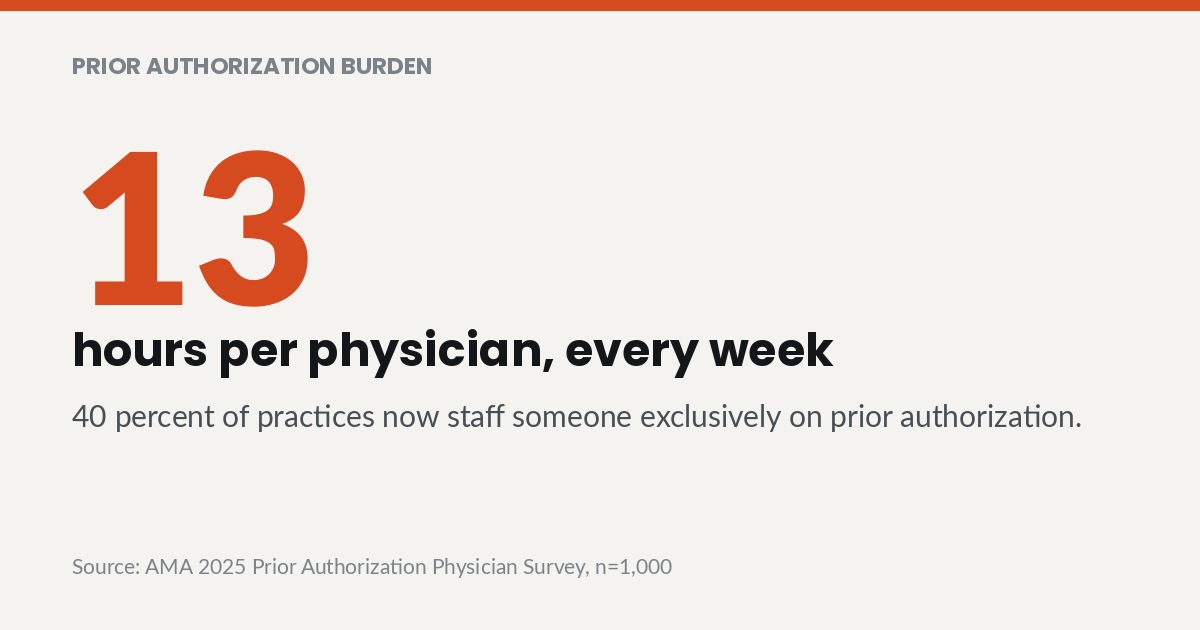
Prior authorization automation reduces the manual work of submitting, tracking and appealing payer approvals. It matters because physicians and staff spend 13 hours per week on prior authorization, according to the American Medical Association's 2025 survey of practicing physicians. The larger opportunity is not speed. It is the denied claims that practices never appeal.
Thirteen hours a week is a headcount decision
Administrative burden is usually discussed in the language of frustration. Prior authorization deserves the language of operations. The AMA fielded its 2025 Prior Authorization Physician Survey in December 2025 across 1,000 practicing physicians. It found that physicians and staff spend 13 hours per week on prior authorization and complete 40 prior authorizations per week.
Those two figures together describe a work center. Forty transactions moving through a process that consumes 13 hours of clinical and clerical time is not overhead. It is a production line with a throughput requirement, a queue, a cycle time and a failure rate. Every operating discipline that applies to a production line applies here.
The AMA also found that 40 percent of practices have staff working exclusively on prior authorization. That is the honest version of the number. Once volume passes a threshold, practices stop absorbing the work into existing roles and create a dedicated function.
The practices that have not made that decision are still doing the work. They do it in fragments, between patients, after hours, spread across people whose job descriptions say something else. The cost does not disappear because it was never budgeted. It shows up as slower scheduling, later charge entry and staff who spend their day on hold.
The appeal gap is where the money sits
Denials are rising and physicians know it. Seventy-four percent of physicians told the AMA in 2025 that prior authorization denials increased over the previous five years. Twenty-one percent say their prior authorizations are often or always denied.
The response to that pressure is the more revealing finding. Only 32 percent of physicians always appeal an adverse determination, according to the same AMA survey. Most denials that a practice believes are wrong are simply absorbed into the write-off column.
The stated reasons matter more than the rate itself. Among physicians who do not appeal, 59 percent do not expect success, 52 percent cite insufficient staff time and 49 percent say care cannot wait, per the AMA. Only the first of those three reasons concerns the merits of the claim.
Two of the three reasons are operational, not clinical
Insufficient staff time is a capacity constraint. Care that cannot wait is a cycle time constraint. Neither one says the denial was correct. Both say the practice lacked the operational room to contest a determination it disagreed with.
That distinction changes the nature of the problem. A practice that declines to appeal because the payer was right has a documentation problem at the front end. A practice that declines to appeal because nobody has the hours has a revenue cycle problem with a staffing cause.
Denial management is normally treated as a downstream billing activity that happens after a claim is rejected. Prior authorization denials do not behave that way. They arrive before the service is rendered, they carry a clinical deadline, and the window to contest them closes while a patient waits for care.
The result is a category of recoverable revenue that never enters the accounts receivable aging report at all. Nothing was billed. Nothing was denied on a remittance. The service simply did not happen, and no report in the practice management system flags it.
Denial rates are a payer behavior, not a fact of nature
Practices often treat denials as the fixed price of a particular payer contract. The variation across payers is real, and it is wider than most contracting conversations acknowledge. KFF analysis of CMS federal transparency data for 2024 found an average in-network claim denial rate of 19 percent in HealthCare.gov marketplace plans. Rates ranged from 13 to 35 percent across the largest insurers.
A spread that wide among insurers operating under the same rules says something about utilization management practice rather than clinical necessity. Payers make different choices about how much friction to introduce into the approval path. Those choices land on practice staff and on patients.
Burden also varies sharply by line of business. AMA respondents in 2025 rated Medicare Advantage as high or extremely high burden at 69 percent, commercial plans at 63 percent and Medicaid at 47 percent. A practice weighted toward Medicare Advantage runs a materially different back office than one weighted toward Medicaid.
Payer contract negotiation rarely addresses any of this directly. Rate gets negotiated. Authorization friction gets inherited. Practices that track denial volume, appeal rate and appeal outcomes by payer arrive at renewal with evidence instead of complaints, and evidence is what moves a utilization management conversation.
What automation removes and what it leaves behind
The tooling landscape is thinner than vendor messaging suggests. Only 24 percent of electronic health records offer electronic prior authorization for prescriptions, according to the AMA in 2025. Only 5 percent of practices report access to gold-card or exemption programs.
Gold carding is the structural fix rather than the mechanical one. When a payer exempts a physician with a strong approval history from authorization requirements on defined services, the work disappears instead of accelerating. At 5 percent adoption, gold carding is a negotiating objective for most practices rather than a current-state benefit.
Automation compresses the transaction, not the decision
Software handles the mechanical layer well. Eligibility verification at the point of scheduling, benefit checks against the payer file, pulling clinical documentation from the chart into the submission, routing through a clearinghouse, and tracking status without a telephone call all respond to automation.
Software does not make the determination. The payer's utilization management criteria still governs the outcome. Automation moves a case to that decision faster and with fewer defects, which raises clean claim rate and pulls down days in accounts receivable tied to authorization holds.
The real return is recovered capacity. Hours reclaimed from status calls and duplicate data entry become hours available for appeals, which is precisely the constraint that 52 percent of non-appealing physicians named in the AMA survey. Automation that saves time without redirecting it produces a quieter office and the same write-offs.
Designing the staffing model around the queue
Most practices staff prior authorization by accident. A capable person absorbed the work, the volume grew, and the task became that person's job without ever becoming a defined role. The result is a single point of failure operating an undocumented process with no service level.
A designed model looks materially different. Authorization requirements are checked during scheduling rather than on the day of service. Documentation standards are written per payer and per procedure before anything is submitted. Denials route to a named owner with an appeal deadline attached and a default assumption that an appeal will be filed.
That last point is the pivot. Appeals should require a reason to skip, not a reason to pursue. Reversing the default is a policy change that costs nothing and directly addresses the finding that only 32 percent of physicians always appeal.
This is ordinary operations work applied to a clinical administrative function, and most practices have nobody whose job is to do it. Practices without a full-time operations executive frequently bring in fractional COO support to build the workflow, define the metrics and hand a running function back to the internal team.
The metrics that make automation measurable
The measurement set is not exotic. Authorization turnaround time, denial rate segmented by payer and procedure, appeal rate, appeal win rate, and days in accounts receivable attributable to authorization holds cover the operating picture.
Practices that cannot produce those figures cannot tell whether an automation purchase worked. They will feel busier or less busy and call that a result. A baseline captured before implementation is the cheapest part of the project and the part most often skipped.
The burnout number is a retention number
Ninety-four percent of physicians say prior authorization increases physician burnout, per the AMA in 2025. The clinical consequences track alongside it. Ninety-five percent report care delays, 92 percent report negative clinical impact, and 26 percent report a serious adverse event resulting from the process.
Those figures are normally cited in support of policy reform, and they belong in that argument. They also belong in a staffing conversation. Physician time spent chasing authorization is the most expensive labor in the building applied to the least clinical task available to it.
Practices that move authorization work off physicians and onto a trained, properly tooled administrative function collect two returns. Cost per transaction falls because the work sits at the right wage level. The people most likely to leave stop spending their week on the activity that makes them want to leave.
The appeal statistics describe practices declining to collect money they believe they are owed. That choice is rational under a capacity constraint and expensive under every other reading. Prior authorization automation is worth buying, but the case for it is not the hours it returns. The case is what a practice decides to do with those hours once they exist, and the honest answer for most practices is that nobody has decided yet.
Frequently Asked Questions
What does prior authorization automation actually automate?
Automation handles the transactional layer of the process rather than the clinical determination. That includes eligibility verification at scheduling, benefit checks, assembling documentation from the chart, submitting through a clearinghouse and monitoring status without phone calls. The payer still applies its own utilization management criteria to decide the case. Practices that expect approval rates to change from software alone are measuring the wrong outcome.
How do I know whether my practice should appeal more denials?
The test is why appeals are being skipped rather than how many are filed. The AMA reported in 2025 that among physicians who do not appeal, 52 percent cite insufficient staff time and 49 percent say care cannot wait. Both reasons are operational and neither indicates the denial was clinically correct. A practice that cannot separate merit-based decisions from capacity-based ones is leaving recoverable revenue uncounted.
Should a practice hire dedicated prior authorization staff?
Dedicated staffing becomes justified when volume is steady enough to keep a specialist productive and complex enough that generalists make errors. The AMA found in 2025 that 40 percent of practices already have staff working exclusively on prior authorization. The alternative is not zero cost, because the work is still performed by clinical staff at a higher wage and with more interruption. Practices should price the current arrangement before deciding it is cheaper.
What is gold carding and can a mid-market practice obtain it?
Gold carding exempts physicians with strong approval histories from authorization requirements on specified services. The AMA reported in 2025 that only 5 percent of practices have access to gold-card or exemption programs, so it remains rare. Obtaining it requires clean historical approval data organized by payer and procedure, which most practices do not currently produce. Building that reporting is a prerequisite for the conversation, not an outcome of it.
How does prior authorization affect days in accounts receivable?
Authorization holds delay the service, which delays the charge, which delays the claim. The effect appears as aged receivable and as revenue that never entered the cycle because the service was abandoned. Tracking days in accounts receivable attributable specifically to authorization holds separates this from ordinary billing lag. Without that segmentation, revenue cycle reporting misattributes the cause and the fix lands in the wrong department.
Which payers should a practice examine first?
Burden concentrates unevenly across lines of business. AMA respondents in 2025 rated Medicare Advantage as high or extremely high burden at 69 percent, commercial plans at 63 percent and Medicaid at 47 percent. Denial behavior also varies widely by insurer, with KFF analysis of CMS data for 2024 showing marketplace in-network denial rates from 13 to 35 percent across the largest insurers. Practices should start with the payer combining high volume, high burden and high denial rate, because that is where process investment returns fastest.