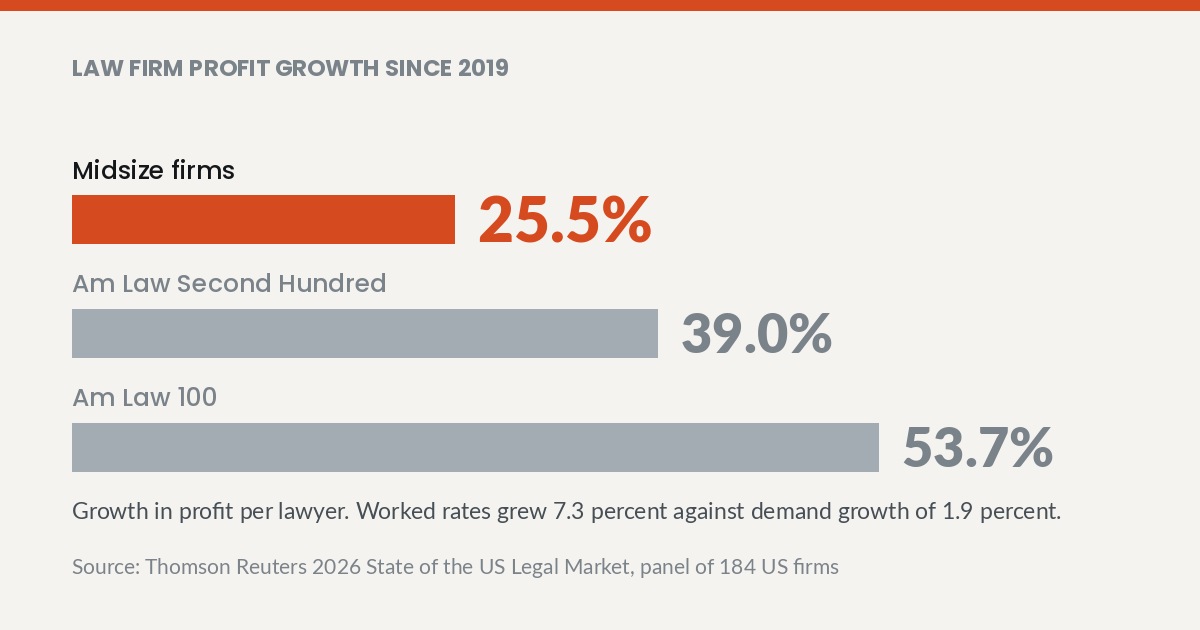
A law firm consultant reading the 2026 Thomson Reuters State of the US Legal Market will find one number that matters. Profit per lawyer since 2019 grew 25.5 percent at midsize firms and 53.7 percent at Am Law 100 firms. Both cohorts grew, and the distance between them is compounding.
The gap, not the growth, is the finding
Most coverage of legal market data reports the top of the market. The 2026 Thomson Reuters State of the US Legal Market gives all three cohorts. Profit per lawyer since 2019 grew 25.5 percent at midsize firms, 39.0 percent at Am Law Second Hundred firms and 53.7 percent at Am Law 100 firms.
The panel behind those figures covered 184 US firms, comprising 50 Am Law 100 firms, 58 Second Hundred firms and 76 midsize firms. The cohorts are not small samples of outliers. They describe a market-wide pattern with a consistent direction.
Every cohort grew profit per lawyer, which is the part usually missing from the anxious version of this story. Midsize firms as a group are not failing. They are gaining ground more slowly than the firms they compete with for talent and for work.
A gap in compounding rates does not stay constant. Each year the larger firms convert their profit advantage into higher associate compensation, better laterals and deeper investment. That is how a difference in growth rates becomes a difference in kind.
The profit came from pricing, not from volume
Thomson Reuters reports average law firm profit growth of 13.0 percent year over year for 2025. The composition of that growth is the important part. Worked rate growth ran 7.3 percent against demand growth of 1.9 percent.
Rates rose far faster than the volume of work being performed. That is a pricing result rather than a growth result. Firms did not win materially more work, they charged materially more for the work they already had.
Pricing is a legitimate lever and firms were right to use it. The problem is that it is finite in a way volume is not. A firm can raise rates until clients push back, and client tolerance is the ceiling.
Demand growth of 1.9 percent tells a midsize firm something specific about strategy. Matter volume is not expanding fast enough to carry a profit plan on its own. Any firm budgeting for both rate increases and demand recovery is counting the same lever twice.
Realization is where the rate increase leaks
A worked rate is not a collected rate. Thomson Reuters puts collection realization against worked rates at 90.3 percent for 2025. The difference between the rate a firm sets and the rate it collects is a management problem rather than a market condition.
The leak is not evenly distributed across the firm. Associate realization sits at 85.6 percent, the lowest of any timekeeper level in the Thomson Reuters data. That is the cohort a firm depends on for margin.
Associate write-downs happen for identifiable and fixable reasons. Work assigned above a lawyer's capability, matters staffed without a budget and time entered without a usable narrative all produce the same result. Each is a billing hygiene issue a firm can fix without asking a client for anything.
Recovering realization points is quieter than raising rates and easier to defend. A rate increase requires a client conversation every single year. A realization improvement requires an internal process change once.
The expense side is moving faster than the rate
Rate growth does not reach the bottom line intact. Thomson Reuters reports direct expenses, meaning fee-earner compensation and benefits, consuming 32 percent of the average firm's revenue. Direct spend on lawyer compensation rose 8.2 percent while overhead per lawyer rose 4.3 percent and support staff cost rose more than 6 percent.
Lawyer compensation rising faster than worked rates is the structural squeeze. The talent market sets compensation and the client market sets rates, and the two are never negotiated with each other. A firm caught between them absorbs the difference in margin.
Headcount growth adds another layer to that pressure. Thomson Reuters reports lawyer headcount up 2.9 percent across the panel. Total headcount since January 2023 rose 8.2 percent at midsize firms, 9.4 percent at Second Hundred firms and 5.1 percent at Am Law 100 firms.
Midsize firms grew headcount faster than the largest firms while growing profit per lawyer more slowly. Adding people without adding proportional profit is the definition of a dilutive expansion. The question a midsize firm should ask is whether new headcount bills at a realization the firm can live with.
How the gap transmits into the talent market
Profit per lawyer is not an abstract scoreboard. It determines what a firm can pay an associate class and what it can offer a lateral partner without diluting existing partners. A firm growing profit per lawyer faster than its competitors sets the compensation benchmark everyone else has to answer.
Thomson Reuters put direct spend on lawyer compensation up 8.2 percent for 2025. Firms in every cohort paid that increase, but they did not all fund it from the same profit base. The firm with slower profit growth funds the same compensation increase out of a thinner margin.
That is the transmission mechanism between the two cohorts. Compensation is set close to market regardless of a firm's own economics, because the alternative is losing people. A midsize firm therefore imports the cost structure of the Am Law 100 without importing its rate structure.
Recognizing that changes what a midsize firm should optimize. Matching the largest firms on compensation while trailing them on rate requires better realization, better staffing design or a different practice mix. Firms that pick none of the three run a narrower margin every year.
Market structure is shifting underneath the numbers
The available talent pool has started expanding again. The ABA National Lawyer Population Survey for 2025 records total licensed US lawyers at 1,374,720, up 1.38 percent from 1,355,963. That was the first significant rise since 2020.
An expanding lawyer population changes the recruiting calculus as well. A pool that grows again loosens a market that had been tightening for several years running. Firms that built their retention assumptions during the scarcity period should test those assumptions against current conditions.
The market those lawyers work in remains fragmented. US Census County Business Patterns for 2023 counted 165,491 offices of lawyers establishments with an average of 6.61 employees. A market of very small firms is a market where consolidation has room to run.
Consolidation is concentrated at the small end of the market. Fairfax Associates reports 76 percent of law firm mergers in 2025 involved a firm of five to twenty lawyers, up from 69 percent in each of the prior two years. That was across 59 completed mergers in the year. Small firms are being absorbed while midsize firms compete for the same laterals as the largest ones.
What a midsize firm can act on
The gap is not closable through rate alone. Am Law 100 firms raise rates from a stronger client position and a different matter mix. A midsize firm chasing that pricing curve without the matter mix behind it loses clients rather than gaining margin.
Matter profitability before matter volume
Most midsize firms measure revenue by practice and profit by firm. The gap between those two views hides matters that generate revenue and destroy margin. Profitability at matter level, including write-downs and write-offs, changes which work a firm chases next year.
Billing hygiene as a margin program
Collection realization at 90.3 percent and associate realization at 85.6 percent describe recoverable money. Narrative quality, timely entry and budget discipline move those numbers without a rate conversation. Firms that treat billing hygiene as an administrative chore leave the easiest margin on the table.
Timekeeper mix and staffing design
Work assigned above its appropriate level is the most common cause of associate write-downs. Staffing matters deliberately, with the right timekeeper level on each task, protects both realization and client relationships. Alternative fee arrangements only work when a firm knows what a matter costs to deliver.
None of this is a strategy problem in the conventional sense. It is operating discipline applied to a business that historically managed itself through rate increases. Firms that want that discipline installed without adding a permanent executive line often start with a fractional COO engagement and a defined operating agenda.
The 2026 Thomson Reuters data does not describe a midsize crisis. Midsize firms grew profit per lawyer 25.5 percent since 2019, which is a good outcome in most industries. The problem is that they grew it in a market where their direct competitors grew 53.7 percent.
Compounding gaps do not announce themselves in a single year. They show up as a lateral who takes a different offer, a client who moves a matter and an associate class that costs more than the last one. The firms that close the gap will do it on the expense and realization side, because the rate side is already spent.
Frequently Asked Questions
Should my firm raise rates again next year?
Rate increases remain available but produce less than they used to. Thomson Reuters reported worked rate growth of 7.3 percent against demand growth of 1.9 percent for 2025, which means the market has already been pricing aggressively. A firm raising rates without improving realization is increasing the number it writes down. The sequence that works is realization first and rate second.
What does profit per lawyer actually tell a firm?
It measures how much profit the firm generates for each lawyer it employs, combining pricing, realization, expense control and staffing design. Thomson Reuters recorded growth since 2019 of 25.5 percent at midsize firms against 53.7 percent at Am Law 100 firms. The measure is useful because it normalizes for firm size. It becomes misleading when read without the headcount trend beside it.
How do I know whether my realization problem is fixable?
Realization losses fall into two categories, client resistance and internal process failure. Write-downs traced to unclear narratives, late time entry or work staffed above its level are internal and correctable. Thomson Reuters reports associate realization at 85.6 percent, the lowest of any timekeeper level, which points toward staffing and supervision rather than client pushback. A firm that categorizes write-downs by cause for one quarter will know which problem it has.
Is merging the right answer for a small or midsize firm?
Merger activity is concentrated among smaller firms right now. Fairfax Associates reported 76 percent of law firm mergers in 2025 involved a firm of five to twenty lawyers, up from 69 percent in each of the prior two years. A merger solves scale and coverage problems but does not solve realization or expense discipline. Firms carrying operating problems into a merger usually carry them out the other side.
Why is lawyer compensation growing faster than rates?
The two prices are set in entirely different markets. Thomson Reuters reported direct spend on lawyer compensation up 8.2 percent while overhead per lawyer rose 4.3 percent. Talent competition sets compensation and client tolerance sets rates, with no mechanism connecting the two. Firms absorb the difference until they change either their staffing design or their matter mix.
Where should a managing partner start if none of this is measured?
The first step is a matter-level profitability view covering a full year of closed work. That view identifies which practices and which clients fund the firm and which ones consume it. The second step is a write-down analysis by cause, which converts a realization percentage into a list of fixable behaviors. Both take weeks rather than months and require no client conversation at all.