Thursday, April 9, 2026

You Cannot Analyse Your Way Out of a Cash Constraint

You Cannot Analyse Your Way Out of a Cash Constraint. Frameworks describe position.

Financial readiness is the question of whether a business can fund a growth decision from the cash it will actually hold, at the time it will actually need it. Frameworks describe where a company stands. Cash decides what that position permits the company to do this quarter, and no amount of analysis converts one into the other.

Position Is Not Permission

A strategic analysis can be entirely correct and completely unusable. It can identify the right market, the right product change, and the right sequence of moves. None of that matters if the company cannot fund the first step without missing payroll.

Owners rarely make this mistake deliberately. They make it because the two questions are answered by different people at different times. Strategy is discussed in a planning session and cash is discussed with the bookkeeper.

The two conversations never meet, and so a plan gets approved on its merits rather than on its affordability. The constraint only surfaces later, usually as a surprise, usually at the worst possible moment.

The corrective is procedural rather than analytical. Every strategic option should be presented alongside the cash it consumes before it returns anything. If that figure is not on the page, the option has not been fully described.

What Financial Readiness Actually Measures

Financial readiness is not the same as profitability, and confusing the two causes real damage. A profitable business can be entirely unable to fund growth, and an unprofitable one can occasionally afford a bet if it holds enough cash.

Readiness measures three things. It measures how much cash the business holds and can access. It measures how quickly cash converts through the operating cycle. It measures how much of the coming period is already committed to obligations that cannot be moved.

The third item is the one most often skipped. Committed cash is not available cash, even though it sits in the same account. Tax liabilities, loan repayments, seasonal supplier payments, and payroll for staff already hired all reduce the genuinely discretionary balance.

A business that measures readiness against the bank balance rather than the uncommitted balance will overestimate its capacity every time. The gap between those two figures is where most funding surprises live.

Working through whether the business can genuinely afford the growth it is planning means running that calculation before the strategy is chosen rather than after. The order matters more than the sophistication of the method.

Why Frameworks Feel Like Progress

Analytical frameworks are popular because they are satisfying. They convert an anxious, formless worry into a structured page with quadrants and headings. That conversion feels like the problem has been handled.

It has not been handled. It has been described. Description is a real contribution and it is routinely mistaken for a decision.

The mistake is easy to spot after the fact. A leadership team completes a thorough analysis, agrees it was valuable, and then makes exactly the same operating choices it would have made anyway. The analysis changed the vocabulary and not the behaviour.

None of this makes frameworks worthless. A structured analysis that actually changes what a small business decides is a different exercise from one that produces a filled-in template. The difference is whether the output feeds a specific choice with a deadline.

The test is straightforward. Before starting any analysis, name the decision it will inform and the date that decision must be made. An analysis with no decision attached is an interesting document and nothing more.

Growth Consumes Cash Before It Produces It

This is the mechanism that catches most small and mid-market businesses, and it catches them precisely because they are succeeding. Growth is not free. It is funded in advance and repaid later.

A larger order requires more inventory, bought before the invoice is raised. A bigger team requires salaries paid before the additional output reaches a customer. A new location requires deposits, fit-out, and staffing months before it trades at capacity.

Each of these creates a gap between money leaving and money returning. The faster the growth, the wider the gap. A business growing quickly can be more fragile than the same business growing slowly, even though every other indicator looks better.

Owners often read the warning signs backwards. Sales are rising, the pipeline is full, the team is busy, and the bank balance is falling. The natural interpretation is that the balance will recover once the current work invoices out.

Sometimes it does. Often the next tranche of growth consumes the recovery before it arrives, and the business enters a pattern where every good quarter tightens the position further. Escaping that pattern requires a deliberate decision to slow down, which almost nobody makes voluntarily.

There is a second reason growth tightens the position. Larger customers pay more slowly than small ones, and winning them is treated as an unambiguous success. The revenue improves and the collection period lengthens at the same time.

Neither effect is visible on a profit statement. Both are visible immediately on a cash forecast, which is why the forecast is the instrument that matters during expansion.

The Questions That Come Before the Analysis

Four questions establish whether a strategic conversation can proceed usefully. They take an afternoon rather than a project, and they should be answered before any framework is opened.

The first asks how many weeks the business could operate if revenue stopped entirely tomorrow. Not months, weeks, and calculated against committed outgoings rather than average ones. That figure sets the boundary on how much risk is available.

The second asks how long it takes for a unit of spend to return as revenue. That is the operating cycle, and it determines how much funding any growth step requires before it becomes self-sustaining.

The third asks what proportion of the coming quarter is already spoken for. Committed costs, scheduled repayments, and known liabilities all reduce the room to manoeuvre in ways that do not appear on a profit statement.

The fourth asks what access to additional funding exists, on what terms, and how quickly it can be drawn. A facility that takes ten weeks to arrange is not available for a decision that must be made this month.

A business that can answer those four questions has a real constraint to plan against. A business that cannot is guessing, and every subsequent analysis inherits that guess as an assumption.

Where Analysis Earns Its Place

None of this argues against analysis. It argues for a specific ordering, in which the cash position is established first and the analysis is conducted inside that boundary.

Analysis conducted within a known constraint is more useful, not less. Options that cannot be funded are removed early, which shortens the process and sharpens the debate about what remains. Teams that plan without a constraint spend most of their energy on options they were never going to take.

The constraint also changes the character of the recommendations. Faced with limited cash, teams stop proposing transformation and start proposing sequence. Sequence is almost always the better answer for a business of this size.

Sequenced growth funds each step from the returns of the last. It is slower than the plan the analysis would have produced without the constraint, and it survives contact with a bad quarter. That trade is worth making explicitly rather than discovering by accident.

The strongest planning conversations tend to be the least ambitious on paper. They pick one move, fund it properly, define what success looks like, and specify what happens if the return arrives late. That last element is what separates a plan from a hope.

A rolling cash forecast is the practical instrument. It projects receipts and payments week by week for the next several months and is updated weekly rather than monthly.

Weekly updating matters because the errors compound. A forecast reviewed monthly gives the business a handful of chances a year to notice a developing problem. A weekly one gives it enough warning to act while options still exist.

Accuracy in the near weeks matters more than precision in the distant ones. The next month should be close to exact, because most of it is already committed and knowable. Beyond that, directional accuracy is sufficient for the decisions the forecast supports.

The forecast does not need to be sophisticated. A spreadsheet maintained honestly beats an elegant model maintained occasionally. What it needs is to be believed, which means the person maintaining it must be free to report bad news without consequence.

That last condition fails more often than the arithmetic does. Where a forecast is used to assign blame, it stops being accurate quickly, and the business loses the one instrument that gives it advance warning.

Strategy work is valuable and cash work is unglamorous, which is why the second is chronically underdone in businesses that pride themselves on thinking clearly. A company that knows its constraint can plan aggressively inside it. A company that does not know its constraint will eventually be told what it was, at a moment chosen by the constraint rather than by the owner.

Frequently Asked Questions

What is the difference between financial readiness and profitability?
Profitability describes whether revenue exceeded cost over a completed period. Readiness describes whether cash will be available at the moment a commitment falls due. A profitable business with slow collections and fast payments can run out of cash while its accounts look healthy. The two measures answer different questions and neither substitutes for the other.

How far ahead should a cash forecast run?
Most small and mid-market businesses are well served by a rolling forecast covering the next three to six months, updated weekly. Shorter horizons miss seasonal effects and scheduled liabilities. Longer horizons carry so much assumption that the later weeks stop being informative. The discipline of updating matters more than the length of the window.

Does this mean strategic frameworks are a waste of time?
No. Frameworks organise thinking and surface factors that would otherwise be missed. The failure is using them as a substitute for a decision rather than an input to one. Any analysis should be attached to a named choice with a deadline before the work begins.

What if the numbers say growth is not affordable?
That is a usable answer rather than a failure. The response is usually to sequence the growth into smaller funded steps rather than abandon it. Smaller steps also generate evidence about whether the underlying assumptions hold. Businesses that discover the constraint early keep more options than those that discover it mid-commitment.

Who should own the cash forecast in a smaller business?
Ownership belongs to whoever has visibility of both commitments and collections, often a finance lead or an operations manager. The owner of the business should read it weekly regardless of who maintains it. Delegating the maintenance is sensible. Delegating the attention is not.

How does external funding change the picture?
Available funding widens the constraint but does not remove it, because borrowed cash carries a repayment schedule that becomes a future commitment. Facilities also take time to arrange, which means they are only useful if secured before they are needed. Arranging access while the position is strong is far easier than arranging it under pressure. The terms available reflect the position at the moment of asking.

Sunday, April 5, 2026

A Vision Nobody Can Act On Is Just a Sentence

A Vision Nobody Can Act On Is Just a Sentence. Strategy documents describe a destination.

Strategic planning produces two different things, and most organisations only produce one. A strategy document describes a destination. A quarterly commitment assigns named people to specific work with a date attached. The second does not follow automatically from the first, and a plan that stops at the destination changes nothing about how the week is spent.

A Destination Is Not an Assignment

Almost every company has a vision statement. Very few have a working answer to the question of who is doing what about it before the quarter ends. The distance between those two states is where most strategic planning fails.

The vision statement is genuinely useful. It sets direction, filters opportunities, and gives people a way to judge whether a request belongs to the business. None of that is trivial and none of it survives contact with a busy operating week on its own.

What survives a busy week is an assignment. Assignments have owners, deadlines, and a defined finished state. A vision has none of those things and was never designed to.

The failure is not that companies write visions. The failure is that they treat the writing as the completed act. The document is signed off, circulated, and printed, and everyone returns to the work they were already doing.

There is a reason the writing feels like completion. Producing a strategy document is genuinely hard work, and the relief at finishing it is real. That relief is easily mistaken for arrival.

Anyone who has watched a leadership offsite end in applause has seen the effect. The energy in the room is authentic and it dissipates within about a fortnight. Nothing in the process was designed to convert that energy into scheduled work.

Why the Annual Plan Decays So Quickly

Annual planning assumes the operating environment holds still for a year. It rarely does. By the second quarter the assumptions behind the plan have usually shifted enough that the numbers no longer describe anything real.

What happens next is predictable. Nobody formally cancels the plan, because cancelling it would require admitting the planning process produced something disposable. Instead the plan quietly stops being referenced.

Meetings move on to whatever is urgent. The document remains on a shared drive, technically current and functionally dead. When the next planning cycle arrives, the same process runs again with new numbers and the same fate.

The deeper problem is the length of the feedback loop. A plan reviewed once a year gives the organisation a single opportunity to notice it was wrong. That is far too few chances to correct in a market that moves faster than the calendar.

Shortening that loop is the single highest-return change available to most leadership teams. It costs nothing beyond meeting discipline. It requires no new system and no consultant.

What a Quarterly Commitment Has That a Plan Does Not

A quarterly commitment is a short list of outcomes the company intends to achieve in the next three months. Each item has one owner. Each item has a definition of done that two reasonable people would judge identically.

That last property does most of the work. Vague commitments survive review because nobody can prove they were missed. Specific commitments cannot hide, which is why teams resist writing them and why writing them changes behaviour.

The list must also be short. A leadership team that commits to fifteen outcomes has committed to none of them, because the organisation will default to whatever is loudest rather than whatever was agreed. Three to five outcomes is the practical limit for most mid-market companies.

The case for running the business on quarterly execution cycles rather than annual plans rests on this compression. A shorter horizon forces sharper choices, and sharper choices are easier to assign.

Quarterly commitments also create a natural moment to kill work. Anything not on the list is explicitly not a priority for the next three months. Saying that out loud is uncomfortable, which is exactly why it needs a formal occasion.

The Translation Layer Nobody Owns

Between the strategy document and the quarterly list sits a translation step. Someone has to convert an ambition into a set of finite tasks that a specific team can complete. In most companies nobody is responsible for that step.

The executive who wrote the strategy considers the work finished at the document. The managers who receive it consider their job to be delivering the current operating plan. The translation falls into the gap between those two views and stays there.

Where a company does have someone doing this work, it is usually informal. A chief of staff, an operations lead, or a founder who happens to think in tasks. That arrangement functions until the person leaves, at which point the connection between strategy and execution disappears without anyone diagnosing why.

Making the translation layer explicit is the fix. One person owns the conversion of strategy into quarterly commitments. That person is accountable for the list existing, being specific, and being reviewed.

The role does not require authority over the work itself. It requires authority over the process that defines the work. Those are different powers and the second is far easier to grant.

Testing Whether a Vision Can Be Acted On

A vision statement can be tested without a workshop. Take the statement to three people at different levels of the company and ask each of them what it means for their next two weeks. Then compare the answers.

If the answers differ wildly, the statement is not directing anything. If the answers are all some version of keeping up the good work, the statement is decorative. Either result is diagnostic and neither requires a facilitator to interpret.

A second test is subtraction. Ask what the company has stopped doing because of the vision. A direction that has never eliminated an activity is not a direction, because it has never had to choose.

The third test is the hardest. Ask a manager what they would need to change if the vision were replaced with its opposite. If nothing meaningful would change, the vision was never load-bearing.

Building a strategic vision the team will actually execute means passing all three of those tests before the statement is circulated. Most statements are written to survive a board slide rather than a Tuesday.

What Changes When the Work Is Assigned

The first thing that changes is the quality of disagreement. Abstract strategy produces polite nodding, because nobody has to accept a cost. Assigned work produces argument, because the costs are now visible and personal.

That argument is the point. A leadership team that never argues during planning has not made a real choice, and the absence of conflict is a warning rather than a sign of alignment.

The second change is in how progress gets reported. Status against a vision is a narrative exercise. Status against a defined outcome with a date is binary, and binary reporting removes most of the room for optimistic framing.

The third change is slower and more valuable. Teams that repeatedly set and review specific commitments become better at estimating what they can actually deliver. That calibration compounds, and after several cycles a leadership team can forecast its own capacity with reasonable accuracy.

None of this requires new software. Most companies attempt to solve execution problems with tools, then discover the tool has faithfully recorded the same vagueness that existed before. A tracker inherits whatever specificity the commitments already had.

Most planning time is spent on the wrong half of the process. Days go into refining the document, choosing language, and building the presentation. Hours, sometimes minutes, go into deciding who does what next.

Reversing that ratio is the practical recommendation. The strategy document should be short enough to state in a paragraph, because anything longer will not be remembered and therefore will not be used.

The quarterly list deserves the remaining effort. Naming owners, defining what finished means, sequencing the dependencies, and agreeing what gets dropped to make room. That work is unglamorous and it is the part that determines whether anything moves.

The sequencing question deserves particular attention. Most quarterly lists fail not because the items were wrong but because two of them required the same scarce person in the same fortnight. Nobody checks for that collision until it happens.

Reviews should be frequent and brief. A monthly check on a quarterly list takes under an hour when the commitments are specific. It takes an afternoon when they are not, which is a reliable signal that the list needs rewriting rather than the meeting needing more time.

A vision that nobody can act on still has a use. It sounds good in a recruitment conversation and it fills a slide. What it does not do is change the order in which work gets done, and that ordering is the only mechanism by which a strategy ever becomes a result. The difference between a company that executes and one that plans is rarely ambition. It is whether somebody wrote down who was doing what, and then went back and checked.

Frequently Asked Questions

How often should a strategic plan be revisited?
The destination itself changes rarely and can be reviewed annually. The commitments underneath it should be rebuilt every quarter and checked monthly. That split keeps the direction stable while allowing the work to respond to what the market actually did. Companies that revisit the destination too often confuse motion with strategy.

What if the leadership team cannot agree on priorities?
Disagreement at this stage is useful information rather than an obstacle. It usually means the strategy was too abstract to force a choice, and the abstraction was hiding a genuine conflict of view. The resolution is to make the trade-off explicit by naming what will be given up. A decision that costs nobody anything was not a decision.

How many commitments should a quarter contain?
Three to five outcomes is the workable range for most small and mid-market companies. Longer lists do not increase output, because capacity is fixed and attention is scarcer than time. Anything beyond that range tends to be a wish list rather than a plan. The discipline is in what gets left off.

Does this replace annual budgeting?
No. Budgets serve a financial control function and follow their own cycle for good reasons. Quarterly commitments describe operational focus, which is a different question from how money is allocated. The two should inform each other without one being collapsed into the other.

Who should own the quarterly list?
One named person should own the existence and quality of the list, though not the delivery of every item on it. That is usually an operations leader, a chief of staff, or the founder in a smaller company. Splitting the ownership across a committee reliably produces a list that nobody maintains. The role is process authority rather than delivery authority.

What should happen when a commitment is missed?
The miss should be recorded plainly and examined for cause rather than blame. Most misses trace back to an unclear definition of done, an unfunded dependency, or a capacity assumption that was never tested. Fixing the pattern matters more than punishing the instance. Teams that treat misses as data improve their forecasting within a few cycles.

Wednesday, April 1, 2026

Some Decisions Are Too Expensive to Make Alone

Some Decisions Are Too Expensive to Make Alone. The cost of an outside opinion is knowable in advance.

A business assessment is a structured outside review of how a company earns, where it loses, and which constraints cap the next stage of growth. The price is quoted before any work begins. The cost of a major decision made in isolation is discovered afterwards, and it never arrives as a line item with a name attached.

The Comparison Is Usually Framed Backwards

Owners weigh the price of an assessment against the price of doing nothing. Doing nothing appears free. It is not free, but its cost shows up late and gets attributed to something else.

The honest comparison sets a known price against an unknown one. On one side sits a fee that can be stated in advance. On the other sits a spread of outcomes from a decision that no outside party has examined.

Those two things are not equivalent in the way a budget line makes them look. One is a purchase. The other is exposure. Treating them as the same kind of commitment is what sends the whole conversation sideways.

The useful question is not whether the assessment is expensive. The question is whether the decision it informs is expensive enough to justify a second set of eyes. Most owners answer by looking at the wrong side of the ledger.

What an Assessment Actually Buys

An assessment does not buy an opinion. It buys a documented view of the operating reality, assembled by someone with no stake in the internal story. That distinction matters more than the analysis attached to it.

Every company runs on a set of shared explanations. Sales slowed because the market softened. Margin slipped because a supplier raised prices. Delivery ran late because the team was short-handed.

Some of those explanations are accurate. Most are partly accurate and have gone unchallenged long enough to feel settled. An outside review tests them against the record rather than against memory.

What the buyer receives is a smaller set of decisions, each better defined. Ambiguity is expensive because it multiplies the plausible next moves. Narrowing the field is the actual product, and the written analysis is only its packaging.

There is a further benefit that rarely appears in a proposal. An assessment forces the leadership team to state, out loud and in front of a stranger, what the business is trying to become. Many teams discover during that conversation that they disagree.

The Decisions That Do Not Survive Isolation

Not every choice needs outside input. Most operational calls should be made quickly by the person closest to the work. The category that breaks under solitary judgment is narrow and identifiable.

Three conditions define it. The decision is hard to reverse. It commits cash across more than one quarter. Nobody in the room has watched the same decision fail before.

Any two of those conditions appearing together should slow the process down. All three together should stop it until an outside view has been taken. The conditions are not exotic, and most owners can identify them without help.

Hiring a senior leader qualifies. So does entering a new market, taking on debt to fund expansion, replacing a core system, or restructuring how the company charges for its work. Each of these is a bet that will not reveal its result for months.

The pattern behind them is consistent. The owner has strong instincts built from experience, and those instincts were built inside a version of the business that no longer exists. Instinct scales badly across a structural change.

A closer look at the specific choices growing companies should never make in isolation shows how stable that list is across industries. The categories change name from sector to sector. The underlying risk does not.

Why Internal Review Rarely Substitutes

The obvious objection is that a company already has advisers. There is an accountant, a lawyer, a board, or at minimum a leadership team that meets weekly. All of that is real, and none of it does this particular job.

An accountant reviews what happened. A lawyer reviews what is permitted. Neither is asked to judge whether the operating model still fits the market, and neither is paid to volunteer that view.

The leadership team faces a different problem. Its members are evaluating a decision that will change their own scope, budget, and reporting line. Honest analysis from people with skin in the outcome is possible, but it is not the default and it should not be assumed.

The board, where one exists, sees a curated version of the business. Board packs are prepared by the same people whose judgment is under review. That is not dishonesty. It is the natural compression that happens when a complicated quarter is summarised for an hour of discussion.

There is also the question of who is allowed to ask. Junior people frequently see the operational truth first, because they handle the exceptions the system was never designed for. Very few of them will raise it with an owner unprompted.

An outside reviewer can ask those people directly and treat the answers as evidence rather than as complaint. That access is often the single most valuable part of the engagement. It is also the part that internal process almost never replicates.

Outside review works precisely because the reviewer has no future in the org chart. The absence of a stake is the qualification. Anyone who will still be in the building next year has a reason, however small, to shade the account.

The Price Is Knowable, Which Is the Whole Point

Buyers hesitate on assessments because the scope feels open-ended. That hesitation is reasonable when the scope genuinely is open-ended, which signals a badly designed engagement rather than a badly chosen buyer.

A well-defined assessment states what will be examined, who will be interviewed, which documents are required, and what the deliverable contains. It ends on a stated date. The fee does not move unless the scope moves, and scope changes are agreed in writing before work continues.

Anyone weighing the investment should understand how assessment pricing is actually constructed before assuming the range is arbitrary. Fees track the depth of the review and the size of the operation. They do not track the size of the problem the review might uncover.

Compare that with the alternative. A wrong senior hire costs the salary, the recruitment fee, and months of reduced output. It also costs the departure of good people who reported to that leader.

Then comes the delay to whatever the hire was supposed to deliver, which is usually the reason the role existed. None of that is quotable in advance. It is only ever counted afterwards, and usually not counted at all.

The asymmetry is the argument. One path has a ceiling. The other has a long tail, and the tail is where the damage lives.

A useful assessment feels uncomfortable in the middle and clarifying at the end. If it feels pleasant throughout, the reviewer has been managed rather than engaged.

The early interviews should surface disagreements the leadership team has been routing around. The middle should produce at least one finding the owner did not want. The end should reduce the decision to a small number of options with the consequences of each stated plainly.

Recommendations should be specific enough to argue with. A recommendation nobody can disagree with is not a recommendation. It is a description of the current state with encouraging adjectives added.

The deliverable should also be honest about what remains unknown. Some questions cannot be settled from outside, and a reviewer who claims otherwise is selling confidence rather than analysis. Naming the residual uncertainty is part of the value.

When Skipping It Is the Right Call

Outside review is not always warranted, and pretending otherwise would be dishonest. A reversible decision made with money the business can afford to lose does not need a formal process. Speed has real value, and consuming weeks to validate a small bet destroys it.

Skipping is also correct when the owner has made the same decision before, in the same business, at roughly the same size, and remembers what went wrong. Earned pattern recognition is genuine expertise. It is simply narrower than most owners believe.

The mistake is applying that logic to the wrong category. A decision that feels familiar is not the same as a decision that is familiar. Familiarity is a feeling produced by confidence, and confidence rises fastest in people with the least recent exposure to being wrong.

The test is simple enough to run in a meeting. Ask what would have to be true for this to fail, then ask who in the room is positioned to notice that first. If the answer to the second question is nobody, the decision is being made alone regardless of how many people are sitting at the table.

Companies rarely fail from a single catastrophic choice. They accumulate a run of medium decisions made confidently, in isolation, each defensible on its own, which together commit the business to a shape nobody chose deliberately. Outside review interrupts that accumulation. The interruption, not the report, is what the money actually buys.

Frequently Asked Questions

What does a business assessment actually include?
A defined assessment covers financial performance, operating process, organisational structure, market position, and the constraints linking them. The reviewer examines documents, interviews the leadership team and often people below it, and compares stated intentions against recorded results. The deliverable is a written analysis with prioritised findings and specific recommendations. Scope should be agreed before work begins so the buyer knows what is and is not covered.

How do you know whether a decision is big enough to warrant one?
Three tests apply. Ask whether the decision can be reversed cheaply, whether it commits cash beyond the current quarter, and whether anyone involved has made the same call before and watched it fail. A decision meeting two of those tests deserves outside input. A decision meeting all three should not proceed without it.

Is an assessment worth it for a smaller company?
Smaller companies often benefit more, because they make fewer large decisions and each one carries proportionally greater weight. A larger organisation can absorb a bad call inside a portfolio of other activity. A small business frequently cannot. Scope should be sized to the operation, which keeps the fee proportionate to the risk being managed.

Can an internal team run the assessment instead?
Internal teams can gather the data competently and should. What they cannot reliably do is judge the findings without regard to their own position. Every internal reviewer has a stake in which department turns out to be the problem. That does not make internal work worthless, but it does mean the conclusions need external testing.

How long should the process take?
Most assessments of a small or mid-market business run several weeks rather than several months. Longer engagements usually indicate scope that was never properly bounded. The deliverable should land while the decision it informs is still open. An analysis that arrives after the choice has been made is an expensive history lesson.

What happens if the findings are ignored?
That outcome is common and worth planning for. Recommendations fail to land when they require a change the owner was never willing to consider, which is why the willingness question belongs at the start rather than the end. A capable reviewer establishes early what is genuinely open for change. Findings outside that boundary should still be stated, but nobody should be surprised when they sit unactioned.

Tuesday, March 24, 2026

Practices Are Not Selling Because They Are Failing. They Are Selling for Negotiating Power

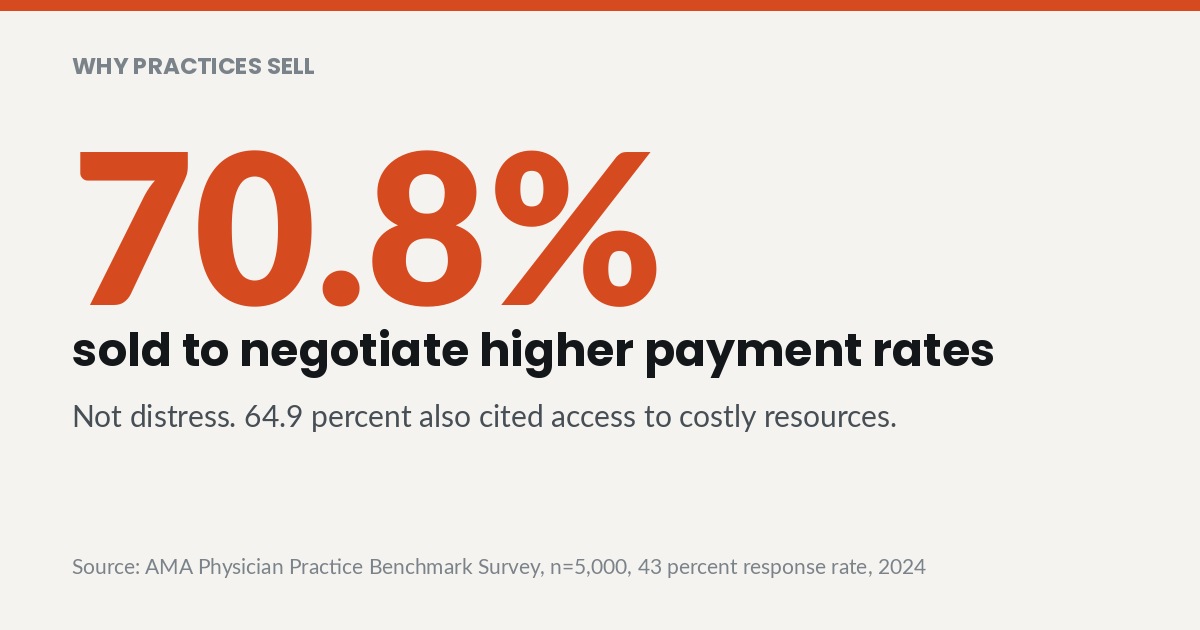
70.8% sold to negotiate higher payment rates. AMA Physician Practice Benchmark Survey, n=5,000, 43 percent response rate, 2024

Physician practice management is the operating discipline of running a medical practice as a business: payer contracting, revenue cycle, staffing and compliance. The reason it matters now is what sellers actually say. The AMA found that 70.8 percent of practices that sold cited the ability to negotiate higher payment rates. That is a contracting problem, not a distress signal.

The stated reasons for selling are not distress reasons

The standard account of practice consolidation describes exhausted physicians and failing economics. Sellers describe something more specific. The AMA Physician Practice Benchmark Survey for 2024, drawn from 5,000 physicians at a 43 percent response rate, asked practices that sold why they did it.

The top answer was payment rates. Seventy point eight percent cited the ability to negotiate higher payment rates as a reason for the sale. The next two answers were access to costly resources at 64.9 percent and managing payer regulatory and administrative requirements at 63.6 percent.

Read those three together and a picture forms that has nothing to do with a practice running out of patients. All three describe a relationship with payers rather than a relationship with patients. Practices are not exiting a broken market. They are exiting a weak negotiating position.

That distinction changes the entire diagnostic. A failing practice has an operations problem, a demand problem or a cost problem, and each has known remedies. A practice that sells for rate improvement has none of those. It has a bargaining problem, and bargaining power comes from structure.

What negotiating position is actually made of

Payer contracting rewards a short list of attributes and practice quality is not first among them. Network adequacy sits at the top. A payer that cannot build an adequate network in a geography without a particular group will pay that group differently.

Patient volume and geographic coverage follow. A group representing a meaningful share of a specialty in a market has a credible alternative to accepting terms. A practice representing a small fraction does not, regardless of outcomes or patient satisfaction.

Data comes third and is the most neglected. Practices that can demonstrate cost per episode, referral patterns, quality measures and utilization performance can argue from evidence. Most independent practices cannot produce those figures, which reduces negotiation to accepting a fee schedule as presented.

Nothing on that list correlates with clinical excellence at the individual practice level. That is the uncomfortable part of the finding. Physicians are being asked to solve a structural problem with professional merit, and merit is not the currency being priced.

The practical consequence shows up every renewal cycle. A practice requests an increase, receives a standard response, and concludes the payer is unreasonable. The payer is behaving rationally toward a counterparty with no alternative to offer.

Fragmentation is the underlying condition

The scale picture explains why so few practices hold a strong position. US Census County Business Patterns for 2023 counts 204,617 offices of physicians establishments averaging 13.2 employees, with 52.7 percent having fewer than five.

The AMA data agrees from a different angle. Physicians in practices of ten or fewer fell to 47.4 percent in 2024, below half for the first time, and 49.2 percent of private-practice physicians work in practices of fewer than five physicians.

An industry composed largely of very small units facing a small number of very large payers has a predictable outcome. The counterparty with concentration sets terms. The counterparty with fragmentation accepts them and calls the result market rates.

Consolidation is the market solving that imbalance in the crudest available way. Practices merge into entities large enough to be negotiated with rather than dictated to. Every seller in that 70.8 percent figure is buying a seat at a table they could not otherwise reach.

The destination is employment, not partnership

The transaction is frequently described as joining a larger group. The aggregate data describes something more definitive. Physicians in wholly physician-owned practices fell to 42.2 percent in 2024 from 60.1 percent in 2012, per the AMA.

Hospital-owned practice participation rose to 34.5 percent from 23.4 percent over the same period. Physicians employed directly by a hospital rose to 12.2 percent from 5.6 percent in 2012.

The employment share tells the plainest version. The AMA reports 57.5 percent of physicians are employees and 7.1 percent are independent contractors as of 2024. A majority of American physicians now work for someone else.

Rate improvement obtained through acquisition arrives bundled with governance changes that no contract negotiation would have produced. Scheduling, staffing ratios, referral direction and technology decisions transfer with the ownership stake. Physicians who sold for a payer contracting reason acquired a much broader set of consequences.

None of that makes the decision wrong. It makes the accounting incomplete. A rate increase quantified in advance sits against governance costs that surface gradually and are rarely modeled during diligence.

The open question about scale and independence

The honest position is that scale genuinely works for rate negotiation, and no operating improvement fully substitutes for it. Pretending otherwise sets independent practices up for disappointment. The productive question is how much bargaining power is reachable without an equity sale.

Structures that aggregate without acquiring

Independent practice associations exist precisely to negotiate on behalf of practices that remain separately owned. Clinically integrated networks go further, permitting joint contracting where practices demonstrate genuine clinical integration. Both structures carry real legal requirements and neither works as a paper arrangement.

Management services organizations formed by independents deliver the administrative scale without the ownership transfer. Billing, credentialing, human resources, purchasing and technology run once for many practices. That directly addresses the 64.9 percent who cited access to costly resources and the 63.6 percent who cited administrative and regulatory burden.

Value-based contracting offers a different route. A practice that can document total cost of care performance negotiates on outcomes rather than on volume. Payers pay differently for demonstrated savings, and that argument does not require size in the same way a fee schedule negotiation does.

What each route demands first

Every one of these paths requires data the practice does not currently produce. Joining an independent practice association without cost and quality reporting means joining as a passenger. Entering a value-based arrangement without knowing current performance means accepting risk blindly.

Building that reporting capability is an operations project, not a clinical one. It requires someone to define the measures, integrate the sources and hold the reporting cadence. Practices without a full-time operations executive frequently engage fractional COO leadership to build the function before any contracting conversation begins.

The controllable half of the reimbursement problem

While rate negotiation depends on structure, realized revenue depends on execution, and the second half is entirely controllable. Contracted rates only matter to the extent claims are actually paid at them.

Denial behavior varies more than most practices assume. KFF analysis of CMS federal transparency data for 2024 found in-network claim denial rates in marketplace plans averaging 19 percent, with insurer-level variation from 13 to 35 percent.

A practice with strong contracted rates and weak denial management collects less than a practice with modest rates and disciplined revenue cycle operations. Eligibility verification, documentation standards, clean claim rate and appeal discipline determine which of those two a practice becomes.

Denial rate by payer is also negotiating evidence. A practice arriving at renewal able to demonstrate that one insurer denies far above the others has changed the conversation from a rate request into a performance discussion. Most practices arrive with neither the data nor the framing.

Group purchasing works the same way on the cost side. Supplies, malpractice coverage, technology contracts and staffing services are all priced against volume that independents can aggregate without merging. The savings are smaller than a rate increase and considerably easier to obtain.

Reframing the decision

Practices considering a sale usually evaluate the offer against the status quo. That comparison is incomplete because the status quo already assumes the practice will not change how it operates or contracts.

The fuller comparison includes a third option. Build the reporting, join or form an aggregating structure, fix the revenue cycle, then evaluate offers from a stronger position. A practice that does this either negotiates better independently or sells at better terms, and both outcomes beat the current path.

Time is the real constraint. Aggregating structures take years to establish and value-based track records take years to accumulate. Practices that begin the work while an offer is on the table have already lost the option they are trying to preserve.

Administrative burden deserves the same treatment. It is genuinely heavy, and it is also the component most improved by process design rather than by ownership change. Practices that fix it internally remove one of the three reasons sellers gave.

The most cited reason practices sell is a negotiating problem wearing the costume of an economic one. That is worth sitting with, because negotiating problems have structural answers and economic problems do not always. The question independent medicine has not seriously answered is whether physicians are willing to build the shared infrastructure that would make independence viable, or whether selling remains simply easier than organizing.

Frequently Asked Questions

Why do practices sell if they are financially stable?
The survey evidence points to contracting position rather than financial distress. The AMA found for 2024 that 70.8 percent of practices that sold cited the ability to negotiate higher payment rates as a reason, followed by 64.9 percent citing access to costly resources and 63.6 percent citing payer regulatory and administrative requirements. None of those three describes failing demand or unsustainable cost. Stable practices sell because the ceiling on independent negotiating position is structural rather than operational.

Can a small practice improve its reimbursement rates without merging?
Improvement is possible but bounded, and the bounds should be stated honestly. Independent practice associations, clinically integrated networks and value-based contracting arrangements allow practices to negotiate with more standing while remaining separately owned. Each requires cost, quality and utilization data that most practices do not currently produce. Building that reporting capability is the prerequisite step, and it takes considerably longer than practices expect.

How much does practice size actually matter to payers?
Size affects network adequacy, which is what payers price. US Census County Business Patterns for 2023 counts 204,617 offices of physicians establishments averaging 13.2 employees, with 52.7 percent having fewer than five. A single practice at that scale rarely represents enough of a specialty in a market to alter a payer's network. Groups large enough to create an adequacy gap negotiate on different terms.

What should my practice fix before entering a payer negotiation?
Reporting comes first because negotiation without evidence is a request rather than a discussion. A practice should be able to produce denial rate and appeal outcomes by payer, cost per episode, referral patterns and quality measures. KFF analysis of CMS data for 2024 showed marketplace in-network denial rates averaging 19 percent with insurer-level variation from 13 to 35 percent, which means payer-specific performance is a real and arguable point. Practices that cannot document their own numbers negotiate against a fee schedule they have no basis to contest.

Is hospital employment different from private equity acquisition for physicians?
The governance outcome is similar even where the structures differ. AMA data for 2024 shows physicians in hospital-owned practices rising to 34.5 percent from 23.4 percent in 2012, and physicians employed directly by a hospital rising to 12.2 percent from 5.6 percent. In both models, decisions about scheduling, staffing and referrals move away from the practicing physician. Physicians evaluating either option should examine the specific governance terms rather than the ownership label.

How long does it take to build an alternative to selling?
Realistically it takes years rather than months. Clinically integrated networks require demonstrated clinical integration, value-based contracts require a performance track record, and management services arrangements require practices willing to standardize their operations. Revenue cycle improvements deliver faster and can begin immediately, which makes them the sensible starting point. Practices that begin only after receiving an acquisition offer have already run out of the time the alternative requires.

Tuesday, February 10, 2026

Midsize Firms Grew Profit Per Lawyer 25.5 Percent Since 2019. The Am Law 100 Grew 53.7

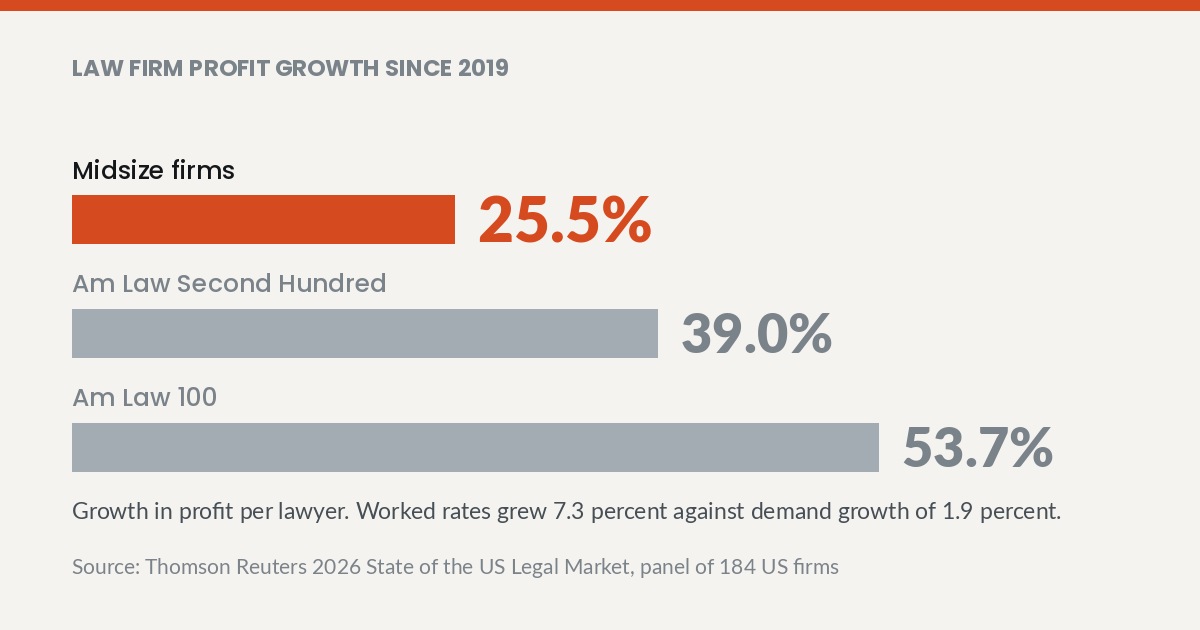
Law firm profit growth since 2019: Midsize firms 25.5%, Am Law Second Hundred 39.0%, Am Law 100 53.7%. Thomson Reuters 2026 State of the US Legal Market, panel of 184 US firms

A law firm consultant reading the 2026 Thomson Reuters State of the US Legal Market will find one number that matters. Profit per lawyer since 2019 grew 25.5 percent at midsize firms and 53.7 percent at Am Law 100 firms. Both cohorts grew, and the distance between them is compounding.

The gap, not the growth, is the finding

Most coverage of legal market data reports the top of the market. The 2026 Thomson Reuters State of the US Legal Market gives all three cohorts. Profit per lawyer since 2019 grew 25.5 percent at midsize firms, 39.0 percent at Am Law Second Hundred firms and 53.7 percent at Am Law 100 firms.

The panel behind those figures covered 184 US firms, comprising 50 Am Law 100 firms, 58 Second Hundred firms and 76 midsize firms. The cohorts are not small samples of outliers. They describe a market-wide pattern with a consistent direction.

Every cohort grew profit per lawyer, which is the part usually missing from the anxious version of this story. Midsize firms as a group are not failing. They are gaining ground more slowly than the firms they compete with for talent and for work.

A gap in compounding rates does not stay constant. Each year the larger firms convert their profit advantage into higher associate compensation, better laterals and deeper investment. That is how a difference in growth rates becomes a difference in kind.

The profit came from pricing, not from volume

Thomson Reuters reports average law firm profit growth of 13.0 percent year over year for 2025. The composition of that growth is the important part. Worked rate growth ran 7.3 percent against demand growth of 1.9 percent.

Rates rose far faster than the volume of work being performed. That is a pricing result rather than a growth result. Firms did not win materially more work, they charged materially more for the work they already had.

Pricing is a legitimate lever and firms were right to use it. The problem is that it is finite in a way volume is not. A firm can raise rates until clients push back, and client tolerance is the ceiling.

Demand growth of 1.9 percent tells a midsize firm something specific about strategy. Matter volume is not expanding fast enough to carry a profit plan on its own. Any firm budgeting for both rate increases and demand recovery is counting the same lever twice.

Realization is where the rate increase leaks

A worked rate is not a collected rate. Thomson Reuters puts collection realization against worked rates at 90.3 percent for 2025. The difference between the rate a firm sets and the rate it collects is a management problem rather than a market condition.

The leak is not evenly distributed across the firm. Associate realization sits at 85.6 percent, the lowest of any timekeeper level in the Thomson Reuters data. That is the cohort a firm depends on for margin.

Associate write-downs happen for identifiable and fixable reasons. Work assigned above a lawyer's capability, matters staffed without a budget and time entered without a usable narrative all produce the same result. Each is a billing hygiene issue a firm can fix without asking a client for anything.

Recovering realization points is quieter than raising rates and easier to defend. A rate increase requires a client conversation every single year. A realization improvement requires an internal process change once.

The expense side is moving faster than the rate

Rate growth does not reach the bottom line intact. Thomson Reuters reports direct expenses, meaning fee-earner compensation and benefits, consuming 32 percent of the average firm's revenue. Direct spend on lawyer compensation rose 8.2 percent while overhead per lawyer rose 4.3 percent and support staff cost rose more than 6 percent.

Lawyer compensation rising faster than worked rates is the structural squeeze. The talent market sets compensation and the client market sets rates, and the two are never negotiated with each other. A firm caught between them absorbs the difference in margin.

Headcount growth adds another layer to that pressure. Thomson Reuters reports lawyer headcount up 2.9 percent across the panel. Total headcount since January 2023 rose 8.2 percent at midsize firms, 9.4 percent at Second Hundred firms and 5.1 percent at Am Law 100 firms.

Midsize firms grew headcount faster than the largest firms while growing profit per lawyer more slowly. Adding people without adding proportional profit is the definition of a dilutive expansion. The question a midsize firm should ask is whether new headcount bills at a realization the firm can live with.

How the gap transmits into the talent market

Profit per lawyer is not an abstract scoreboard. It determines what a firm can pay an associate class and what it can offer a lateral partner without diluting existing partners. A firm growing profit per lawyer faster than its competitors sets the compensation benchmark everyone else has to answer.

Thomson Reuters put direct spend on lawyer compensation up 8.2 percent for 2025. Firms in every cohort paid that increase, but they did not all fund it from the same profit base. The firm with slower profit growth funds the same compensation increase out of a thinner margin.

That is the transmission mechanism between the two cohorts. Compensation is set close to market regardless of a firm's own economics, because the alternative is losing people. A midsize firm therefore imports the cost structure of the Am Law 100 without importing its rate structure.

Recognizing that changes what a midsize firm should optimize. Matching the largest firms on compensation while trailing them on rate requires better realization, better staffing design or a different practice mix. Firms that pick none of the three run a narrower margin every year.

Market structure is shifting underneath the numbers

The available talent pool has started expanding again. The ABA National Lawyer Population Survey for 2025 records total licensed US lawyers at 1,374,720, up 1.38 percent from 1,355,963. That was the first significant rise since 2020.

An expanding lawyer population changes the recruiting calculus as well. A pool that grows again loosens a market that had been tightening for several years running. Firms that built their retention assumptions during the scarcity period should test those assumptions against current conditions.

The market those lawyers work in remains fragmented. US Census County Business Patterns for 2023 counted 165,491 offices of lawyers establishments with an average of 6.61 employees. A market of very small firms is a market where consolidation has room to run.

Consolidation is concentrated at the small end of the market. Fairfax Associates reports 76 percent of law firm mergers in 2025 involved a firm of five to twenty lawyers, up from 69 percent in each of the prior two years. That was across 59 completed mergers in the year. Small firms are being absorbed while midsize firms compete for the same laterals as the largest ones.

What a midsize firm can act on

The gap is not closable through rate alone. Am Law 100 firms raise rates from a stronger client position and a different matter mix. A midsize firm chasing that pricing curve without the matter mix behind it loses clients rather than gaining margin.

Matter profitability before matter volume

Most midsize firms measure revenue by practice and profit by firm. The gap between those two views hides matters that generate revenue and destroy margin. Profitability at matter level, including write-downs and write-offs, changes which work a firm chases next year.

Billing hygiene as a margin program

Collection realization at 90.3 percent and associate realization at 85.6 percent describe recoverable money. Narrative quality, timely entry and budget discipline move those numbers without a rate conversation. Firms that treat billing hygiene as an administrative chore leave the easiest margin on the table.

Timekeeper mix and staffing design

Work assigned above its appropriate level is the most common cause of associate write-downs. Staffing matters deliberately, with the right timekeeper level on each task, protects both realization and client relationships. Alternative fee arrangements only work when a firm knows what a matter costs to deliver.

None of this is a strategy problem in the conventional sense. It is operating discipline applied to a business that historically managed itself through rate increases. Firms that want that discipline installed without adding a permanent executive line often start with a fractional COO engagement and a defined operating agenda.

The 2026 Thomson Reuters data does not describe a midsize crisis. Midsize firms grew profit per lawyer 25.5 percent since 2019, which is a good outcome in most industries. The problem is that they grew it in a market where their direct competitors grew 53.7 percent.

Compounding gaps do not announce themselves in a single year. They show up as a lateral who takes a different offer, a client who moves a matter and an associate class that costs more than the last one. The firms that close the gap will do it on the expense and realization side, because the rate side is already spent.

Frequently Asked Questions

Should my firm raise rates again next year?
Rate increases remain available but produce less than they used to. Thomson Reuters reported worked rate growth of 7.3 percent against demand growth of 1.9 percent for 2025, which means the market has already been pricing aggressively. A firm raising rates without improving realization is increasing the number it writes down. The sequence that works is realization first and rate second.

What does profit per lawyer actually tell a firm?
It measures how much profit the firm generates for each lawyer it employs, combining pricing, realization, expense control and staffing design. Thomson Reuters recorded growth since 2019 of 25.5 percent at midsize firms against 53.7 percent at Am Law 100 firms. The measure is useful because it normalizes for firm size. It becomes misleading when read without the headcount trend beside it.

How do I know whether my realization problem is fixable?
Realization losses fall into two categories, client resistance and internal process failure. Write-downs traced to unclear narratives, late time entry or work staffed above its level are internal and correctable. Thomson Reuters reports associate realization at 85.6 percent, the lowest of any timekeeper level, which points toward staffing and supervision rather than client pushback. A firm that categorizes write-downs by cause for one quarter will know which problem it has.

Is merging the right answer for a small or midsize firm?
Merger activity is concentrated among smaller firms right now. Fairfax Associates reported 76 percent of law firm mergers in 2025 involved a firm of five to twenty lawyers, up from 69 percent in each of the prior two years. A merger solves scale and coverage problems but does not solve realization or expense discipline. Firms carrying operating problems into a merger usually carry them out the other side.

Why is lawyer compensation growing faster than rates?
The two prices are set in entirely different markets. Thomson Reuters reported direct spend on lawyer compensation up 8.2 percent while overhead per lawyer rose 4.3 percent. Talent competition sets compensation and client tolerance sets rates, with no mechanism connecting the two. Firms absorb the difference until they change either their staffing design or their matter mix.

Where should a managing partner start if none of this is measured?
The first step is a matter-level profitability view covering a full year of closed work. That view identifies which practices and which clients fund the firm and which ones consume it. The second step is a write-down analysis by cause, which converts a realization percentage into a list of fixable behaviors. Both take weeks rather than months and require no client conversation at all.

Thursday, January 8, 2026

Understanding Business Strategy: Cost Leadership vs. Differentiation


Introduction: The Two Fundamental Paths to Winning in Business

Every successful business needs a clear plan to compete and win in its market. While there are countless tactics, most winning strategies boil down to one of two fundamental approaches. This guide will explain the core strategies of Cost Leadership and Differentiation, using concepts from Michael Porter’s renowned generic strategy framework. Understanding this fundamental choice is the first step to understanding how the world's most successful companies operate.

1. The First Path: Competing on Price (Cost Leadership)

The Cost Leadership strategy focuses on becoming the most efficient business in an industry, offering products or services at highly competitive prices.

How They Do It:

  • Operational Efficiency: Streamlining every process to reduce waste, time, and expense, ensuring the business runs like a well-oiled machine.
  • Economies of Scale: Producing goods in large volumes, which lowers the cost per item and allows the company to pass those savings on to the customer.
  • Tight Cost Control: Diligently managing all expenses, from raw materials to marketing, to maintain the lowest possible cost structure.

Who Does This Well?

  • Walmart dominates retail by leveraging its massive scale and hyper-efficient supply chain to offer "everyday low prices."
  • McDonald's: Employs standardized, highly efficient processes in its kitchens worldwide to deliver fast, affordable food.
  • Ryanair: Masters tight cost control in every aspect of its airline, from aircraft purchasing to no-frills service, to offer some of the cheapest flights in Europe.

Now that we see how companies win by being the most affordable, let's look at how others win by being the most unique.

2. The Second Path: Competing on Uniqueness (Differentiation)

The Differentiation strategy focuses on creating a unique product, service, or brand identity that customers perceive as superior, enabling the company to charge higher prices.

How They Do It:

  • Uniqueness: Developing distinct features, designs, or capabilities that competitors cannot easily replicate.
  • Superior Quality: Using premium materials, craftsmanship, and service to deliver a product that is demonstrably better than alternatives.
  • Innovation: Constantly pushing the boundaries with new technology, features, and ideas that captivate the market.
  • Strong Branding: Building a powerful brand image and story that creates an emotional connection with customers, making them loyal advocates.

Who Does This Well?

  • Apple: Excels through innovative product design, superior quality, and a powerful brand that commands a premium price and fierce customer loyalty.
  • BMW: Differentiates itself as the "Ultimate Driving Machine" through superior engineering, high-quality materials, and a brand synonymous with performance luxury.
  • Starbucks: Sells more than coffee by creating a unique customer experience, a strong brand identity, and a sense of community that justifies its premium prices.

With both strategies defined, the difference becomes clearer when they are seen side by side.

3. At a Glance: Cost Leadership vs. Differentiation

Attribute

Cost Leadership Strategy

Differentiation Strategy

Primary Goal

Become the lowest-cost producer.

Create a unique product/service.

Core Focus

Efficiency and affordability.

Creativity and emotional connection.

Pricing Power

Offers competitive, low prices.

Commands premium pricing.

Key Examples

Walmart, McDonald's, Ryanair

Apple, BMW, Starbucks

This comparison highlights a critical point: a company must choose its path deliberately.

4. The "So What?": Why a Clear Choice is Crucial for Success

This strategic choice is not a minor decision; it is a fundamental commitment that dictates how resources are allocated, how value is communicated, and how a brand positions itself in the marketplace. Organizations that clearly define their chosen path gain significant advantages, while those attempting to be both the cheapest and most unique often fail.

  1. Build a Stronger Market Identity: A clear strategy helps customers understand what a brand stands for. Whether it's the best price or the best quality, this clarity makes a company memorable and distinct.
  2. Enhance Customer Trust: When a company consistently delivers on its promise—whether that's affordability or premium quality—it builds deep and lasting trust with its customers.
  3. Achieve Consistent Growth: A focused strategy allows a company to allocate its resources (time, money, and talent) more effectively, driving consistent and sustainable growth.

Clarity of focus, supported by execution excellence, remains the key to enduring success.

5. Final Takeaway

Cost Leadership and Differentiation are two distinct and powerful ways for a business to achieve a competitive advantage. The first wins by being the most efficient and affordable, while the second wins by being the most creative and unique. The most successful and enduring companies are those that choose one of these paths, commit to it fully, and execute their strategy better than anyone else. To read more visit Competitive Strategy Consulting

Guide to Mintzberg's Organizational Structure


1.0 Introduction: What is Organizational Structure and Why Does It Matter?

For any business leader, understanding Mintzberg’s Theory of Organizational Structure is crucial for optimizing efficiency and aligning the company's configuration with its strategic goals. This framework serves as a blueprint that helps create scalable and adaptable business operations. By providing a data-driven approach to organizational design, leaders can build a more effective and resilient enterprise. To leverage this theory, you must first understand its core components before examining their strategic value in practice.

2.0 The Five Core Building Blocks of an Organization

Mintzberg's framework categorizes an organization into five fundamental components. These building blocks represent the different groups and functions that exist within any business.

  • Operating Core
  • Strategic Apex
  • Middle Line
  • Technostructure
  • Support Staff

The strategic value of Mintzberg's model emerges not from these parts in isolation, but from how they are configured and balanced to address inefficiencies, streamline operations, and drive innovation.

3.0 The Strategic Value of Mintzberg's Model

By leveraging this model, companies can gain several primary benefits that lead to enhanced performance and structural balance.

  • Identify Inefficiencies: The framework helps leaders locate and address problems within the company structure, making it easier to pinpoint areas that hinder productivity or decision-making.
  • Streamline Workflows: It provides a clear map of business operations, allowing for targeted improvements that make day-to-day processes more effective and efficient.
  • Foster Innovation: When an organization's components are properly balanced, it creates an environment that encourages new ideas and supports long-term growth.

The model is especially valuable for companies looking to evolve their structure to meet modern demands. It helps guide the transition from outdated, rigid systems to more dynamic and responsive ones.

Traditional Approach

Modern Goal

Mechanistic Hierarchy

Agile Configuration

This evolution from a rigid hierarchy to an agile configuration is not merely about efficiency; it's about building a structure capable of sustainable growth.

4.0 Conclusion: A Blueprint for Sustainable Growth

Mintzberg's insights provide a durable blueprint for businesses to enhance performance and achieve a state of structural balance. By carefully analyzing and aligning its core components, any organization can build a foundation for resilience and success. The ultimate goal of applying this framework is to achieve sustainable growth through strategic structural alignment. To read  more, visit: organizational design consultant

Cyber, Data Privacy, and Security | VWCG OS

Module 12 serves as the security and compliance layer within the VWCG OS framework. Instead of isolating cybersecurity and data privacy as ...