Showing posts with label process architecture. Show all posts

Monday, August 31, 2026

Outsourced Against Fractional, Decided On Cost Structure

Split panel graphic reading: The two words are used interchangeably What it actually is: They differ on cost structure, not seniority.

Companies facing an operating leadership gap must choose between two models that sound similar but work differently. Outsourced coo services for small business bring an external operator who runs functions remotely. A fractional chief operating officer joins the leadership team on a recurring schedule and builds context inside the company.

The difference is not about price. It is about where the work happens, who owns the decisions, and what remains when the engagement ends.

The anti-pattern is comparing hourly rates

A familiar mistake runs through companies evaluating operating help. The comparison is reduced to cost per hour or cost per month. The fractional option looks expensive next to the outsourced option, and the decision is made on arithmetic rather than on structure.

That comparison is wrong because the two models deliver different things. Outsourced services perform specific functions according to a defined scope. A fractional operator shapes how functions connect and who decides what. One is execution and the other is architecture.

The cost structure reflects that difference. Outsourced services are typically scoped to a function or a set of tasks, and the pricing matches that scope. Fractional engagements are scoped to an outcome, and the pricing reflects the judgment required to reach it.

Do not price, scope

A calmer response begins with an honest statement of what the company needs to have in place when the engagement ends. If the need is for someone to perform a function that the company cannot staff, outsourcing may fit. If the need is for someone to design how functions work together, a fractional model may fit better.

outsourced coo services for small business work best when the process is already documented and the decisions are already clear. The outsourced operator executes against a known standard. When the standard is missing, the outsourced operator either improvises or stalls, and neither is what the company paid for.

Fractional operators work best when the company needs leadership but cannot afford a full-time executive. The fractional model provides senior judgment on a part-time basis, and it requires the company to have internal counterparts who can act on that judgment.

Understanding the boundary between execution and judgment is the core of the decision. Execution requires clarity while judgment requires context. An outsourced operator can execute with clarity provided by the company. A fractional operator can exercise judgment only after building context inside it.

The systemic fix is a cost-structure audit

A serious position on outsourced operating help treats the choice as a match between organizational need and delivery model. Three questions settle the audit.

First, is the constraint a missing person or a missing system? A missing person can be filled by outsourcing. A missing system requires design, and design requires someone who sees how the parts connect.

Second, does the company need continuity or capacity? Continuity means the same person returns week after week and builds context. Capacity means a task is performed regardless of who performs it, so fractional models provide continuity while outsourced models provide capacity.

Third, what is the true cost of each model? The outsourced rate may be lower, but if the company must still manage the operator, the total cost includes management time. The fractional rate may be higher, but if the operator manages the function, the total cost may be lower.

RACI analysis supports this audit by clarifying who owns the decisions in each model. Outsourced operators typically own execution but not strategy. Fractional operators typically own strategy but delegate execution. A mismatch between what the company needs and what the model owns produces friction that shows up as cost overruns.

Porter value chain analysis adds another lens by separating primary activities that need execution from support activities that need design. A primary activity gap may fit outsourcing. A support activity gap may need fractional judgment.

What this looks like in practice

Consider a mid-market company that hired an outsourced operator to manage its supply chain. The scope was clear and the operator performed well. When a supplier failure disrupted the chain, the outsourced operator had no authority to renegotiate terms or switch vendors. The decision sat with the founder, who was traveling.

A fractional operator in the same role would have had the authority and the context to make that decision. Continuity of the role would have meant the operator knew the supplier landscape, the contract terms, and the founder's risk tolerance. That decision would not have waited.

Several days later the founder returned to find the supply chain stalled and the outsourced operator waiting for instructions. This operator had done exactly what was scoped. Scope had not included decision authority, and the company learned that execution without authority stops at the first exception.

Organizations that match cost structure to need report a consistent effect. Their operating spend produces the intended outcome because the model fits the problem rather than the budget.

Organizations that match cost structure to need report a consistent effect. Their operating spend produces the intended outcome because the model fits the problem rather than the budget.

Why this is an intellectual discipline

Choosing between outsourced and fractional requires the company to know its own constraint. That knowledge is intellectual work, not financial work. The spreadsheet is easy. The hard part is distinguishing between a function that needs performing and a system that needs designing.

This discipline protects human capital. A company that outsources leadership work forces its internal team to hold the strategy in memory while the outsourced operator handles execution. That division is exhausting and it produces errors that are blamed on the team rather than on the structural mismatch.

Shared clarity about the constraint type prevents the common error of hiring for the wrong capability. Companies that skip this classification often discover the mismatch only after the engagement has begun, and by then the switching cost is high.

A company that uses a fractional operator for execution work wastes senior judgment on tasks that do not require it. The operator becomes bored and the company overpays for capacity it does not need. Both outcomes are avoidable with honest scoping.

What compounds

Firms that master this distinction accumulate a structural advantage. They know when to buy capacity and when to buy judgment, and they do not confuse the two. That clarity makes their operating spend more efficient and their leadership more stable.

That accumulated judgment about when to buy capacity and when to buy judgment is a form of capital that compounds over time. Each correct decision makes the next classification easier, and the organization becomes more precise in how it allocates operating budget.

A balanced scorecard is useful here because it forces the company to define what operational excellence means before choosing the model. If the measure is cost per transaction, outsourcing may win. If the measure is decision speed, fractional may win.

Theory of constraints adds another lens by asking whether the constraint is in the work itself or in the decisions that guide the work. A constraint in the work yields to capacity. A constraint in decision-making yields to judgment. Shared understanding of which constraint type is present prevents mismatches before they become expensive.

Every company that chooses the right model for the right constraint builds capability. Every company that chooses on price alone buys a mismatch that will surface later, usually at the worst possible moment.

Frequently Asked Questions

What is the difference between outsourced and fractional operating help?
Outsourced services perform specific functions according to a defined scope. Fractional operators provide leadership on a recurring schedule and shape how functions connect. One delivers capacity. The other delivers judgment.
When should a company choose outsourced services?
When the process is documented, the decisions are clear, and the need is for someone to execute against a known standard. Outsourcing fits execution gaps, not design gaps.
When should a company choose a fractional operator?
When the company needs senior judgment but cannot afford a full-time executive. Fractional operators design systems, make decisions, and build context inside the company over time.
How should cost be compared between the two models?
By total cost including management time, not by hourly rate alone. An outsourced operator who requires significant management may cost more than a fractional operator who manages the function independently.
What happens when the wrong model is chosen?
Friction appears as cost overruns, decision delays, or burnout. An outsourced operator asked to make strategic decisions lacks authority. A fractional operator asked to perform routine tasks wastes judgment. Both mismatches are avoidable.
When does outside help make sense?
When the company has identified whether its constraint is in capacity or in judgment. An honest answer to that question determines the model, and the model determines the cost structure.

Tuesday, August 25, 2026

The Scope of an Operations Engagement

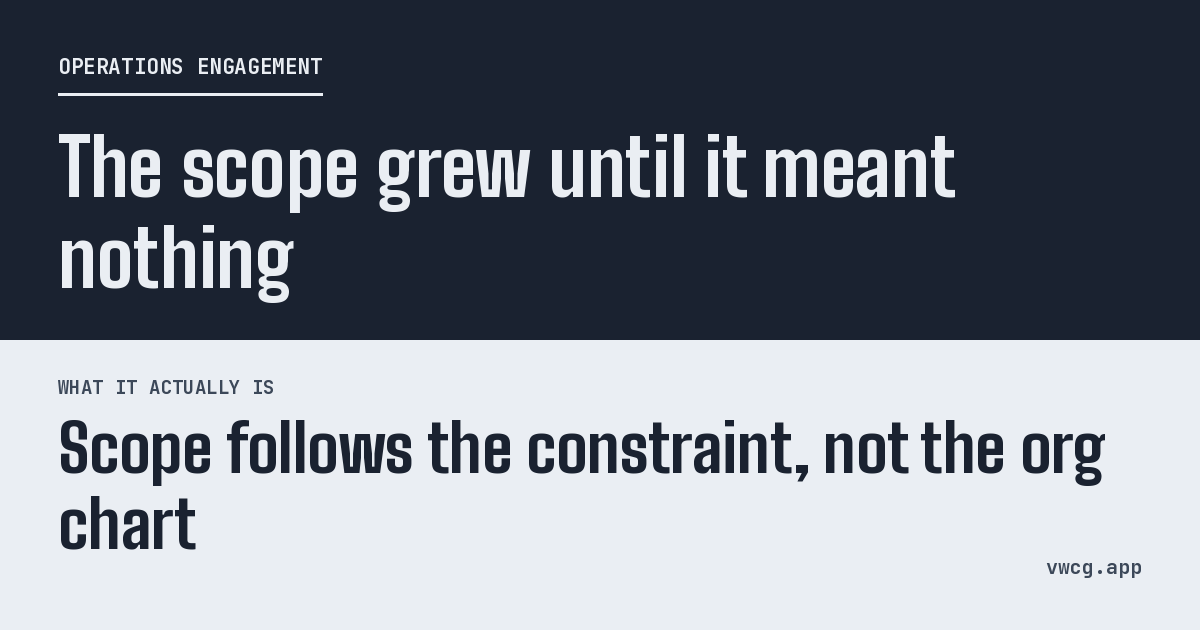
Split panel graphic reading: The scope grew until it meant nothing What it actually is: Scope follows the constraint, not the org chart.

Business operations consulting begins with a clear scope or it fails without one. Most engagements struggle not because the consultant lacks skill but because the company and the consultant never agreed on what success would look like. The scope is that agreement, written down before any work begins.

A well-scoped engagement has boundaries. It names the functions to be examined, the measures to be moved, and the handoff that will happen when the engagement ends. Anything beyond those boundaries is a separate conversation, not an implicit expectation.

The anti-pattern is the open-ended engagement

A familiar anti-pattern runs through companies hiring operational help. The scope is described in vague terms like improve processes or make the company more efficient. The consultant arrives, observes, and produces recommendations.

That company expected implementation. Both parties are disappointed.

Open-ended engagements have a signature. The consultant produces a report. The company files it.

Six months later nothing has changed and the company concludes that consultants do not work. The real conclusion is that the engagement was never scoped to produce change.

The ambiguity is usually mutual. That company did not know what to ask for. That consultant did not know what the company needed. Both assumed that discovery would clarify the scope, and discovery produced more questions rather than more clarity.

Do not discover, define

A calmer response to operational pain begins with a defined scope before any discovery begins. Before any consultant is hired, the company needs to know which of three phases it is buying: diagnosis, design, or implementation.

Diagnosis means the consultant maps the current state, identifies constraints, and recommends what to change. The deliverable is a documented assessment with prioritized actions. The company implements those actions itself.

Design means the consultant diagnoses and then designs the specific changes. The deliverable is a documented design with specifications, measures, and a plan for implementation. The company builds or hires the implementation.

Implementation means the consultant diagnoses, designs, and then executes the changes. The deliverable is a working system, documented, measured, and transferred to the company. The consultant leaves when the system is operational.

Most companies believe they need implementation when they have not yet completed diagnosis. That mismatch is the source of most engagement failure. A company that buys implementation without a diagnosis is asking someone to build a bridge without surveying the river.

The systemic fix is a phased scope

A serious position on business operations consulting treats every engagement as a sequence of gated phases. Each phase has a defined deliverable, a defined measure, and a defined decision point that gates the next phase.

Phase one is discovery, but it is bounded discovery. The consultant examines the named functions, not the whole company. This deliverable is a constraint map, not an exhaustive assessment.

The measure is whether the constraint is correctly identified. The decision is whether to proceed to design.

Phase two is design, scoped to the diagnosed constraint. The consultant designs the smallest intervention that moves the throughput measure. Such a deliverable is a design document with specifications and a test plan.

The measure is whether the design addresses the constraint. The decision is whether to proceed to implementation.

Phase three is implementation, scoped to the approved design. The consultant builds, tests, and transfers the system. Each deliverable is a working process with documentation and a named owner.

The measure is whether the throughput moved. The decision is whether to extend the engagement to additional constraints.

A RACI grid is useful across all three phases, because most scope failures turn out to be ownership failures. Somebody commissioned the work yet nobody was named to receive the deliverable. Somebody designed the change yet nobody was trained to operate it.

Why this is a snowball question

Each phase that is properly scoped and completed makes the next phase easier, because the company learns how to engage and the consultant learns how the company decides. The accumulation of that learning is the asset. The specific deliverables are replaceable. That habit of scoping before working is what compounds.

Firms that engage this way discover something unexpected. Later phases move faster than earlier phases, because the diagnostic discipline from phase one makes the design in phase two more precise. The precise design in phase two makes the implementation in phase three more focused. Focused implementation produces visible results, which makes the company more willing to fund the next engagement.

That snowball effect is the structural advantage of phased scoping. Each success funds the next success, and each success is defined before it is pursued.

What this looks like in practice

Consider a mid-market company that hired an operations consultant to improve efficiency. The scope was a single phrase in the contract. The consultant spent three months mapping every function, produced a broad report, and presented it to the leadership team.

That leadership team was overwhelmed. The report identified seventeen constraints, each with a recommended intervention. This company had budget and appetite for two.

The consultant had moved on to the next client. The report gathered dust.

A phased engagement would have produced a different result. Phase one would have identified the single constraint that limited throughput. Phase two would have designed the smallest intervention that moved that measure.

That phase three would have implemented it. The company would have seen movement, built confidence, and funded the next phase.

Organizations that scope engagements in phases report a consistent effect. Their operational spending produces measurable outcomes, because each phase is defined and judged before the next begins.

Why this protects human capital

An open-ended engagement forces the internal team to hold the consultant's work in memory while continuing their own. That dual burden is exhausting and it produces errors that are blamed on the team rather than on the scope failure.

A phased engagement with defined deliverables and handoffs is a form of care because it makes the work survivable. The internal team receives a documented process, a named owner, and a measured outcome at the end of each phase. They do not have to reverse engineer the consultant's thinking across an undefined timeline.

The moral core is straightforward. People should not have to be heroes to absorb outside help. The help should be scoped so that ordinary people can receive it.

What compounds

Firms that build a phased engagement habit accumulate operational coherence that no single consultant can install. Each scoped phase teaches the company what it actually needs. Each completed phase builds the internal capability to receive the next one.

A balanced scorecard is useful here because it forces the company to state what operational excellence means in measurable terms before claiming any engagement delivered it. If the measure is throughput, the engagement must move throughput. If the measure is error rate, the engagement must reduce error rate.

Theory of constraints adds another lens by clarifying which constraint to address in each phase. Output is governed by a single limiting step, so each phase should focus on that step rather than on everything at once. A phased approach that respects this principle produces movement rather than motion.

Porter value chain analysis supports the diagnosis by separating primary activities that create output from support activities that make output possible. This separation helps the consultant and the company agree on which functions are in scope.

That clarity creates shared expectations between the company and the consultant. Both parties know what the phase is for and how success will be judged. That alignment is a collaboration outcome that compounds.

Every phase a company can scope, complete, and hand off is a phase that builds capability. Every phase that bleeds into the next without a defined boundary is a phase that will likely be disputed, delayed, or abandoned.

Frequently Asked Questions

What should the scope of an operations engagement include?
Named functions to be examined, measures to be moved, and the handoff that happens when the phase ends. The scope should also name the phase: diagnosis, design, or implementation. Most companies need all three in sequence.
Why do operations engagements often fail?
They are scoped in vague terms like improve processes. The consultant produces recommendations. The company expected implementation. Both parties assumed discovery would clarify the scope, and it did not.
What is the difference between diagnosis, design, and implementation?
Diagnosis produces a documented assessment with prioritized constraints. Design produces a documented intervention with specifications. Implementation produces a working system with documentation and a named owner. Each phase gates the next.
How long should each phase take?
Weeks, not months. Bounded discovery means examining named functions, not the whole company. Focused design means addressing the diagnosed constraint, not every problem. Scoped implementation means building the smallest intervention that moves the measure.
What happens between phases?
A defined decision point. The company reviews the deliverable, confirms that the measure was addressed, and decides whether to proceed. That decision is part of the scope, not an afterthought.
When does outside help make sense?
When the company has tried internal improvement and cannot identify its own constraints. An outside consultant brings the diagnostic framework and the distance needed to see structural gaps that insiders have normalized.

Sunday, August 23, 2026

Firm, Solo Practitioner Or Fractional, Compared On Structure

Split panel graphic reading: Comparing on price tells you nothing What it actually is: Compare on who carries the execution.

Companies seeking operational help face a structural choice before they evaluate any candidate. They must decide whether to hire a firm, a solo practitioner, or a fractional operator. That decision shapes what the engagement can deliver, how it is governed, and what happens when the work ends.

Each model has a different cost structure, a different accountability mechanism, and a different handoff. None is universally superior. The right choice depends on what the company needs to have built, and whether it needs that thing to survive the person who built it.

The anti-pattern is choosing on price or prestige

One anti-pattern repeats across industries. Companies select the engagement model for the wrong reason. Firms are chosen because they feel safe, solo practitioners because the chemistry is good, and fractional operators because the monthly cost is lower than a full-time hire.

Each of those criteria contains a category error. Safety is a function of structure, not headcount. Chemistry is useful and it is not governance. Cost is real and it should be compared against the value of what is delivered, not against what a full-time employee would cost.

The result is often a mismatch. A company that needs rapid diagnosis hires a firm that brings a team and a methodology that adds overhead to a simple problem. Institutional documentation needs often lead to solo practitioners who excel at diagnosis but lack a handoff process.

Do not hire the label, hire the fit

A calmer response begins with an honest statement of what the company needs to have in place when the engagement ends. If the need is a documented system with named owners and measured outcomes, the delivery model must include a handoff mechanism. If the need is a diagnostic assessment with prioritized recommendations, the model must include someone senior enough to see across functions.

Firms bring structure. They have methodologies, templates, and a hierarchy that allows a partner to review the work of an associate. That structure produces consistency, and it also produces overhead. The client pays for the methodology as well as the insight, and the ratio between the two varies widely.

Solo practitioners bring direct access. The person selling the work is the person doing the work, which removes translation overhead between sales and delivery. It also removes the safety net. If the practitioner becomes unavailable, the engagement stops.

Fractional operators bring continuity. They work inside the company on a recurring schedule, and they build relationships with the team that outlast any single project. That continuity produces context that no intermittent consultant can match. It also produces dependency, because the fractional operator holds knowledge that has not been transferred.

The systemic fix is a fit assessment

A serious position on business operations consulting firm structure treats the choice as a match between delivery model and organizational need. Three questions settle the fit.

First, does the company need a permanent capability or a temporary intervention? Permanent capabilities require documentation, training, and handoff. Temporary interventions require diagnostic skill and decisive recommendations. Firms and fractional operators tend toward permanence, while solo practitioners tend toward intervention.

Second, does the company have internal bandwidth to receive the work? Firms can deliver a full report and walk away. Fractional operators need internal counterparts who can meet regularly and implement decisions. Solo practitioners need a single point of contact who can make choices quickly.

Third, what happens when the engagement ends? Firms typically leave a binder and a follow-up call. Solo practitioners leave whatever they built and whatever notes they kept. Fractional operators leave a transition plan and sometimes a trained internal candidate, so the best model is the one whose natural exit matches what the company can absorb.

RACI analysis is useful here because the choice of model is partly an ownership question. Firms can own the deliverable but not the implementation. Fractional operators can own implementation but may blur the line between consultant and employee. Solo practitioners can own the diagnosis but not the system that follows.

Porter value chain analysis adds another lens by separating primary activities that need direct intervention from support activities that need enabling systems. A firm may be better suited to primary activity redesign, while a fractional operator may be better suited to support activity optimization.

What this looks like in practice

Consider a mid-market company that needed a complete overhaul of its order-to-delivery process. An owner hired a solo practitioner who diagnosed the constraint correctly and designed a new workflow. That practitioner left after several weeks, and the new workflow died because nobody had been trained to operate it.

The diagnosis was correct and the design was sound. Handoff was absent, and the absence was structural. A solo practitioner model was chosen for a permanent-capability need, and the mismatch was predictable.

Organizations that match model to need report a consistent effect.

Organizations that match model to need report a consistent effect. Their operational spending produces sustainable outcomes because the delivery structure includes a transfer plan that fits the company's absorption capacity.

Organizations that match model to need report a consistent effect. Their operational spending produces sustainable outcomes because the delivery structure includes a transfer plan that fits the company's absorption capacity.

Why this is a collaboration question

The choice of engagement model is not a procurement decision. It is a collaboration decision, because the model determines how the consultant and the company will work together over time.

A firm collaborates through process. It brings a defined methodology, regular checkpoints, and a partner who mediates between the client and the delivery team. That process protects the client from variability in individual consultants, and it can also distance the client from the people doing the work.

A solo practitioner collaborates through personal relationship. The work is shaped by ongoing conversation, and adjustments happen in real time. That responsiveness is valuable and it depends on the availability of one person.

A fractional operator collaborates through embedded presence. They attend the same meetings, learn the same context, and build the same relationships as an internal leader. That depth produces trust and it also makes the operator harder to replace.

What compounds

Firms that choose the right model accumulate operational coherence faster than those that cycle through mismatched engagements. Each successful handoff teaches the company how to absorb outside help. Each failed handoff teaches the company to avoid that model, and the lesson is expensive.

A balanced scorecard is useful for evaluating the choice after the fact. It forces the company to state what success looked like in measurable terms before judging whether the engagement delivered it. If the measure was a documented system, the scorecard asks whether the system is operational. If the measure was throughput, the scorecard asks whether throughput moved.

Theory of constraints adds another lens by clarifying whether the constraint is structural or personal. A structural constraint requires a firm or fractional model that can build systems. A personal constraint requires a solo practitioner who can coach the individual. Choosing the wrong model for the constraint type produces movement without progress.

EOS provides a useful rhythm for fractional engagements because its meeting structure creates regular touchpoints that keep the work visible without requiring daily presence. That rhythm supports the collaboration by making the fractional operator part of the cadence rather than an interruption to it.

Every engagement that ends with a clean handoff builds the company's capability to engage the next one. Every engagement that ends with a dependency teaches the company to be cautious about outside help, and that caution slows growth.

Frequently Asked Questions

When should a company hire a firm rather than a solo practitioner?
When the need is a documented system with named owners and a training plan. Firms bring methodologies, review structures, and handoff processes that solo practitioners may lack. Overhead is justified when the deliverable must survive the people who built it.
What are the risks of a solo practitioner?
The primary risk is continuity. The person doing the work is the person who sold it, and if they become unavailable, the engagement stops. Handoff depends on the individual's habits rather than on institutional process, and those habits vary widely.
What does a fractional operator do differently?
A fractional operator works inside the company on a recurring schedule, building context and relationships that outlast any single project. That continuity produces deeper diagnosis and smoother implementation, and it also creates dependency if knowledge is not transferred.
How should the engagement model be chosen?
By matching the delivery model to the organizational need. Three questions settle the fit. Does the company need a permanent capability or a temporary intervention? Does it have bandwidth to receive the work, and what happens when the engagement ends?
What makes a handoff successful?
Documentation, training, and a named internal owner who is accountable for the system before the consultant leaves. A handoff without all three is a transfer of hope rather than a transfer of capability.
When does outside help make sense?
When the company has identified the need clearly and can describe what success looks like in terms of systems, measures, and ownership. Choosing the model before clarifying the need produces mismatches that are expensive to unwind.

Thursday, August 20, 2026

The People Measures a Smaller Company Can Actually Collect

Split panel graphic: people analytics

People analytics is not about big data. It is about the right data, collected consistently, and acted on honestly. Smaller companies often believe they cannot compete with large organizations on people measurement. The truth is that they can compete, and they can win, by choosing measures that matter and collecting them without bureaucracy.

The mistake is copying the enterprise playbook. Large companies run engagement surveys, competency matrices, and predictive attrition models. Smaller companies do not have the headcount to justify that complexity, and they do not need it.

The anti-pattern is the survey theater

A familiar anti-pattern runs through smaller companies trying to measure their people. They launch an engagement survey, collect responses, and file the results. Six months later they run another survey. The scores move slightly, yet nothing changes.

Survey theater has a signature. Data is collected but not connected to decisions. Managers see the results but have no authority to act on them, and employees participate but never hear what followed. The survey becomes a ritual rather than a tool.

The deeper problem is that engagement is a lagging indicator. It measures how people feel after the conditions have already affected them. A smaller company needs leading indicators, the signals that predict problems before they become retention risks.

Do not measure feelings, measure signals

A calmer response to people analytics pressure begins with a structural question. Before any survey is launched, the company needs to know what decision the data will inform. A measure without a decision owner is noise.

The right measures for smaller companies are behavioral rather than attitudinal. They ask what people do, not how people feel. Behavior is visible, countable, and connected to outcomes that matter.

Three measures suffice for most smaller companies. Time to productivity asks how long it takes a new hire to complete their work without asking for help, which exposes onboarding quality. Exception rate asks how often a process requires a judgment call rather than following a rule, which exposes documentation quality. Handoff clarity asks whether the person receiving work knows what done looks like, which exposes communication quality.

None of these requires a survey. All of them produce data that a manager can act on immediately.

The systemic fix is signal-based measurement

A serious position on people analytics treats people data as operational data rather than as human resources data. The measures are collected where the work happens, not in a separate system. The owners are the people who manage the work, not the people who manage the data.

A new hire asking the same question three times is a signal. A process that requires a meeting to interpret is a signal. One handoff that arrives without context is a signal.

Step two is building the trigger. When the signal crosses a threshold, a defined action follows. Not a committee review.

A specific conversation, a specific change, a specific follow-up. The trigger makes the measure operational.

Step three is closing the loop.

Step two is building the trigger. When the signal crosses a threshold, a defined action follows. Not a committee review.

A specific conversation, a specific change, a specific follow-up. The trigger makes the measure operational.

Step three is closing the loop. The person who experienced the signal learns what changed and why. The person who acted on the signal records what they did and whether it worked. Without that closure, the measure decays into surveillance.

Step two is building the trigger. When the signal crosses a threshold, a defined action follows. Not a committee review.

A specific conversation, a specific change, a specific follow-up. The trigger makes the measure operational.

Step three is closing the loop. The person who experienced the signal learns what changed and why. The person who acted on the signal records what they did and whether it worked. Without that closure, the measure decays into surveillance.

Step three is closing the loop. The person who experienced the signal learns what changed and why. The person who acted on the signal records what they did and whether it worked. Without that closure, the measure decays into surveillance.

Step four is reviewing the measures themselves. Every quarter, the company asks whether the signals still predict the outcomes they care about. Measures that no longer predict should be replaced, not grandfathered.

A RACI grid is useful here, because most people measurement failures turn out to be ownership failures. Somebody collected the data yet nobody was named to act on it. Somebody acted yet nobody told the team what happened.

Why this is a moral question

People analytics is often justified as a way to optimize human capital. That framing is dangerous because it treats people as capital to be optimized rather than as humans to be supported. The moral test of any people measure is whether the person being measured would agree that it is fair, relevant, and actionable.

Signal-based measurement passes that test because it measures the system rather than the person. When a new hire takes too long to become productive, the measure points to onboarding rather than to the hire. When a process requires constant exceptions, the measure points to documentation rather than to the operator.

That orientation is a form of care because it protects people from being blamed for system failures. It directs improvement effort toward the conditions that make success possible rather than toward the individuals who struggle within broken conditions.

What this looks like in practice

Consider a mid-market company that was losing new hires within the first year. The human resources team launched an exit survey and discovered that people left for better opportunities. That insight was true and useless.

A signal-based approach revealed that the constraint was time to productivity. New hires were taking four months to complete work independently. The onboarding consisted of shadowing a senior person who was too busy to document anything. The senior person was not failing, and the system was failing the senior person and the new hire simultaneously.

Fixing it required a structured onboarding sequence with defined milestones, a named owner, and a check-in at thirty days. Time to productivity dropped. Retention improved. The exit survey was no longer necessary because the signal had been fixed.

Organizations that adopt signal-based measurement report a consistent effect. Their managers spend less time interpreting data and more time fixing the conditions that produce it. Their people experience less surveillance and more support.

Why this protects human capital

A company that measures engagement without acting on it teaches its people that their input is decorative. A company that measures behavior without blaming individuals teaches its people that the system is being improved on their behalf. The difference is the difference between extraction and care.

Signal-based measurement is a form of servant leadership because it puts the manager's attention on the conditions rather than on the person. The manager who can point to a broken onboarding and a fix in progress practices deeper leadership. The alternative is reporting low morale and scheduling the next survey.

Underneath sits a straightforward moral core. People should not have to be studied to be supported. The measures should be simple enough to collect, clear enough to act on, and honest enough to change when they stop working.

What compounds

Firms that build signal-based measurement habits accumulate people intelligence that no survey can deliver. Defined signals make the next one easier to identify, built triggers make the next one faster to implement, and closed loops make the next one more trusted.

A balanced scorecard is useful here because it forces the company to state what people success means in measurable terms before claiming any program delivered it. If the measure is time to productivity, the scorecard connects onboarding design to that number. If the measure is exception rate, the scorecard connects documentation quality to that number.

Theory of constraints clarifies which people signal to address first. The constraint on team performance is usually onboarding or a critical handoff, and improving anything else is local motion. The manager who fixes the constraint moves the whole team.

That clarity creates shared expectations between managers and their teams. Both know what is being measured, why, and what follows when the signal changes. That alignment is a collaboration outcome that compounds.

Every measure a company can describe with a defined signal, a named owner, and a closed loop is a measure that makes the company better. Every measure that is collected and filed is a measure that wastes time and erodes trust.

OKR practice supplies a discipline worth borrowing. A measure attached to a stated objective gets reviewed, and a measure attached to nothing becomes decoration on a dashboard.

Frequently Asked Questions

What people measures work best for smaller companies?
Behavioral signals rather than attitudinal surveys. Time to productivity, exception rate, and handoff clarity are three measures that require no survey infrastructure and produce actionable data immediately.
Why do engagement surveys often fail?
They measure feelings after the fact and are rarely connected to specific decisions. Employees participate but never see what changes. Managers see results but lack authority to act. The survey becomes a ritual rather than a tool.
What is a leading indicator in people analytics?
A measure that predicts a problem before it becomes a retention risk. Time to productivity predicts turnover better than engagement scores, because struggling onboarding creates frustration that surveys only capture after the decision to leave is made.
How do you close the loop on people data?
The person who experienced the signal learns what changed and why. The person who acted records what they did and whether it worked. Without that closure, measurement becomes surveillance and trust erodes.
How often should people measures be reviewed?
Quarterly. The company should ask whether the signals still predict the outcomes they care about. Measures that no longer predict should be replaced. Keeping obsolete measures wastes time and obscures the signals that still matter.
When does outside help make sense?
When the company has been running surveys without seeing change. An outside operator brings the signal framework and the distance needed to see whether the gap is measurement, action, or both.

Monday, August 17, 2026

Sequencing A Rollout So The Second Step Is Possible

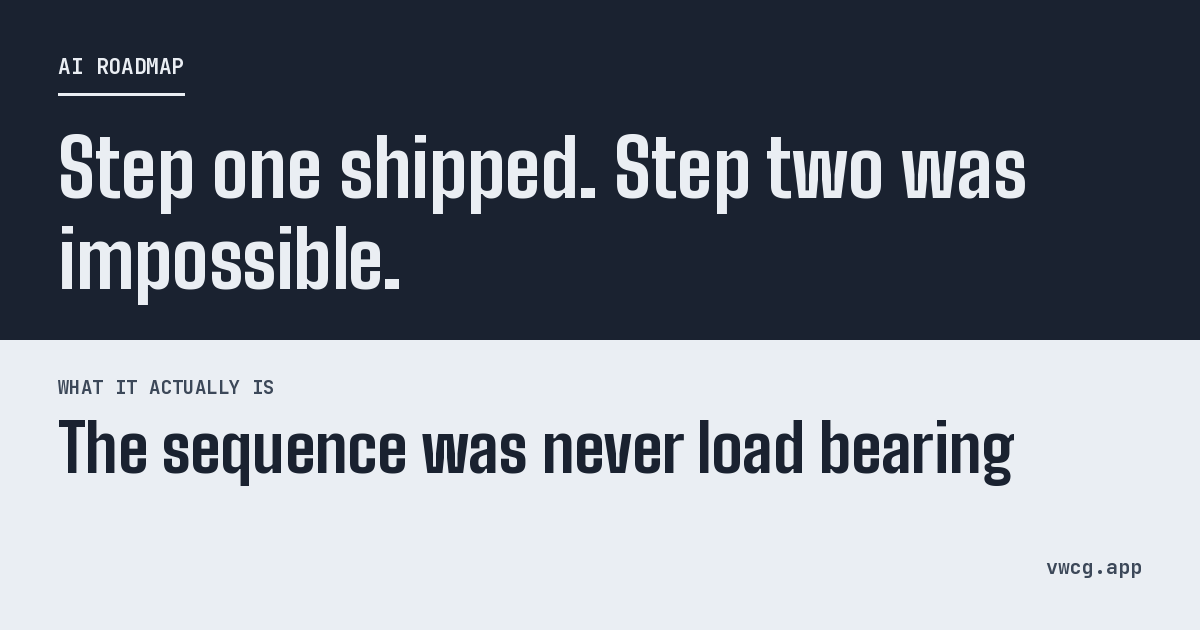
Split panel graphic reading: Step one shipped. Step two was impossible. What it actually is: The sequence was never load bearing.

Artificial intelligence implementations fail when the first step makes the second step impossible. A company deploys a system, discovers that the data is unusable, and learns that the rollout must pause for cleanup. The pause becomes permanent and the investment is written off.

That pattern is not a technology failure. It is a sequencing failure, and it repeats because companies plan rollouts around vendor capabilities rather than around their own readiness.

The anti-pattern is the full-speed rollout

One anti-pattern repeats across companies adopting artificial intelligence. A vendor is selected, a timeline is agreed, and deployment begins on schedule. Enthusiasm is high and the first use case goes live.

Then the second use case requires data that the first use case never cleaned. Integration needs an API that the first system never exposed. The team that would operate the second use case was never trained because training was scheduled for after go-live.

Each of these blockers was predictable. They were not predicted because the plan was built backward from the vendor demo rather than forward from the company's own readiness.

Do not roll out, stage

A calmer response to implementation pressure begins with a staged sequence where each stage makes the next stage easier. The first stage is never a deployment. It is a readiness audit that asks three questions.

Does the data exist in retrievable form? Named owners must exist for every decision the system will inform. Fallback processes must exist for cases where the system is wrong. Any stage failing one of the three is not ready for deployment of any kind.

An ai implementation roadmap consultant treats readiness as a prerequisite list rather than as a score. Three green lights mean the stage can proceed. Any amber or red light means the stage stops and the prerequisite is addressed before any technology is touched.

The systemic fix is a gated sequence

A serious position on artificial intelligence rollout work treats every deployment as a sequence of gated stages. Each stage has a defined deliverable, a defined measure, and a defined decision point that gates the next stage.

Data readiness comes first. Deliverables include a clean, labeled dataset with known provenance and known limitations. Measures focus on whether a human can correctly predict the outcome using only the data provided. Decisions about whether the data is sufficient to train a system happen at this gate.

Decision readiness follows. Deliverables include a RACI grid showing who owns each decision the system will inform. Measures focus on whether those people are available and accountable. Decisions about whether the organization can act on the system's output happen at this gate.

Fallback readiness comes third. Deliverables include a documented process for operating when the system is unavailable or wrong. Measures focus on whether the team can perform the fallback without the system. Decisions about whether the company can survive the system's failures happen at this gate.

Only after all three stages does deployment begin. Deployment is stage four, and it is scoped to the smallest use case that proves the system works in production. Expansion to adjacent use cases becomes stage five, with each new use case gated by the same readiness criteria.

Porter value chain analysis supports staging by separating primary activities that create output from support activities that make output possible. A system touching a primary activity has stricter readiness requirements than a system touching support.

What this looks like in practice

Consider a mid-market company that bought a customer-service system to automate responses. The vendor promised quick deployment and the company agreed. Readiness was skipped because the data was assumed clean.

The system went live and immediately produced incorrect responses because the training data contained unresolved contradictions. Teams had to pause deployment, clean the data, and retrain. The second use case, which was scheduled for the same quarter, was delayed by months.

A staged approach would have produced a different result. Data readiness would have exposed the contradictions before any system was built. Decision readiness would have revealed that nobody owned the decision about which responses were correct. Fallback readiness would have shown that the team had no process for when the system was wrong.

Organizations that stage rollouts this way report a consistent effect. Their technology spending produces working systems because each stage builds the foundation that the next stage needs.

Why this protects human capital

An unstaged rollout forces the internal team to hold the new system and the old process in memory at the same time. That dual burden is exhausting and it produces errors that are blamed on the team rather than on the sequencing failure.

A staged rollout with defined fallbacks protects human capital because it makes the work survivable. The internal team receives a documented process, a named owner, and a measured outcome at the end of each stage. They do not have to reverse engineer the system's thinking across an undefined timeline.

The moral core is straightforward. People should not have to be heroes to absorb new technology. The rollout should be staged so that ordinary people can operate it.

Staged implementation also builds trust between leadership and the people who operate the systems. When each stage delivers a documented process and a named owner, the team sees that the change is being managed rather than imposed. That trust is a form of human capital that compounds across every future technology decision.

What compounds

Firms that build a staged rollout habit accumulate implementation coherence that no single vendor can install. Each completed stage teaches the company what it actually needs. Each gated decision builds the internal capability to receive the next one.

A balanced scorecard is useful here because it forces the company to state what success means in measurable terms before claiming any implementation delivered it. If the measure is response accuracy, the stage must move accuracy. If the measure is handling time, the stage must reduce handling time.

Theory of constraints adds another lens by clarifying which stage is the true constraint. Data readiness, decision readiness, and fallback readiness each can block deployment. Addressing the wrong stage first produces motion without progress.

EOS provides a useful meeting rhythm for staged rollouts because its structured checkpoints create natural gates between stages. Each level meeting becomes an opportunity to verify readiness before moving forward, and that rhythm prevents the common error of skipping stages under pressure.

That clarity creates shared expectations between the company and the consultant. Both parties know what each stage is for and how success will be judged. That alignment is a collaboration outcome that compounds.

Every stage a company can scope, complete, and hand off is a stage that builds capability. Every stage that bleeds into the next without a defined boundary will likely be disputed, delayed, or abandoned.

The same logic governs the reverse case. A company that needs judgment more than hours is buying a different thing entirely, and pricing it by the hour will misprice it in both directions. Structure the engagement around the decision being made, not the time spent making it.

Frequently Asked Questions

What is the first step in an artificial intelligence rollout?
Readiness, not deployment. The company audits whether the data exists in retrievable form, whether named owners exist for every decision, and whether fallback processes exist. Any gap found at this stage is cheaper to fix before technology is purchased.
Why do artificial intelligence implementations stall?
They are sequenced around vendor timelines rather than around organizational readiness. The first use case deploys on schedule and the second use case discovers that data, ownership, or fallback processes are missing. The pause to fix those gaps delays everything downstream.
How should a rollout be staged?
In five stages. Data readiness, decision readiness, fallback readiness, limited deployment, and expansion. Each stage has a defined deliverable, a defined measure, and a decision point that gates the next stage.
What makes a stage complete?
A green light on all three readiness questions for that stage. Retrievable data, named decision owners, and documented fallbacks. Any amber or red light means the stage stops and the prerequisite is addressed first.
Who should own the decisions a system informs?
A named person who is accountable for the outcome, not merely available to review it. RACI analysis is useful here because most readiness failures turn out to be ownership failures wearing a technical costume.
When does outside help make sense?
When the company has tried to stage the rollout internally and cannot identify its own readiness gaps. An outside consultant brings the diagnostic framework and the distance needed to see structural gaps that insiders have normalized.

Sunday, August 16, 2026

Retention as an Operations Function

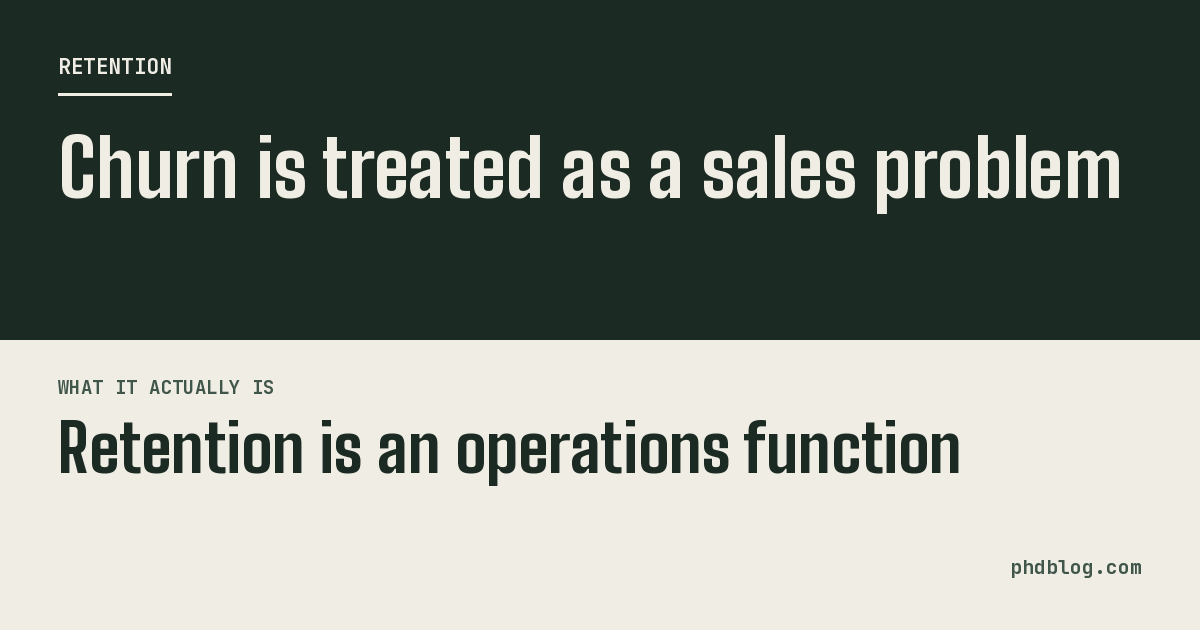
Split panel graphic reading: Churn is treated as a sales problem What it actually is: Retention is an operations function.

Customer success is not a department. It is the operating system of a recurring revenue business. Companies that treat retention as a relationship problem hire account managers to call clients. Companies that treat it as an operations problem design the system that makes clients want to stay.

The difference is measurable. Relationship-driven retention depends on the personality and availability of individual account managers. Operations-driven retention depends on documented processes, defined triggers, and measured outcomes that survive any single person.

The anti-pattern is the hero account manager

A familiar anti-pattern runs through companies with recurring revenue models. One account manager knows every client, anticipates their needs, and resolves issues before they escalate. That manager leaves, and a quarter of the client base follows.

The hero account manager looks like an asset. In practice, they are a concentration risk. The client relationship lives in one person's memory, inbox, and judgment, and no documentation exists.

No backup has been introduced. The company has outsourced its retention strategy to an individual.

Clients sense this dependency even when they do not articulate it. They stay because of the person, not because of the system. When the person leaves, they discover how much of their service depended on informal favors and undocumented exceptions.

Do not manage, architect

A calmer response to retention pressure begins with a systems question rather than a staffing one. Before any account manager is hired, the company needs to know whether the gap is a people problem or a design problem.

That distinction is easy to miss because design problems look like people problems. A client that complains about slow response appears to need a more attentive manager. More often, the client needs a defined escalation path, a stated service level, and a confirmation that their issue was received.

An operator designs those elements. They map the client journey, define the moments that predict churn, build the triggers that alert someone to act, and create the feedback loop that measures whether the action worked. Theory of constraints clarifies which moment matters most. The constraint on retention is usually onboarding or a specific handoff, and improving anything else is local motion that leaves churn where it was.

The account manager then operates inside that system rather than compensating for its absence.

The systemic fix is a success loop

A serious position on customer success treats retention as a closed-loop system rather than as a collection of relationships. The loop has four stages, and each stage must be measured.

Stage one is onboarding. The client receives a defined sequence of actions that produce their first success with the product or service. That first success is the single best predictor of retention, yet most companies leave it to chance.

Stage two is health monitoring. The company identifies the behaviors that indicate a client is getting value. Login frequency, feature utilization, support ticket patterns. Any deviation from the healthy profile triggers an intervention before the client complains.

Stage three is intervention design. When the health signal changes, a defined process begins that specifies who contacts the client, by what channel, and with what offer of help. The intervention is not a sales call disguised as care. It is a diagnostic conversation with a documented outcome.

Stage four is outcome measurement. The intervention either restores the health signal or it does not. If it does not, the case escalates to a defined next step. If it does, the pattern is recorded so the next similar case can be handled faster.

A RACI grid is useful across all four stages, because most retention failures turn out to be ownership failures. Somebody saw the signal yet nobody was named to act on it. Somebody called the client yet nobody recorded what was learned.

Why this is a collaboration question

Retention is not a single department's job. It is the output of every function that touches the client. Onboarding is a product and training question, health monitoring is a data question, intervention is a support question, and measurement is a finance question.

The collaboration pillar here is the alignment of all those functions around a shared definition of client health and a shared dashboard that shows it. When onboarding, product, support, and finance all look at the same number, they can coordinate their efforts. When each looks at their own number, they optimize locally and the client suffers globally.

The orchestrator's role is to build that alignment. Not by managing every department, but by defining the shared measure and the shared process that makes coordination possible.

What this looks like in practice

Consider a mid-market software company that was losing clients at renewal. The response was to hire more account managers and increase check-in frequency. Churn continued.

An operations approach revealed that the constraint was not relationship frequency. It was onboarding. Clients who did not complete the setup sequence within the first two weeks were churning at five times the rate of those who did. The account managers were calling clients who were already disengaged.

Fixing onboarding required no new hires. It required a sequence, a trigger, and an intervention. An email on day one presents the first task, a check on day three monitors completion, and an offer on day five addresses incompletes.

Escalation on day seven brings in a human. Once the onboarding loop was closed, the health signals improved and the account managers' time was redirected to clients who actually needed help.

Organizations that treat retention as operations rather than as relationships report a consistent effect. Their retention rates improve and their account manager turnover drops, because the job becomes operating a system rather than heroically saving accounts.

Why this protects human capital

A company that relies on hero account managers forces its people to hold client relationships in memory. Memory does not scale, transfer, or take a holiday. The person becomes the process, which flatters the ego and creates a single point of failure.

Documenting the client journey, defining health signals, and building intervention triggers is a form of care because it makes the work survivable. An account manager can take a day off without a client falling through the cracks. That is servant leadership in its most practical form.

The moral core is straightforward. People should not have to be irreplaceable to be valued. The system should be designed so that good work continues even when good people move on.

What compounds

Firms that build success loops accumulate client understanding that no single account manager can deliver. Documented interventions make the next one faster, measured outcomes make the next prediction more accurate, and closed loops make the next client more likely to succeed.

A balanced scorecard is useful here because it forces the company to state what retention means in measurable terms before claiming any program delivered it. If the measure is renewal rate, the scorecard connects onboarding, health, intervention, and outcome to that number. If the measure is expansion revenue, the scorecard tracks the same loop from a different angle.

A VRIO analysis adds another lens by asking whether the retention system being built is valuable, rare, inimitable, and organized. Most companies find that their retention data exists but is not organized, which makes the system a cleanup project before it becomes a strategic asset.

That clarity creates shared expectations across departments. When product, support, and finance all agree on what client health means, they can coordinate their efforts rather than competing for credit. That alignment is a collaboration outcome that compounds.

Every client a company can describe with a documented journey, a health signal, and an intervention trigger is a client whose retention is under control. Every client whose retention depends on a specific person is a client whose retention is a risk waiting to be realized.

Frequently Asked Questions

Why do account managers leave and take clients with them?
Because the client relationship lived in the manager's memory and inbox rather than in a documented system. When the person left, the informal knowledge left with them. Operations-driven retention survives personnel changes.
What is a client health signal?
A measurable behavior that indicates whether the client is getting value. Login frequency, feature utilization, support ticket patterns, and engagement with key resources are common signals. Deviations trigger defined interventions.
How do you design an intervention?
With a defined trigger, a named owner, a documented conversation guide, and a measured outcome. The intervention is not a sales call. It is a diagnostic conversation with a specific goal, such as restoring a health signal or uncovering a product gap.
What is the most important stage of the success loop?
Onboarding. Clients who achieve their first success early stay longer. The onboarding sequence should be designed as carefully as the product itself, with defined tasks, triggers, and human escalation points.
How do you align departments around retention?
With a shared definition of client health and a shared dashboard that shows it. When onboarding, product, support, and finance all look at the same number, they can coordinate their efforts. When each looks at their own number, they optimize locally and the client suffers.
When does outside help make sense?
When the company has hired account managers repeatedly and churn continues. An outside operator brings the systems framework and the distance needed to see whether the gap is relational, operational, or both.

Friday, August 14, 2026

Chair Utilization As The Practice Constraint

Split panel graphic reading: The schedule is full and margin is flat What it actually is: Chair utilization is the real constraint.

Dental practices grow until they hit a utilization wall. The wall is not a marketing limit or a clinical skill limit. It is a scheduling limit, and it appears when the demand for chair time exceeds the available hours in the day.

Most owners respond by adding chairs or extending hours. Adding chairs without fixing the schedule spreads the same inefficiency across more rooms. Extending hours burns out the team without increasing throughput. The real constraint is the appointment system, not the number of chairs.

The anti-pattern is adding capacity to a broken schedule

One anti-pattern repeats across growing dental practices. Demand rises and the owner adds a chair. The new chair is filled and the revenue rises, but the schedule was never designed. Hygiene appointments run long, doctor appointments run short, and emergency calls interrupt the daily flow.

Chaos scales with chairs. Two chairs can be managed by memory. Four require a system, and the system was never built. The front desk becomes the bottleneck, the bottleneck becomes a stressed employee, and growth stops because the schedule cannot absorb another patient.

This anti-pattern has a signature. Chairs sit empty between appointments. Patients wait in the lobby past their scheduled time, and emergency patients get squeezed into slots that were reserved for procedures. Everyone is busy and chair utilization does not rise.

Do not add chairs, sequence appointments

A calmer response to utilization pressure begins with a diagnostic pause before any expansion. The practice maps how a patient moves from check-in to checkout and identifies where time accumulates. Accumulation is the signal of a constraint.

Most practices discover that the constraint is not in the operatory. It is in the handoff between the front desk and the clinical team, where appointments are scheduled based on availability rather than on procedure type and duration. That handoff lacks a template, a buffer rule, and a turnaround logic. Appointments pile up at the handoff while chairs sit empty.

Theory of constraints provides the framing. Output is governed by a single limiting step, and in dental practices that step is usually scheduling. Mapping the flow of work from patient call to chair turnover exposes where accumulation happens, and accumulation signals the constraint.

The systemic fix is an appointment architecture

A serious position on dental practice management consultants work treats scheduling as the primary system that determines throughput. The appointment architecture has four parts. First, procedure-based templates that match appointment length to procedure type. Second, buffer slots that absorb emergencies without displacing scheduled work.

Third, turnaround logic that minimizes chair downtime between patients. Fourth, a recall system that keeps the hygiene schedule full and predictable.

A RACI grid is useful here because most scheduling failures are ownership failures. Somebody answers the phone but nobody owns the template. Another person books the appointment yet nobody owns the buffer. A third person checks out the patient but nobody records whether the chair was ready for the next appointment.

Porter value chain analysis supports the diagnosis by separating primary activities that create output from support activities that make output possible. Scheduling is a support activity, but it is the support activity that governs the output of every clinical activity. Fixing scheduling fixes everything downstream.

What this looks like in practice

Consider a mid-market dental practice that had grown to four chairs. The owner scheduled by habit and knew every patient by name. When a fifth chair was added, the owner could not hold the schedule in memory anymore. Hygiene appointments backed up, doctor appointments ran over, and emergency patients were told to wait days for relief.

The practice had revenue to support more chairs but the scheduling system could not absorb them. Patients who called for emergency relief were told to wait days, even though chairs sat empty between appointments because the schedule lacked turnaround logic. The schedule was full of gaps and empty of purpose.

An appointment architecture would have produced a different result. Procedure-based templates would have matched appointment lengths to actual procedure times, and buffer slots would have absorbed emergencies without displacing scheduled work. Turnaround logic would have reduced chair downtime, while a recall system would have kept hygiene predictable. Doctors would have known how long each procedure actually takes, and the front desk would have scheduled accordingly.

Organizations that fix scheduling before adding chairs report a consistent effect. Their practices produce more revenue per chair without extending hours, because the schedule is designed rather than remembered.

Why this protects human capital

An unsequenced schedule forces the clinical team to hold scheduling decisions in their heads while they treat patients, manage supplies, and coordinate with the front desk. That dual burden is exhausting and it produces errors that are blamed on the team rather than on the scheduling failure. Over time, this burden drives experienced people out of the practice and raises recruitment costs.

A designed schedule with clear templates and logical buffers protects human capital because it makes the work survivable. The clinical team receives clear appointment times, accurate duration estimates, and protected lunch breaks. They do not have to rush procedures or skip breaks to catch up. Predictable days reduce stress and improve the quality of patient interactions.

The moral core is straightforward. People should not have to be heroes to provide good care. The schedule should be designed so that ordinary people can perform well. That principle applies in every practice, regardless of size or specialty.

What compounds

Firms that build a scheduling habit in dental practices accumulate operational coherence that no single chair can deliver. Refined templates make the next template more accurate. Buffer slots make the next emergency less disruptive. Completed appointments on time build patient trust that generates referrals.

A balanced scorecard is useful here because it forces the practice to state what operational excellence means in measurable terms before claiming any schedule change delivered it. Chairs per day, on-time arrival, and patient satisfaction are all valid measures, and the scheduling system must move whichever one the practice has declared as its standard.

Theory of constraints adds another lens by clarifying that scheduling is usually the constraint, not the chair count. Adding chairs to a broken schedule spreads inefficiency rather than increasing output. Fixing scheduling first makes every subsequent chair more productive.

EOS provides a useful meeting rhythm here because its weekly level meetings create natural opportunities to review scheduling performance. Each meeting becomes a chance to refine templates, adjust buffers, and record variances between scheduled and actual appointment times. That rhythm prevents the schedule from drifting back into informality.

That clarity creates shared expectations between the front desk and the clinical team. Both teams know how appointments are templated and how buffers are used. That alignment is a collaboration outcome that compounds over time and makes the practice more resilient to turnover. Shared language around scheduling priorities prevents the daily friction that drives experienced staff to leave.

Every schedule a practice can design, operate, and refine is a schedule that builds capability. Every schedule held in one person's memory will break when that person is unavailable, and that fragility limits growth. Sustainable practices are built on systems that survive their founders.

That framing survives a busy quarter, which is the only test worth applying. Arrangements built on goodwill degrade quietly the moment the schedule tightens.

Frequently Asked Questions

What is the most common constraint in a dental practice?
Scheduling. The handoff between the front desk and the clinical team lacks procedure-based templates, buffer slots, and turnaround logic. Appointments accumulate at the handoff while chairs sit empty.
Why does adding chairs not always increase revenue?
Because the scheduling system was never designed. Informal coordination works for two chairs and breaks down at four. Adding more rooms spreads the same inefficiency across more space without increasing throughput.
What does a good appointment system include?
Four parts. Procedure-based templates match appointment length to procedure type. Buffer slots absorb emergencies. Turnaround logic minimizes chair downtime, and a recall system keeps hygiene predictable.
How should emergencies be handled?
In buffer slots reserved for that purpose. Emergency calls that displace scheduled appointments create a cascade of delays. Buffer slots absorb the shock without disrupting the daily flow.
What happens when scheduling is fixed before adding chairs?
The practice produces more revenue per chair without extending hours. Chair downtime drops, patient satisfaction improves, and the clinical team works at a sustainable pace. Each subsequent chair adds capacity rather than spreading chaos. New patient referrals increase because reliable scheduling creates the trust that drives word-of-mouth growth.
When does outside help make sense?
When the practice has tried to fix scheduling internally and the schedule remains chaotic. An outside consultant brings pattern recognition and distance from the daily urgency that prevents insiders from seeing the structural gap.

Monday, August 10, 2026

Diagnosis Before Prescription In Operational Work

Split panel graphic reading: The recommendation arrived before the diagnosis What it actually is: Prescription without diagnosis is guessing.

Companies call for help when operational symptoms become unbearable. Revenue flatlines, costs rise, and turnover accelerates. The reflex is to ask for a fix, a plan, or a reorganization. Most prescriptions arrive without a diagnosis, and they fail because the underlying condition was never identified.

A proper diagnosis takes longer than a prescription and it is the only thing that makes the prescription stick. Without it, the consultant is guessing and the company is buying hope.

The anti-pattern is prescription without inspection

A familiar sequence plays out in companies under operational stress. Leadership identifies a symptom and commissions a solution. A restructure is announced, a process is redrawn, or a system is purchased. Months later the symptom persists and a new prescription replaces the old one.

This cycle is the substitution of activity for understanding. Each new initiative produces motion that is mistaken for progress. Reports are written, meetings are held, and nothing fundamental changes.

The cost is not just consulting fees. The cost is erosion of trust inside the organization. Teams learn that each new program will be replaced by the next one, and their response is to wait it out rather than to engage.

Do not treat, inspect

A calmer response to operational stress begins with a full stop before any solution is proposed. The company and the consultant agree on what will be examined, what evidence will be collected, and what would constitute a correct identification of the root condition.

That agreement is the scope of the diagnosis. It names the functions to be mapped, the measures to be reviewed, and the stakeholders to be interviewed. It also names what is out of scope, which matters because operational problems tend to expand once inspection begins.

Theory of constraints provides the framing. Output is governed by a single limiting step, and most companies treat symptoms that sit downstream of that step. Mapping the flow of work from initiation to delivery exposes where accumulation happens, and accumulation signals a constraint.

Porter value chain analysis adds the structural view. Primary activities create output and support activities make output possible. A constraint can sit in either category, but the fix differs depending on which. Redrawing a primary activity is a direct intervention, while fixing a support activity is an enabling one.

The systemic fix is a diagnostic protocol

A serious position on operational consulting treats diagnosis as a distinct phase with its own deliverable and its own success criteria. The deliverable is not a recommendation. It is a documented model of how the company currently operates, where the constraint sits, and what evidence supports that conclusion.

The diagnostic protocol has four parts. First, map the value chain as it exists, not as it is described in the handbook. Second, collect throughput measures for each step and identify where output stalls. Third, interview the people who work at the stall point and validate the constraint by checking whether work accumulates before it and starves after it.

RACI grids prove useful during validation because constraint identification often surfaces ownership gaps. The step that stalls may lack a named owner, or it may have four owners which is the same as none. Fixing ownership is sometimes the intervention, and discovering that is the purpose of diagnosis.

What a diagnosis looks like when done well

Consider a mid-market company that called for help with customer churn. The prescription requested was a retention program. Diagnosis revealed that churn was a symptom of delivery delays, and delivery delays were caused by a scheduling bottleneck in operations.

A retention program would have treated the symptom. Customers were leaving because orders arrived late, not because they disliked the company. The constraint was scheduling, and the scheduling problem was caused by a single point of failure where one person held all the knowledge.

That diagnosis changed the prescription entirely. Instead of a retention program, the company needed a scheduling system with documented rules and cross-training. The fix was less visible than a retention campaign and it addressed the actual condition.

Organizations that separate diagnosis from prescription report a consistent effect. Operational spending produces targeted outcomes because each intervention is aimed at a verified constraint rather than at a visible symptom.

Why alignment matters

A diagnosis that sits in a report and is not shared with the people who do the work is a diagnosis that will be disputed during implementation. The people at the constraint point often know more about the friction than any consultant can discover in an interview. Their confidence in the diagnosis determines whether they will support the prescription or resist it.

Bringing them into the validation step is not consultation theater. It is a practical check on whether the diagnosed constraint matches the lived experience of the people who work there. Shared language around the constraint prevents the prescription from being diluted as it moves from leadership to execution. Stories that align give the prescription a coalition, and stories that do not align reveal an incomplete diagnosis.

That alignment is a collaboration outcome that compounds. Each time a company validates a constraint with the people who work at it, the organization learns how to see itself more accurately. That learning builds the trust required for the next intervention.

Why this is an intellectual discipline

Diagnosis requires the company to tolerate uncertainty for a period. It must live with the problem while the problem is being understood, and that patience is uncommon in organizations where pressure for results is constant.

The discipline is intellectual because it prioritizes evidence over instinct. A leader who insists on diagnosis before action is not being slow. That leader is refusing to burn resources on a prescription that may be aimed at the wrong organ.

This discipline also protects human capital. Teams that have lived through multiple undiagnosed initiatives develop cynicism that is hard to reverse. A diagnostic phase signals that the next intervention will be grounded in fact rather than in fashion. That signal rebuilds trust slowly and it is worth the delay.

What compounds

Firms that build a diagnostic habit accumulate something no single engagement can install. Each diagnosis teaches the company how to see its own operations more clearly. Each verified constraint makes the next diagnosis faster, because the organization knows what to look for. Over time, this habit produces a structural advantage that no competitor can copy quickly.

That accumulation is the asset. Prescriptions come and go with the business cycle and the consultant roster. The ability to identify constraints accurately is a permanent capability that improves with use.

A balanced scorecard supports this habit by forcing the company to define operational excellence in measurable terms before any intervention is judged. EOS provides a useful rhythm here by embedding regular diagnosis into the operating system rather than treating it as a one-time event. If the measure is throughput, then the diagnosis must show where throughput is limited. If the measure is error rate, then the diagnosis must trace errors to their source.

Every diagnosis that precedes a prescription is a decision made with clarity. Every prescription that precedes a diagnosis is a gamble, and the odds are poor because operational symptoms share many causes.

Frequently Asked Questions

What is the first step in operational consulting?
Diagnosis. The company and consultant agree on what functions will be examined, what measures will be reviewed, and what evidence will constitute a correct identification of the constraint. Only after that agreement is satisfied does prescription begin.
Why do operational interventions fail?
They are aimed at symptoms rather than at constraints. A symptom is visible and troubling. A constraint is often hidden upstream. Treating the symptom produces temporary relief while the underlying condition continues to damage the system.
How long should a diagnostic phase take?
Weeks, not months. Bounded diagnosis examines named functions, not the entire organization. The deliverable is a constraint map with supporting evidence, not an exhaustive audit of every process.
What evidence proves a constraint has been identified?
Work accumulates before the constraint and starves after it. Throughput measures stall at that step while other steps continue. People working at the constraint describe friction that is structural rather than personal.
Should diagnosis be done internally or by an outsider?
An outside consultant brings distance and pattern recognition that insiders lack. Insiders have normalized the friction. An outsider sees the accumulation and the starvation because they carry no assumption that the current state is inevitable.
What happens after diagnosis is complete?
A defined decision point. The company reviews the documented model, validates the constraint, and decides whether to proceed to design and implementation. That decision is part of the scope, not an afterthought.

Tuesday, August 4, 2026

Capacity And Scheduling As The Constraint In A Trades Business

Split panel graphic reading: More demand did not become more revenue What it actually is: Scheduling is the constraint, not sales.

Trades businesses grow until they hit a capacity wall. The wall is not a market limit or a cash limit. It is a scheduling limit, and it appears when the demand for appointments exceeds the available hours in the day.

Most owners respond by working longer hours or hiring more technicians. Working longer is not scaling. Hiring more technicians without fixing the schedule spreads the same chaos across more people. The real constraint is the scheduling system, not the number of bodies.

The anti-pattern is adding people to a broken schedule

One anti-pattern repeats across growing trades companies. Demand rises and the owner hires a technician. The technician is good and the work gets done, but the dispatch process was never designed. Jobs are assigned by text message, routes are planned by memory, and emergency calls interrupt everything.

Chaos scales with headcount. Two technicians can coordinate informally. Five require a system, and the system was never built. The owner becomes a dispatcher, the dispatcher becomes a bottleneck, and growth stops because the schedule cannot absorb another job.

This anti-pattern has a signature. Technicians spend more time driving than working. Customers wait longer than promised, and emergency calls get answered by whoever is closest rather than by whoever is best suited. Everyone is busy and throughput does not rise.

Do not add, sequence

A calmer response to capacity pressure begins with a diagnostic pause before any hiring. The company maps how a job moves from call to completion and identifies where work accumulates. Accumulation is the signal of a constraint.

Most trades companies discover that the constraint is not in the field. It is in the handoff between the office and the field, where the office receives a call, writes it down, and communicates it to the technician. That handoff lacks a queue, a priority rule, and a dispatch logic. Jobs pile up at the handoff while technicians wait for instructions.

Theory of constraints provides the framing. Output is governed by a single limiting step, and in trades businesses that step is usually dispatch. Mapping the flow of work from customer call to technician arrival exposes where accumulation happens, and accumulation signals the constraint.

The systemic fix is a dispatch system

A serious position on hvac business consultant work treats scheduling as the primary system that determines throughput. The dispatch system has four parts. First, a queue that captures every request in the order received. Second, a priority rule that classifies emergencies, maintenance, and installations.

Third, a routing logic that minimizes drive time and maximizes billable hours. Fourth, a feedback loop that records actual versus estimated time so the schedule learns.

A RACI grid is useful here because most scheduling failures are ownership failures. Somebody takes the call but nobody owns the dispatch decision. Another person drives to the job yet nobody owns the route plan. A third person finishes the work but nobody records whether the estimate was accurate.

Porter value chain analysis supports the diagnosis by separating primary activities that create output from support activities that make output possible. Dispatch is a support activity, but it is the support activity that governs the output of every primary activity. Fixing dispatch fixes everything downstream.

What this looks like in practice

Consider a mid-market heating and cooling company that had grown to eight technicians. The owner dispatched by group text and knew every route by memory. When the ninth technician was hired, the owner could not hold the schedule in memory anymore. Jobs were missed, customers complained, and the owner worked fourteen-hour days trying to coordinate.

The company had revenue to support more technicians but the scheduling system could not absorb them. Customers who called for emergency repairs were told that nobody was available, even though three technicians were driving between jobs without clear destinations. The schedule was full of motion and empty of purpose.

A dispatch system would have produced a different result. Queues would have captured every request. Priority rules would have classified emergencies before they became crises. Routing logic would have reduced drive time and increased billable hours per day, while feedback loops would have made estimates more accurate over time.

Organizations that fix dispatch before adding capacity report a consistent effect. Their technicians complete more jobs per day without working longer hours, because the schedule is designed rather than remembered. Their customers receive accurate arrival windows and consistent service, which produces repeat business and referrals that lower customer acquisition cost.

Why this protects human capital

An unsequenced schedule forces technicians to hold dispatch decisions in their heads while they drive, diagnose, and repair. That dual burden is exhausting and it produces errors that are blamed on the technician rather than on the scheduling failure.

A designed schedule with clear priorities and logical routes protects human capital because it makes the work survivable. Technicians receive clear instructions, predictable routes, and accurate time estimates. They do not have to negotiate priorities with customers or guess which job comes next.

Predictable schedules also reduce turnover, which is costly in trades businesses where experience directly affects service quality. A technician who knows the route, the time estimate, and the priority before leaving the shop can focus on the work rather than on logistics.

The moral core is straightforward. People should not have to be heroes to do good work. The schedule should be designed so that ordinary people can perform well.

What compounds

Firms that build a dispatch habit accumulate operational coherence that no single hire can deliver. Refined routes make the next route easier to plan. Accurate estimates make the next estimate more precise. Completed jobs on time build customer trust that generates repeat business.

A balanced scorecard is useful here because it forces the company to state what operational excellence means in measurable terms before claiming any schedule change delivered it. Jobs per day, on-time arrival, and customer satisfaction are all valid measures, and the dispatch system must move whichever one the company has declared as its standard.

Theory of constraints adds another lens by clarifying that dispatch is usually the constraint, not the technician count. Adding technicians to a broken dispatch system spreads chaos rather than increasing output. Fixing dispatch first makes every subsequent hire more productive.

EOS provides a useful meeting rhythm here because its weekly level meetings create natural opportunities to review dispatch performance. Each meeting becomes a chance to refine priorities, adjust routes, and record variances between estimated and actual time. That rhythm prevents the schedule from drifting back into informality.

That clarity creates shared expectations between the office and the field. Both teams know how priorities are set and how routes are planned. That alignment is a collaboration outcome that compounds over time and makes the business more resilient to turnover.

Every schedule a company can design, operate, and refine is a schedule that builds capability. Every schedule held in one person's memory will break when that person is unavailable, and that fragility limits growth. Sustainable trades businesses are built on systems that survive their founders.

That distinction survives contact with a busy quarter, which is the only test that matters. Arrangements built on availability quietly degrade when availability disappears.

Frequently Asked Questions

What is the most common constraint in a trades business?
Dispatch. The handoff between the office and the field lacks a queue, a priority rule, and a routing logic. Jobs accumulate at the handoff while technicians wait for instructions or drive inefficient routes.
Why does adding technicians not always increase output?
Because the scheduling system was never designed. Informal coordination works for two technicians and breaks down at five. Adding more people spreads the same chaos across more vehicles without increasing throughput.
What does a good dispatch system include?
Four parts. A queue captures every request. A priority rule classifies emergencies, maintenance, and installations. Routing logic minimizes drive time, and a feedback loop records actual versus estimated time.
How should priorities be set?
By impact and urgency. Emergency calls that affect safety or essential systems come first, and scheduled maintenance comes second. Installations come third, with buffer time built in for delays. Every technician should know the rule without asking.
What happens when dispatch is fixed before hiring?
Technicians complete more jobs per day without working longer hours. Drive time drops, billable hours rise, and customer satisfaction improves because arrival times become predictable. Each subsequent hire adds capacity rather than spreading chaos.
When does outside help make sense?
When the company has tried to fix dispatch internally and the schedule remains chaotic. An outside consultant brings pattern recognition and distance from the daily urgency that prevents insiders from seeing the structural gap.

Outsourced Against Fractional, Decided On Cost Structure

Companies facing an operating leadership gap must choose between two models that sound similar but work differently. Outsourced coo service...