Sunday, July 6, 2025

What Resumes Don’t Say Out Loud (But You Should Hear Anyway)

Don’t Read Resumes. Decode Them.

Let’s be honest: most resumes look good these days. Everyone knows the keywords. Everyone adds metrics. Everyone's "driven" and "collaborative." So you'll miss the most essential stuff if you're just skimming for buzzwords or years of experience.

Substance lives beneath the surface. It’s in how people think, not just what they did. It’s the difference between activity and impact. Between movement and direction. Reading for substance means looking past the polish and into the person.

1. Ask: What did they change?

Forget responsibilities for a second. What did they change?

The fingerprints show substance. Did they inherit a system or rebuild one? Did they scale something? Save something? Kill something that needed killing?

Look for verbs that signal transformation: "revamped," "redesigned," "streamlined," "turned around." That’s where the real story lives.

2. Look at cause and effect

Anyone can say they managed a team. But what changed because they did?

Substance means linking action to outcome. "Increased retention by 18% after rebuilding onboarding." That’s a complete thought. That’s a person who understands their impact.

3. Detect the thinking behind the doing

Reading for substance means imagining the thinking process behind each bullet.

When someone says they launched a product, ask yourself: How complex was that? What cross-functional teams were likely involved? Was it iterative? Was it rescue work? Was it Greenfield?

Good resumes don’t just list what happened. They hint at how the candidate thinks through problems.

4. Spot the pattern of curiosity

Did they evolve over time? Did they make lateral moves that suggest exploration? Did they step down to learn something new? That’s courage, not failure.

Substance often looks nonlinear. Straight paths can mean stagnation. The winding ones sometimes signal learning and range.

5. Find what they care about

It leaks through, maybe in volunteer work, maybe in the way they describe their projects, maybe in a one-liner hobby mention that tells you what lights them up.

People with substance bring their whole selves. You won’t find it in the font, but it’s between the lines.

6. Watch for over-polishing

Sometimes the shiniest resumes are the emptiest. Every bullet ends in a percentage. Everything is wrapped in perfect corporate speak. You finish reading and feel... nothing.

Substance isn’t sterile. It’s a little rough. A little weird. A little human. That’s how you know it’s real.

7. Look for earned confidence

Does the resume show ownership? Do they say "I led," or "part of a team that"?

Confidence isn’t arrogance. It’s clarity. Candidates with substance know what they did. They don’t pad. They don’t shrink. They just own it.

8. Trace their through-line

What's the big thread that runs through their work?

Is it fixing broken systems? Is it mentoring junior people? Is it shipping quickly under pressure?

Substance shows up as a theme. Even if their roles look scattered, there's often a core strength they keep leaning into.

9. Ask yourself: Would I trust this person in ambiguity?

This is the real test.

Forget the bullet points. Does their journey show judgment, not just execution? Would you want them in the room when things go sideways?

If yes, you’ve found substance that doesn’t just do the job but grows it.

Final Thought

Reading resumes for substance isn’t fast. It’s not a Ctrl+F search for keywords. It’s a practice. A mindset.

But you must read between the lines if you care about building real teams that can think, stretch, and evolve.

Because that's where the people are.

Saturday, July 5, 2025

Cashflow Management


Let’s get this out of the way: cash flow isn’t sexy. It’s not the part you brag about on LinkedIn or toss around in pitch meetings. It’s not vision-board material. But it is the part that’ll quietly sink your business if you’re not watching it like a hawk with insomnia.

I’ve seen it. I’ve lived it. Founders with million-dollar run rates crying in Slack at 2AM because they couldn’t make payroll. Not because they were reckless, but because they trusted revenue instead of reality.

1. Confusing Revenue with Breathing Room

Let me be blunt: revenue is a mirage. The number on the invoice doesn’t mean a damn thing if the money hasn’t cleared.

I once had a client show me their “record-breaking quarter.” $350K billed. Two months later? $7K in the bank. Because 90% of those invoices were net-60. And they’d already spent money like it was net-zero.

You can’t spend promises.

2. The ‘It’ll Come In’ Fallacy

Have you ever caught yourself saying, “We’re good. That client’s reliable”? Famous last words. I once bet a product launch on a $90K payment that got “stuck in procurement.”

Six weeks later, I’m paying vendors with personal cards. Never again.

Assume nothing. Cash it or count it out.

3. Growing Without a Net

Here’s how it usually goes: You’re scaling, it feels good, so you hire a few more people. Then someone suggests a marketing spend. Maybe new software.

Before you know it, burn rate triples—and your income doesn’t.

Without at least 90 days of operating cash, you’re not scaling. You’re gambling. And the house always wins.

4. Seasonality Amnesia

It’s wild how many businesses forget that not every month is July.

If Q1 is always dead, stop budgeting like it’s Q4. Your expenses don’t care what month it is, but your customers sure do.

Make your budget match your reality, not your optimism.

5. The Magical Thinking Budget

Budgets are great. Until they become fantasy novels.

“We’ll close 5 new clients in April.” Will you? Really?

Until there’s a contract—and a deposit—it’s not revenue. It’s hope dressed up as math.

6. Letting Tools Replace Thinking

Cash flow tools are great. Real-time dashboards? Awesome. But if you’re not looking at them daily—and I mean DAILY—they’re just digital wallpaper.

You need judgment. Gut checks. A Post-it note with worst-case scenarios. Because no software will slap the espresso out of your hand when you’re about to overspend.

7. Ignoring Payment Terms (Yours and Theirs)

If your clients pay in 45 days and you pay vendors in 15, congrats: you’ve created a cash sinkhole.

Fix this. Ask for deposits. Push out terms. If someone says no—cool. Move on.

Better a smaller client who pays fast than a whale who pays late.

8. Overestimating Your Own Tolerance

Some of you think you can “ride it out.” Just a few tight weeks, right?

But that pressure builds. One missed check becomes two. Credit card balance creeps. Sleep shrinks. Resentment grows.

Cash stress turns smart people into short-tempered wrecks. And no strategy survives when you’re burned out.

9. Confusing Profitability With Liquidity

You can be profitable and broke.

Yes, really. If your profits live in inventory, late invoices, or tied-up investments, you’re wealthy on paper, poor in practice.

Liquidity is oxygen. Profits are potential. Don’t mix them up.

10. Avoiding the Mirror

You know when it’s bad. You feel it. But you avoid looking at the account balance.

You hope the next deposit hits in time. You pretend the contractor can wait. You keep your team in the dark.

That’s not a strategy. That’s surrender.

Look. Then act.

Here’s the Bottom Line:

If you’re not actively managing cash—down to the week, even the day—then you’re gambling with everything you’ve built.

Revenue is ego. Profit is theory. Cash is survival.

So yeah, this wasn’t a feel-good blog. But it’s the one I wish someone had written when I needed it before the panic, before the begging, before the rebuilding.

Watch your cash. Because it’s watching you.

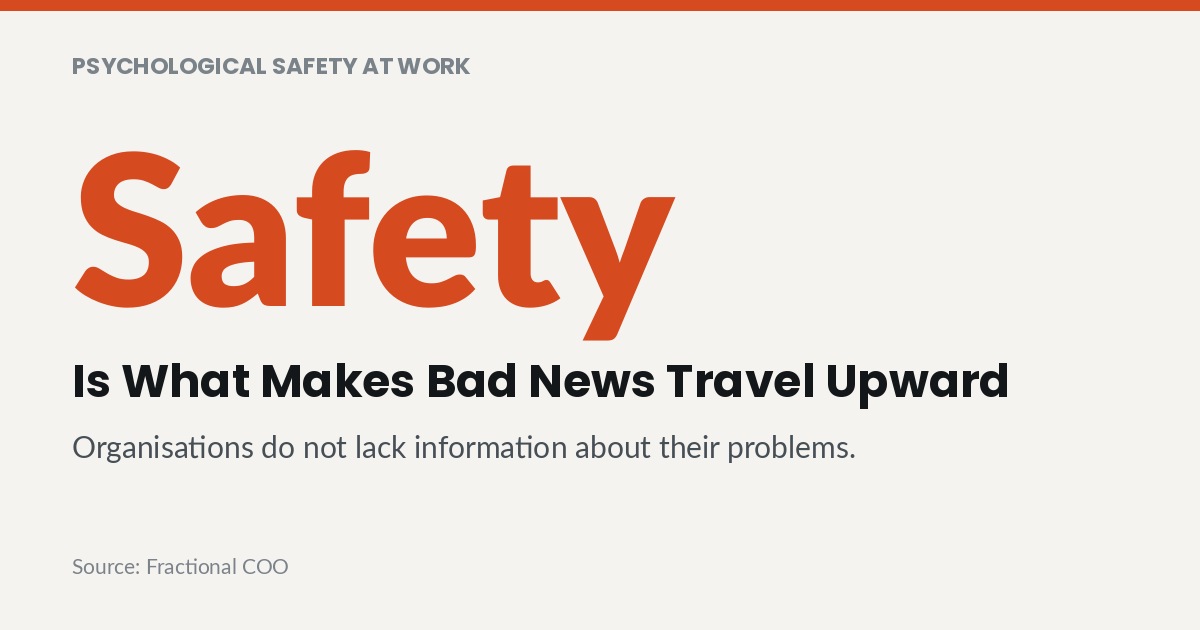
Safety Is What Makes Bad News Travel Upward

Psychological safety at work is a property of the route bad news travels, not a description of how pleasant a workplace feels. Organisation...